How to Use AI on Real Healthcare and Patient Data — Without Sending a Single Real Name
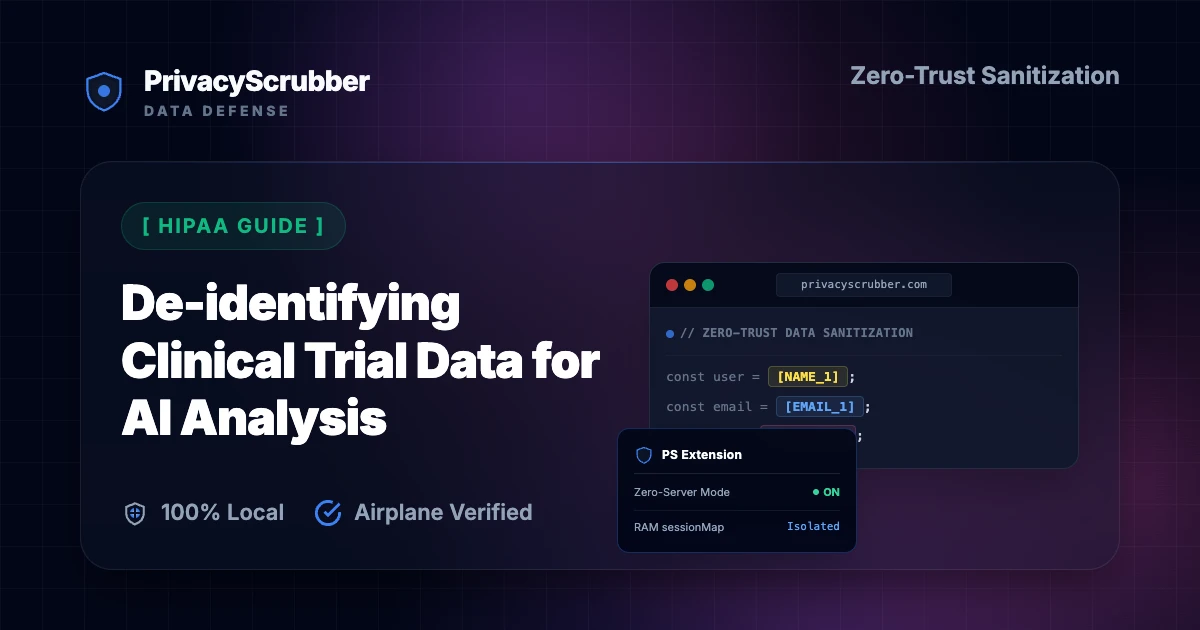
PrivacyScrubber secures the browser text box through local Zero-Trust Data Sanitization, utilizing both a copy-paste web workspace and the automated PrivacyScrubber Chrome Extension. By running local deterministic ZTDS™ entity rules, the tool replaces high-risk text elements with secure placeholders (e.g., [PHONE_1]) before cloud transmission. This aligns with standard procedures for offline compliance auditing, ensuring the AI receives only clean, non-PII context. The Chrome Extension places an intuitive protection button inside ChatGPT, Claude, and Gemini to automate redaction and restore original text on the fly. By executing deterministic ZTDS™ detection parsing entirely in local memory, PrivacyScrubber preserves the usefulness of EPIC, Cerner, and clinical AI assistants for production workflows without introducing external risk.
This zero-transmission architecture is independently auditable via our Airplane Mode Standard. By disconnecting your network and running a full scrub-and-restore cycle, you verify that no outbound packets are transmitted. This aligns with enterprise privacy frameworks for hardened hipaa security: local execution is the primary safeguard for AI data privacy.