Zero-Trust AI for Insurance Agencies
AI Summary / Key Takeaways
"PrivacyScrubber operationalizes the ZTDS™ (Zero-Trust Data Sanitization) open standard for insurance agencies and adjusters by sanitizing claim numbers, policyholder PII, and financial reserves locally in RAM, adhering to NAIC data security standards."
How to redact insurance claim numbers, medical accident records, and settlement sums in AI triage?
Redact insurance claims by tokenizing policyholder identifiers, vehicle VINs, and injury descriptions in local memory. Transmitting zero sensitive health or property records to cloud AI engines preserves adjuster confidentiality and satisfies state insurance commissioner privacy mandates.
Interactive PII Detection & Sanitization Sandbox
Test real-time client-side RAM tokenization. Choose a specialized preset or paste your own raw prompt to test instant reversible redaction.
Sanitized locally in volatile RAM. Pre-prompt compliance maintained under Insurance standards (GDPR, HIPAA, SOC 2).
Enterprise-Grade AI Privacy
Add custom redaction rules and priority support with PRO.
Insurance claims processing is highly data-intensive. When adjusters use AI to summarize claim files, they risk exposing policyholder PII and proprietary loss reserves to public models. PrivacyScrubber provides a local sanitization buffer, masking sensitive insurance identifiers in RAM so adjusters can securely use ChatGPT for summarization without violating NAIC regulations.
Scaling AI adoption within Insurance environments requires a fundamental shift in data governance. Our enterprise AI solutions ensure that while teams use high-velocity LLMs, the underlying Insurance data remains fully sovereign. This solution integrates directly with your Insurance industry guides to provide an automated privacy layer.
The core challenge for Insurance leaders is balancing utility with liability. Standard Cloud DLP filters often strip too much context or require trust in third-party servers. PrivacyScrubber's zero-trust model for enterprise data governance preserves the semantic structure of your prompts locally, ensuring that AI reasoning remains accurate while personally identifiable information (PII) is deterministically masked.
Insurance Critical Compliance Vulnerabilities
Analyzing raw claims data in public LLMs breaches policyholder privacy.
General AI tools may memorize specific loss reserves.
PrivacyScrubber replaces sensitive data with structured tokens locally.
Insurance Vector Analysis & Risk Scenarios
Identifying the primary data exfiltration paths for Insurance workflows using generative AI models.
Insurance Input Neutralization
"Insurance workflows demand strict PII redaction of policyholder records before AI ingestion. PrivacyScrubber tokens loss amounts and claim IDs instantly on the client side."
Instantly mask Insurance identifiers in text, PDF, and DOCX files locally before transmission to any AI provider.
Hardware-level verification ensures no data packets leave your browser RAM session during the redaction process.
Audit Roadmap: Legacy Cloud-DLP vs. ZTDS
| Strategic Metric | Legacy Cloud-DLP | ZTDS (PrivacyScrubber) |
|---|---|---|
| Data Perimeter | Transmitted to Cloud API | 100% Local (Client-Side) |
| Processing Latency | 500ms - 2500ms (Network) | < 15ms (Native JS) |
| Security Posture | Trust-Based (SLA/BAA) | Math-Based (Zero-Server) |
| Compliance Status | Subject to Cloud Audit | Technical Safe Harbor (0 Subprocessors) |
The Airplane Mode Standard
Disconnect your network, enable Airplane Mode, and watch PrivacyScrubber maintain 100% operational integrity. This is not just a feature—it is a verifiable proof that your Insurance records never leave your control.
Solving Insurance Challenges with Enterprise Governance
Scale Zero-Trust Data Sanitization across your entire organization with centralized enforcement and native browser integration.
CISO / Compliance
In the Insurance sector, enforcing Zero-Trust is mandatory. With the PrivacyScrubber Chrome Extension, administrators deploy data masking via MDM to all endpoints. Preventing local model leakage ensures that when employees use GenAI, sensitive Insurance records are never exfiltrated to external LLM servers, instantly satisfying compliance and governance audits.
Operations Lead
Insurance organizations require agile collaboration without compromising privacy. The Enterprise Governance model features encrypted Session Sharing, allowing CISOs and managers to securely distribute custom Regex dictionaries across the department. This enforces uniform data redaction standards across all GenAI workflows, eliminating human error while maintaining high velocity in team-based AI adoption.
Edge Analyst
Daily Insurance operations rely on continuous efficiency. The native extension automates PII scrubbing directly at the browser input field, ensuring analysts never waste time manually censoring data. This automated integration provides zero server latency, enabling end-users to confidently use ChatGPT and Claude for immediate Insurance insights.
General Universal Profile: Detection Coverage
Universal deterministic ZTDS™ detection ruleset. Detects names, government IDs, bank accounts, project codenames, and geographic locations across unstructured text.
Top 6 Insurance Sensitive Entity Types Detected & Scrubbed
Individual Full Name
Government SSN / Tax ID
Bank IBAN & Account Ref
Proprietary Project Codename
Geographic Location
Financial Balance Amount
Continuous Detection Engine Expansion & Custom Regex Sovereignty
The 6 entity types above represent the core detection baseline for Insurance. Our zero-trust engine detects hundreds of additional data classes and is continuously updated with new heuristic patterns, shadow AI leak vectors, and custom regulatory rulesets. Need proprietary database IDs or internal project codenames masked? PRO and TEAMS users can define unlimited custom regular expressions running 100% locally in browser RAM.
How the PrivacyScrubber Engine Solves This
Interactive Tool Controls for Insurance. Hover for specs.
In-DOM Claims Adjuster Shield
The Browser Extension masks claimant names, policy numbers, VINs, and injury notes directly inside ChatGPT.
- EngineWASM-Accelerated
- Privacy100% Local RAM
- SecurityZero-Server Leak
Local Accident Report & Bill Redactor
Drop medical bills and police accident reports into the Wasm OCR Engine for client-side sanitization.
- EngineWASM-Accelerated
- Privacy100% Local RAM
- SecurityZero-Server Leak
Adjuster Teams Handoff
Share tokenized claim summaries with underwriters using zero-server XChaCha20-Poly1305 session links.
- EngineWASM-Accelerated
- Privacy100% Local RAM
- SecurityZero-Server Leak
Insurance Technical Compliance Library
Deep architectural mapping of Zero-Trust Data Sanitization (ZTDS) controls to industry-specific regulatory standards.
Zero-Trust Verification Signature
The above technical controls are enforced deterministically by the PrivacyScrubber Local Engine. All redaction cycles generate zero server-side telemetry, satisfying global data residency requirements for Insurance institutions.
Hardened Audit Standards
Satisfying strict global security and privacy frameworks.
No data persistence on untrusted infrastructure.
Privacy by design at the engineering layer.
Data masking as a core organisational control.
Federal PII minimisation and transparency controls.
Satisfies Safe Harbor de-identification requirements.
Insurance Compliance Library
Step-by-step redaction workflows for Insurance environments.
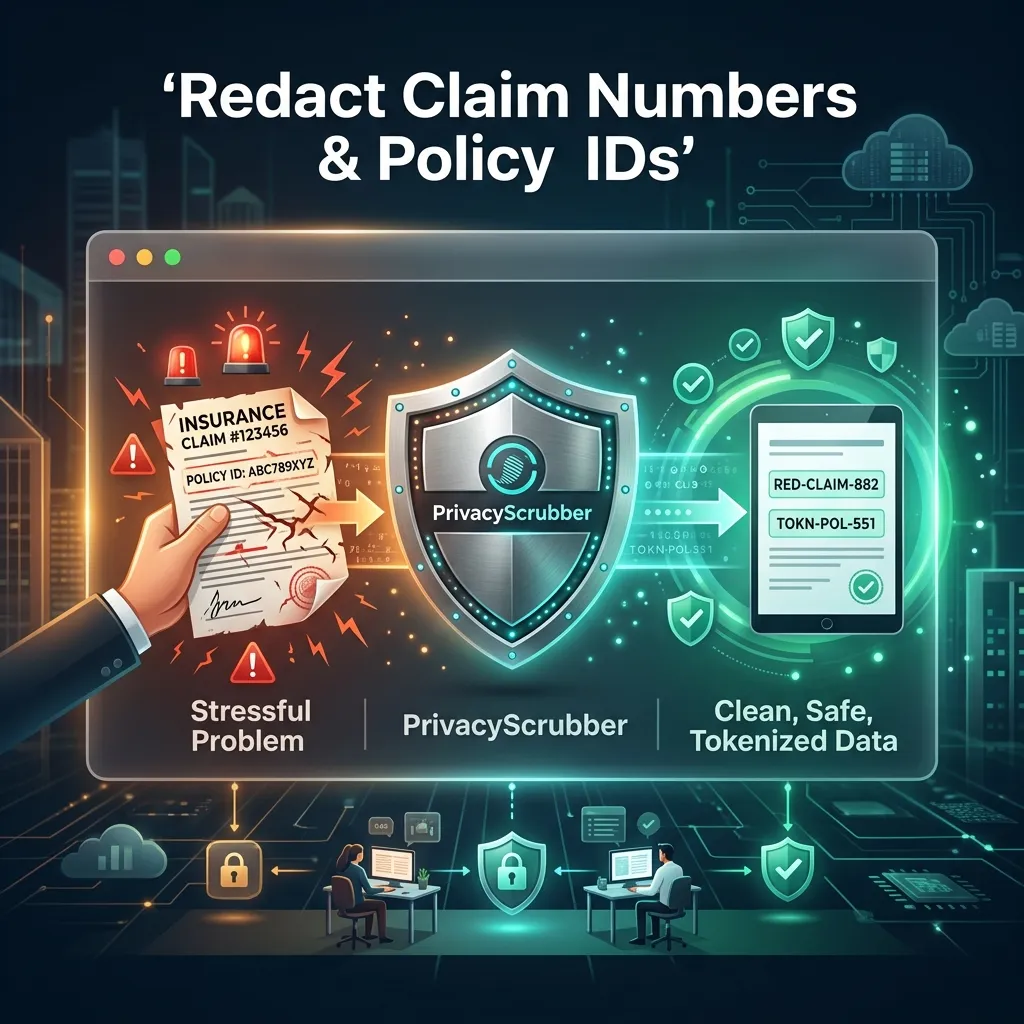
Redact Claim Numbers and Policy IDs for AI
Redact claim numbers and policy IDs locally before analyzing files with ChatGPT. 100% client-side in browser RAM with zero cloud egress.
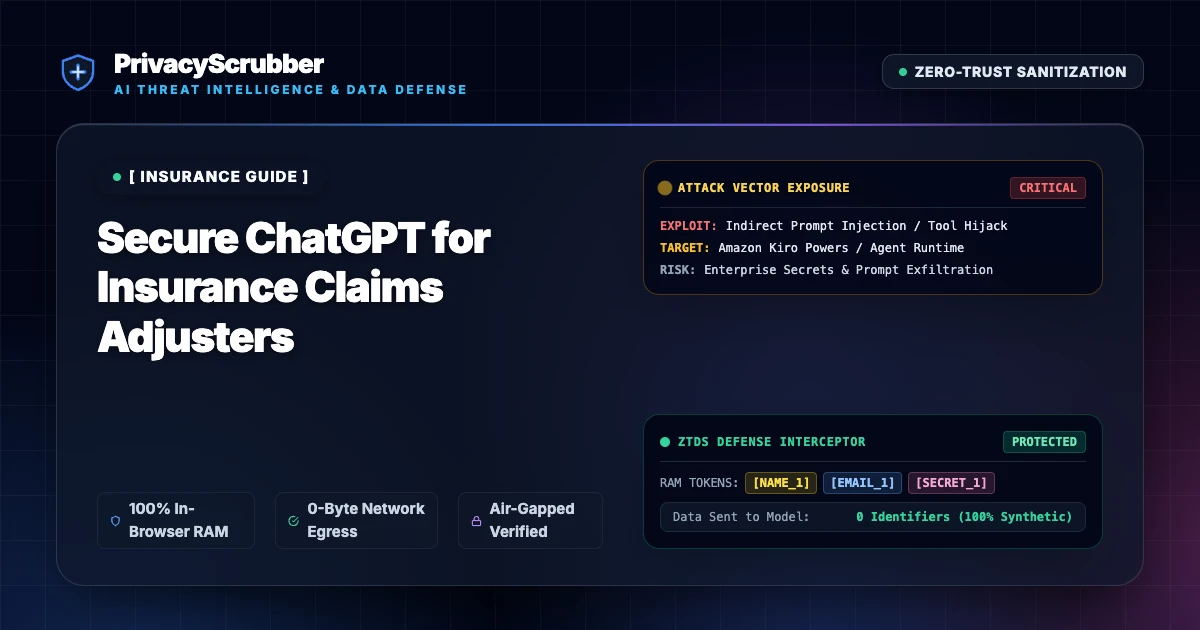
Secure ChatGPT for Insurance Claims Adjusters
Sanitize claims adjuster reports, claimant names, and loss reserves locally before AI analysis. Comply with NAIC Model Act and GLBA with zero data egress.
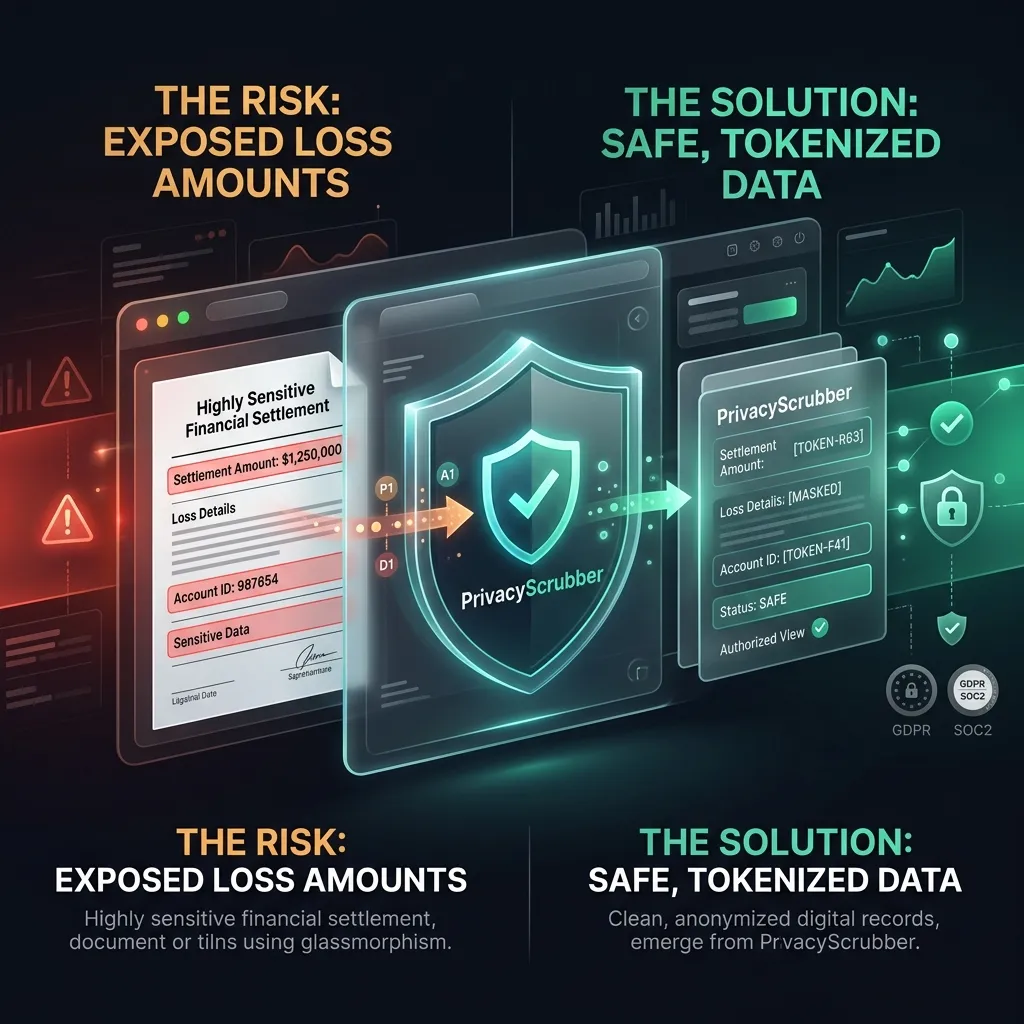
Anonymize Loss Amounts and Settlement Reserves
Anonymize loss amounts and settlement reserves to protect corporate financials in AI tools. 100% client-side in browser RAM with zero cloud egress.
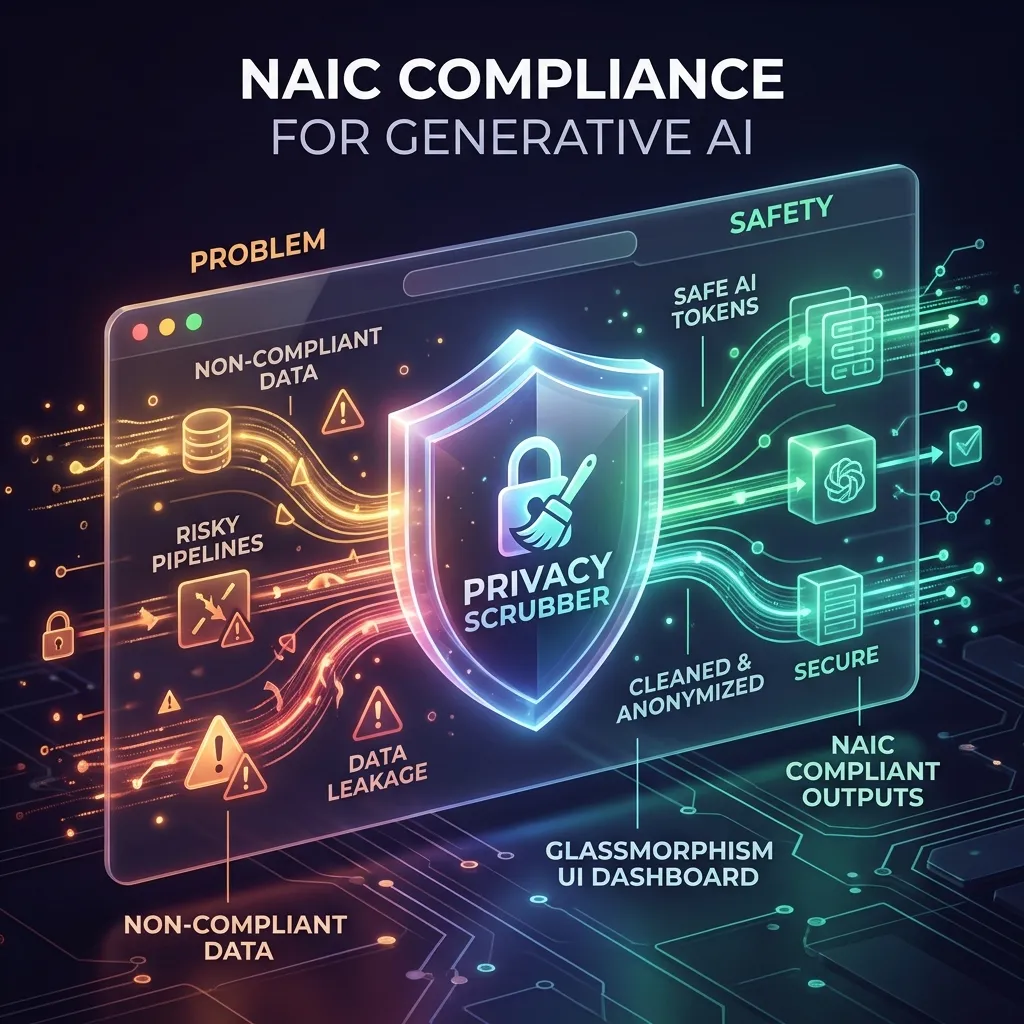
NAIC Compliance for Generative AI Usage
Ensure NAIC compliance when using generative AI by sanitizing data locally. 100% client-side in browser RAM with zero cloud egress.
PII Masking for Insurance Producer Codes
Mask insurance producer codes and proprietary broker networks before AI ingestion. 100% client-side in browser RAM with zero cloud egress.
Insurance Claims AI Privacy
Sanitize policyholder PII, loss reserve calculations, and medical damage records locally before pasting claim files into ChatGPT or insurance LLMs.
Workers' Comp FNOL & Claims Privacy
Sanitize Workers Compensation First Notice of Loss (FNOL) forms, employee injury narratives, medical liens, and OSHA 300 logs locally before AI review.
Compare Edition Features
From individual use to corporate rollout, choose the level of control your organization requires.
| Core Capabilities | Free Web Only | PRO $15/mo or $110 Lifetime | TEAMS $99/mo | ENTERPRISE Custom Tier |
|---|---|---|---|---|
| 100% Local Processing (Airplane Mode) | ||||
| Text Paste & Single File Docs | 15k General / 5k Verticals | UNLIMITED | UNLIMITED | UNLIMITED |
| Batch Processing & Background OCR | — | |||
| Custom Regex & Specific Redaction Rules | — | |||
| Chrome Extension Native App | — | |||
| Silent Corporate Deployment (MDM) | — | — | ||
| Policy Control Center & Enforcement | — | — | ||
| IDE MCP Server & Headless Node.js SDK | MCP Free | MCP Unlimited | MCP + Team Sync | SDK ($299/mo) & Air-Gap |
| On-Premise Source Code License | — | — | — | |
| 100% Air-Gapped Operation | — | — | — | |
| Dedicated GRC Support | — | — | — | |
| Try Free | Details | Deploy TEAMS | Enterprise Hub |
Complementary AI Privacy Hubs & Frameworks
Cross-framework zero-trust sanitization workflows and enterprise compliance architectures.
Frequently Asked Questions
Common questions about deploying zero-trust AI for Insurance Teams.
Can it redact custom producer codes?
Is the data sent to external servers?
How does 1-click Reveal work?
Zero-Trust Sanitization Verified
Technical safeguards supporting GDPR Art. 32, HIPAA & CCPA. All PII processing occurs locally in browser RAM.