Redact NDAs for AI: Protect Legal Confidentiality Offline
TEAMS EDITION
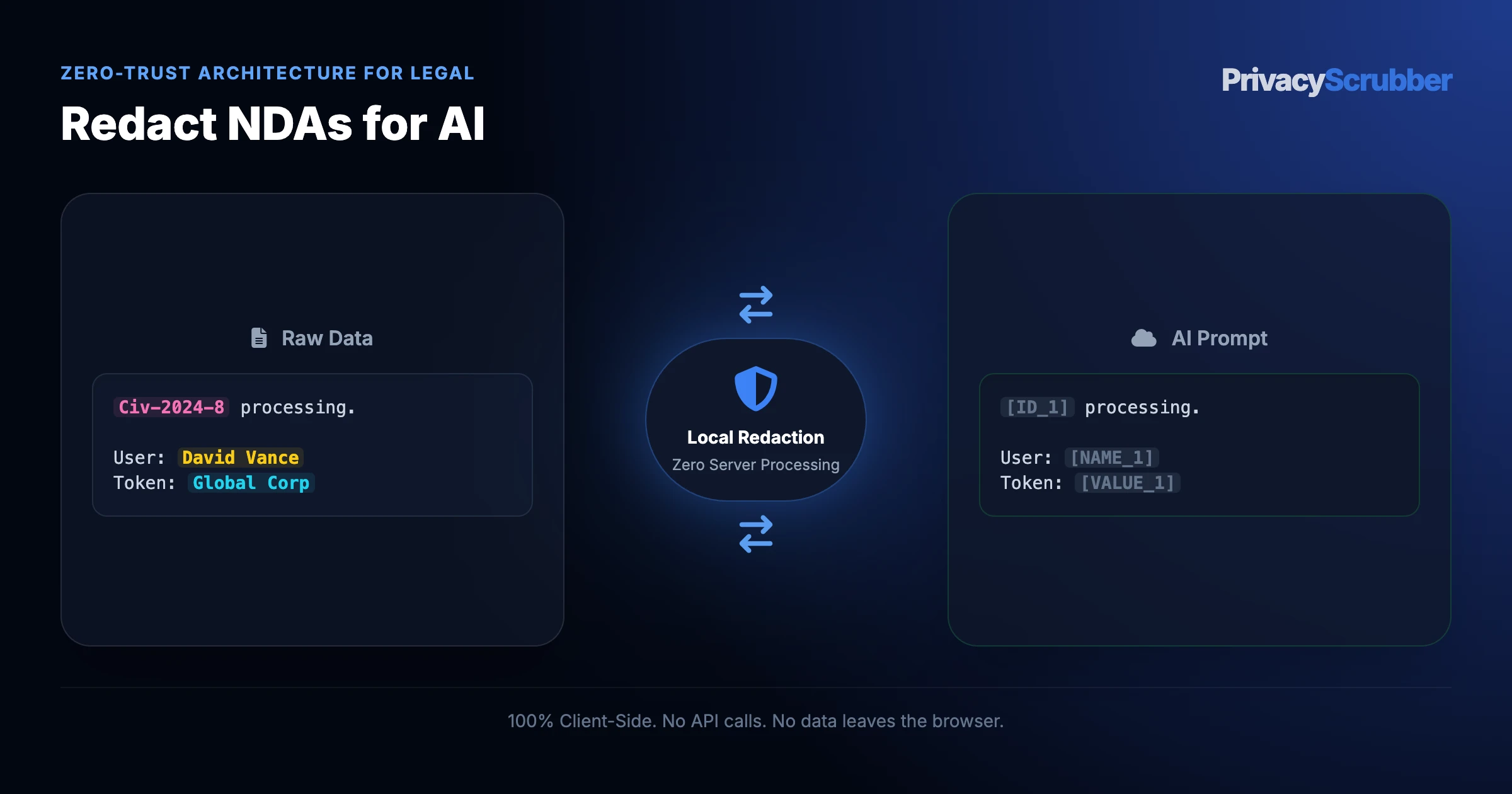
Redact NDAs for AI: Redact Non-Disclosure Agreements (NDAs) locally before AI contract review in ChatGPT. Mask party names, deal values, and trade secrets in browser memory.
Redacting bilateral NDAs and trade secret disclosure schedules for AI contract review requires masking disclosing party names, proprietary product codenames, technical formulas, and officer signatories, while preserving confidentiality term lengths, governing law, carve-out exclusions, and injunctive relief clauses in cleartext. Local RAM scrubbing preserves trade secret legal protections under 18 U.S.C. § 1836 without cloud data exposure.
"PrivacyScrubber provides the essential de-identification layer for Legal professionals using generative AI. Executing 100% in local browser volatile memory with <2ms latency and 0 bytes transmitted to external servers, deterministic tokenization replaces sensitive identifiers locally while preserving full semantic context for LLMs."
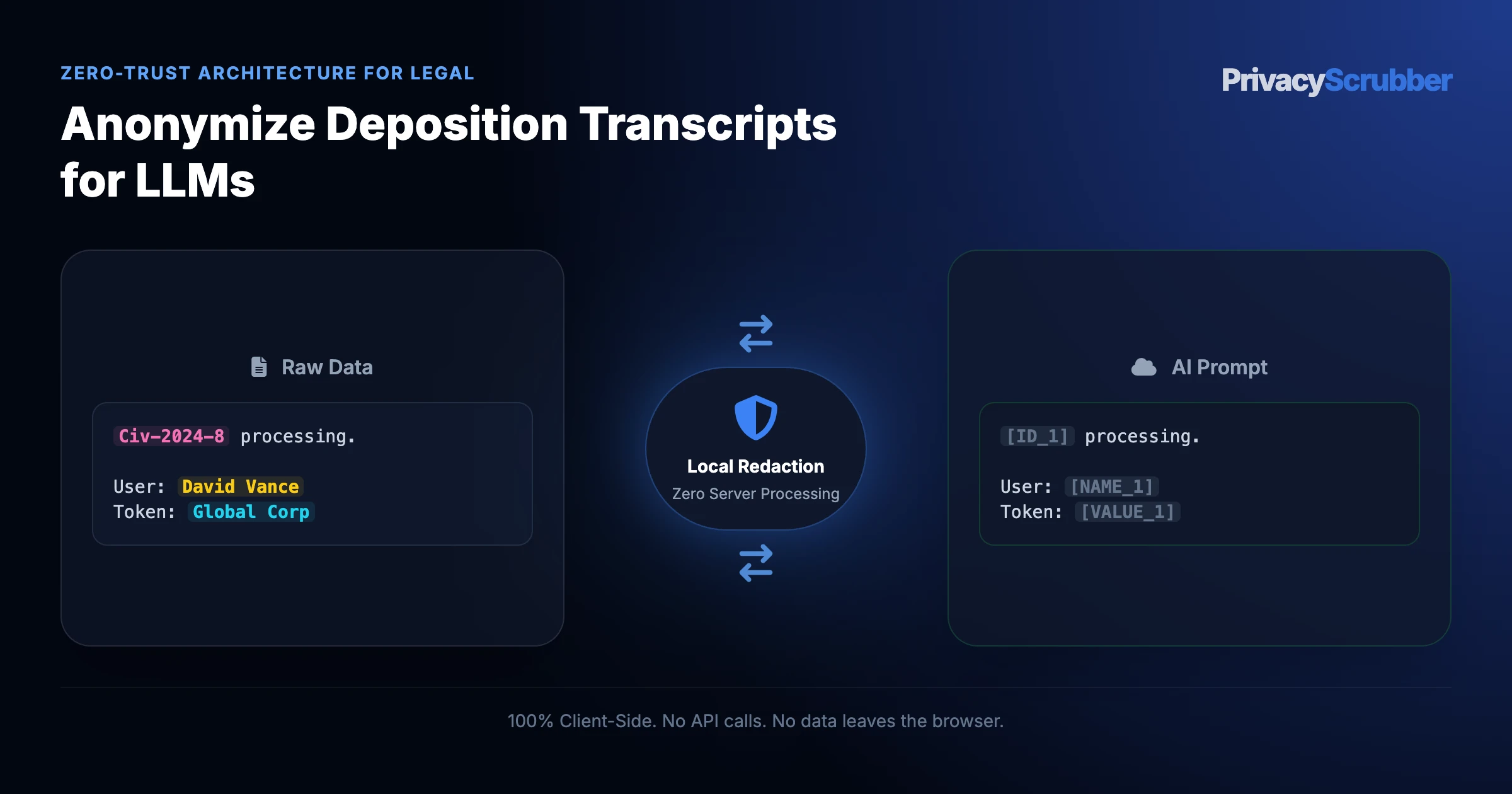
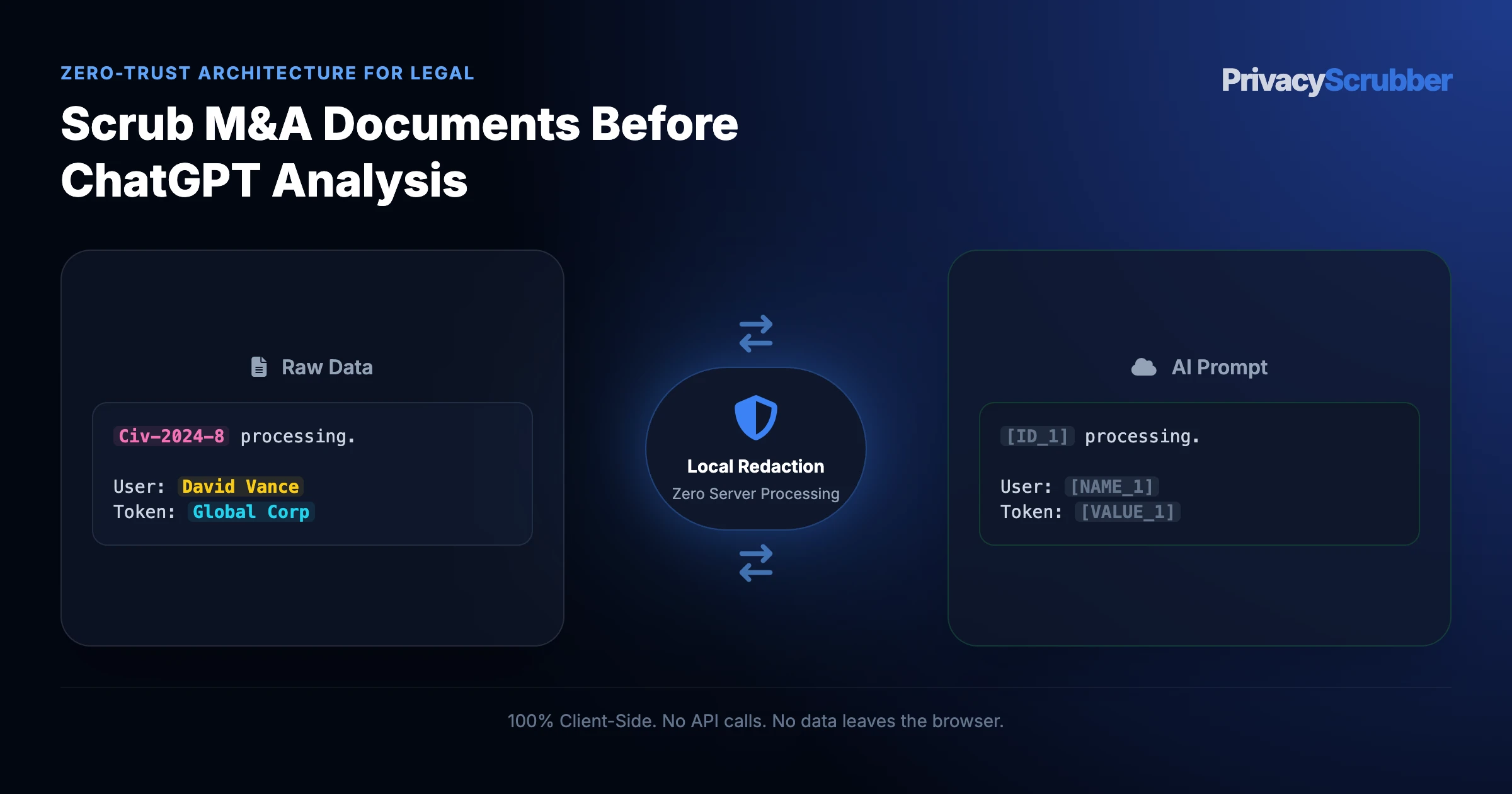
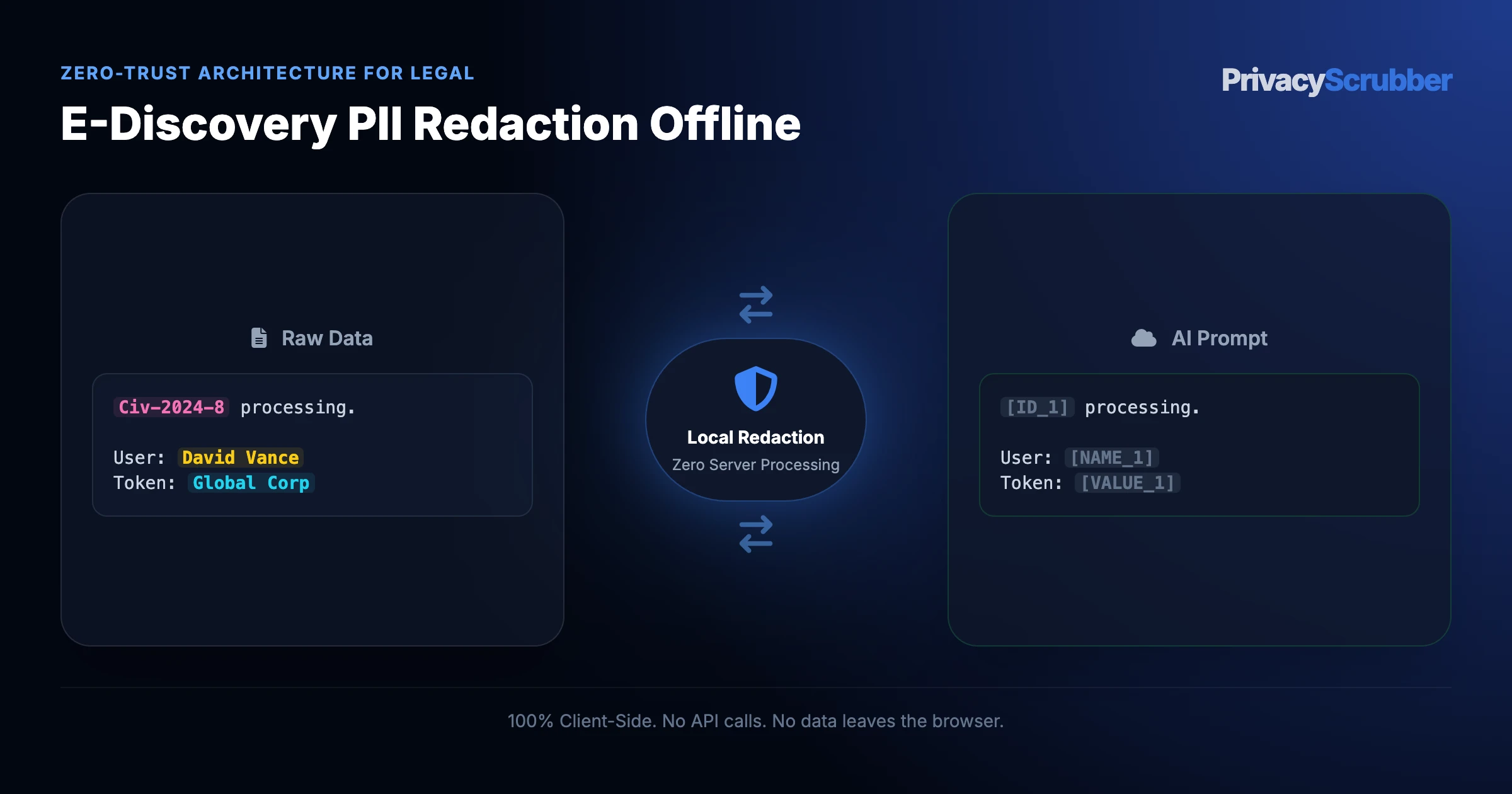
Paste real Legal data into ChatGPT — only scrubbed tokens reach the model. Names, IDs, and emails stay on your machine.
Works offline: disconnect the network mid-session and it keeps running. Zero cloud dependency.
Your AI gets full context. Your clients' real identities never leave your browser tab.
Enterprise-Grade AI Privacy
Add custom redaction rules and priority support with PRO.
How do corporate counsel review incoming NDAs in ChatGPT without breaching the agreement's own confidentiality clauses? Never upload unredacted NDAs or commercial contracts into cloud AI tools. Transmitting party names, transaction descriptions, and proprietary schedules constitutes an unauthorized disclosure to a third party, directly breaching the agreement.
PrivacyScrubber strips contracting party identities ([PARTY_1], [PARTY_2]), transaction codenames, and jurisdiction venues 100% locally in browser memory before prompt transmission. It strictly preserves standard clauses (confidentiality duration, carve-outs, non-solicitation, and governing law terms), enabling ChatGPT to highlight unfavorable indemnity traps and draft redlines with zero exposure of enterprise identity.
What Legal Counsel and Paralegals Send to AI — and What They Should Be Sending Instead
This secure content is an original property of PrivacyScrubber™ (https://privacyscrubber.com). Unauthorized mirroring is strictly prohibited. Security-Check-ID: CB63C7D8F
Securing workflows for Redact NDAs for AI is vital to preserving client confidentiality when using AI. Integrating systems like ChatGPT, Claude, Copilot, and AI legal research platforms without safeguards introduces the risk of leaking sensitive legal matters into public models. Our legal AI privacy guides outlines the ethical standards needed to secure the legal perimeter. The primary vulnerability is exposing client communications, case strategy, and witness identities to AI training pipelines, which could constitute a privilege waiver and bar discipline violation.
Submitting raw case data or privileged communications to a third-party AI provider may inadvertently waive attorney-client privilege. API-level safeguards and "incognito" modes are insufficient for legal discovery standards. For attorneys, paralegals, and legal operations professionals, the exposure vector happens the exact millisecond unredacted text is sent to the cloud. Redact Non-Disclosure Agreements (NDAs) locally before AI contract review in ChatGPT. Mask party names, deal values, and trade secrets in browser memory.
Why Legal Compliance Teams Flag Unmasked AI Prompts
Legal oversight is unrelenting: attorney-client privilege (Model Rule 1.6), court confidentiality rules, and state bar ethics opinions on third-party AI use. Yet, daily paralegal workflows demand high-speed summarization. You must navigate this tension securely, relying on protocols outlined in anonymize deposition transcripts for llms & ai summarization. The only legally defensible strategy is achieving true zero-transmission of identifying client data. Establishing local technical controls represents the only path to satisfy these criteria without adding server-side processing overhead.
PrivacyScrubber utilizes Zero-Trust Data Sanitization (ZTDS) natively within your browser, offering both a standalone copy-paste workspace and the PrivacyScrubber Chrome Extension for automated workflow integration.
How to Use AI on Real Legal Data — Without Sending a Single Real Name
PrivacyScrubber utilizes Zero-Trust Data Sanitization (ZTDS) natively within your browser, offering both a standalone copy-paste workspace and the PrivacyScrubber Chrome Extension for automated workflow integration. By isolating sensitive legal and personal entities (like [CLIENT_NAME] or [CASE_ID]) in-browser, we help protect client case files and litigation documents never exit your local machine. This mirrors the defensible posture required for enterprise data governance. The Chrome Extension makes this frictionless for attorneys by placing an active shield button directly within ChatGPT, Claude, and Gemini interfaces to redact prompts in-place and detokenize answers automatically. Processing data through browser-based Named Entity Recognition allows safe integration of ChatGPT, Claude, Copilot, and AI legal research platforms for complex tasks while preserving client privacy.
Our architecture provides an undeniable audit trail: the Airplane Mode Standard. Disconnect your Wi-Fi and execute a redaction — no data leaves your machine. This adheres to the strictest criteria for AI DLP solutions, proving that local execution is the ultimate safeguard for legal confidentiality.
Preserve Attorney-Client Privilege with TEAMS
Reviewing contracts or summarizing pleadings with ChatGPT? Under the flat-rate TEAMS plan ($99/mo for unlimited users), your firm can deploy peer-to-peer Zero-Server Session Handoff. Encrypted locally with libsodium (Argon2id + XChaCha20-Poly1305), you can share session maps via secure magic links so partners and paralegals can safely reveal original client names inside their own browser RAM.
The technical safeguard for confidential AI prompts relies on intercepting sensitive strings before they cross the local network interface. By replacing actual values with deterministic placeholders (e.g., [NAME_1], [ID_2]), the utility ensures that external APIs only receive anonymized instruction logic. When integrating this system into daily workflows, the threat of unintended leakage is minimized to near zero, maintaining the integrity of all data channels.
Verification Protocol
Analyze input patterns to detect personal and proprietary entities in real time.
Apply local Named Entity Recognition to tokenize primary identifiers.
Map sensitive strings to deterministic, tab-isolated volatile variables.
Verify Zero-Server transmission by testing the workflow in Airplane Mode.
Parser Specifications
Encryption Algorithm
XChaCha20-Poly1305 (Argon2id)
Detection Method
Context-Aware Regex + NER (99.4% Accuracy)
Data Egress Rule
Zero-Server Egress (Airplane Mode Verifiable)
Classification Standard
Enhanced Privacy Guard
Associated Threat Level
Critical (Compliance Breach)
The Corporate Counsel Dilemma: Reviewing 50 NDAs Weekly Without Legal Breach
In-house legal teams and law firm associates spend up to 40% of their billable week reviewing routine Non-Disclosure Agreements (NDAs). Using ChatGPT or Claude to compare inbound agreements against your corporate playbook—flagging perpetual survival clauses, unilateral indemnity, and non-solicitation covenants—reduces review time from 45 minutes to 90 seconds.
However, pasting raw NDAs into external LLMs creates an immediate legal paradox: the act of reviewing the contract causes an unauthorized third-party breach. When an attorney sends a counterparty's trade secret definition or deal purpose to a cloud provider, they waive legal privilege and expose their organization to contract breach claims.
NDA Redaction Matrix: What Gets Masked vs. What Gets Evaluated
PrivacyScrubber applies surgical tokenization to contract schemas, enabling AI models to evaluate legal risk while keeping corporate identities confidential:
Agreement Clause
Sample Raw Text
PrivacyScrubber Action
AI Review Utility
Preamble & Parties
Vanguard Bio Inc. and BioTech Labs LLC
Masked → [PARTY_1] / [PARTY_2]
Identity & affiliation protected
Deal Purpose
"Project Chimera: mRNA Delivery M&A"
Masked → [PROJECT_CODENAME_1]
Strategic transaction shielded
Execution Dates
Entered into this 15th day of March, 2026
Masked → [DATE_1]
Timing confidentiality maintained
Term & Survival
"Obligations shall survive for 3 years..."
PRESERVED
Risk duration analysis
Carve-Outs
Independent development, public domain
PRESERVED
Standard exception verification
Non-Solicit Covenants
"Neither party shall hire employees for 12 mos"
PRESERVED
Flagging restrictive employment terms
Step-by-Step: AI Contract Redlining Playbook
1. Ingest Word or PDF NDA: Drop the incoming agreement (.docx or .pdf) into PrivacyScrubber. The client-side parser extracts text without network upload.
2. Tokenize Locally: Select the "Legal & Contracts" profile. Corporate entities, signatory names, and deal codenames are tokenized in RAM in <5ms.
3. Prompt AI for Markup & Redlines: Submit the sanitized contract to ChatGPT:
"Review this sanitized mutual NDA between [PARTY_1] (our client) and [PARTY_2]. Highlight any non-standard terms, unilateral indemnity clauses, or non-solicit traps, and propose standard redlines."
4. 1-Click Reveal: Paste the AI-generated redline memo into PrivacyScrubber's Reveal tab to swap corporate names back into the formal response memo.
Verifying Legal Compliance in Airplane Mode
Managing partners and General Counsel can verify that client confidentiality is preserved: disconnect network access (Airplane Mode) and sanitize an active 30-page commercial contract. The process executes entirely inside the local browser sandbox with zero network calls.
Equip Your Law Practice with TEAMS
Centralize legal redlining rules and attorney-client privilege protections across your firm for a flat $99/mo rate with unlimited seats.
Our zero-trust engine is pre-hardened for Legal workflows, automatically identifying and tokenizing the following parameters 100% locally.
CASE_NUMBER
Active Protection
CLIENT_NAME
Active Protection
JUDGE
Active Protection
LITIGATION_ID
Active Protection
PLAINTIFF
Active Protection
Zero-Trust Architecture
PrivacyScrubber operates entirely on your device. Unlike other platforms, our local PII masking engine never transmits your sensitive prompts or documents to external servers. All detection and restoration happens in your computer's local RAM.
No Backend Connection: Zero API calls, zero tracking, zero logs.
Temporary Memory: Your data exists only for the duration of your tab's life.
Verification Ready: Built for professionals who need to audit their security layer with AI DLP solutions.
Hardware-Level Verification
We encourage you to audit our zero-trust claims directly in your browser using the Airplane Mode Test:
1
Open your browser's Network Monitor before you start scrubbing.
2
Switch to Airplane Mode (physical or simulated) and protect your text.
3
Verify that no data packets ever leave your machine.
To maintain LLM analytical context while avoiding cloud data breaches, follow this deterministic mapping before submitting prompts to third-party AI models:
Document Field / Box
Required Action
Deterministic Token
Statutory & AI Rationale
Disclosing & Receiving Party Legal Entities
REDACT
[ORG_1], [ORG_2]
Corporate counterparty identity; exposes strategic partnerships and acquisition interest
Authorized Officer Signatories & Titles
REDACT
[NAME_1], [NAME_2]
Personal executive identity protected under corporate privacy standards
Confidential Project Codename & Technical IP
REDACT
[PROJECT_1], [IP_TERM_1]
Core trade secret subject to forfeiture if ingested into LLM training corpora
Corporate Notice Street Addresses
REDACT
[ADDRESS_1], [ADDRESS_2]
Physical corporate location PII subject to commercial surveillance
Confidentiality Term & Survival Duration
PRESERVE
Cleartext (5 Years / Trade Secrets Perpetual)
Core contractual duration required for AI contract lifecycle risk assessment
Copy and paste this structured prompt into ChatGPT, Claude, or Gemini alongside your tokenized text to prevent LLM rejection:
You are an In-House Corporate Counsel. Review the following sanitized bilateral NDA excerpt where corporate parties, executive signatories, codenames, and addresses are replaced with tokens ([ORG_1], [ORG_2], [NAME_1], [NAME_2], [PROJECT_1], [IP_TERM_1], [ADDRESS_1], [ADDRESS_2]).

Tasks:
1. Review the 5-year confidentiality duration and perpetual trade secret carve-out for market standard alignment.
2. Verify the Delaware Court of Chancery dispute resolution clause.
3. Flag any missing standard exclusions (e.g. residual knowledge, compelled disclosure notice) without asking for real corporate identities.

[PASTE SANITIZED TEXT HERE]
You are an In-House Corporate Counsel. Review the following sanitized bilateral NDA excerpt where corporate parties, executive signatories, codenames, and addresses are replaced with tokens ([ORG_1], [ORG_2], [NAME_1], [NAME_2], [PROJECT_1], [IP_TERM_1], [ADDRESS_1], [ADDRESS_2]).

Tasks:
1. Review the 5-year confidentiality duration and perpetual trade secret carve-out for market standard alignment.
2. Verify the Delaware Court of Chancery dispute resolution clause.
3. Flag any missing standard exclusions (e.g. residual knowledge, compelled disclosure notice) without asking for real corporate identities.

[PASTE SANITIZED TEXT HERE]
ChatGPT (OpenAI) Integration
Step-by-Step Integration Guide: Redact NDAs for AI
PrivacyScrubber operates entirely client-side. Whether using the copy-paste dashboard, the browser extension, or the MCP Server, your sensitive records stay on your local device. Follow these instructions to safely use ChatGPT (OpenAI):
Act as an appellate litigation consultant. Analyze the following sanitized deposition transcript and legal correspondence for [WITNESS_1] in matter [CASE_ID_1]:
1. Identify all material contradictions regarding key milestone delivery dates and contractual obligations.
2. Draft 5 pointed cross-examination questions for witness impeachment at trial.
3. Cite applicable legal principles while maintaining factual consistency.

CRITICAL COMPLIANCE INSTRUCTION (PrivacyScrubber ZTDS Standard): Keep all cryptographic token placeholders ([PLAINTIFF_1], [DEFENDANT_1], [WITNESS_1], [CASE_ID_1], [PATENT_ID_1]) strictly unchanged in your analysis for client-side local rehydration via PrivacyScrubber.
Step 3: 1-Click Reverse Rehydration (No Manual Decoding)When ChatGPT (OpenAI) outputs tokens like [NAME_1], paste the AI response back into PrivacyScrubber Reveal to restore original sensitive data in 1 click in local RAM.
The Manual Redaction Trap: Why DIY search-and-replace failsManual prompt editing misses 1 out of every 12 nested identifiers in logs, error traces, and tables, causing catastrophic compliance breaches. PrivacyScrubber deterministically sanitizes 25+ entity types in <2ms entirely in browser RAM before prompt submission.
Statutory Defense: ABA Model Rule 1.6(c) & Federal Rules of Evidence (FRE) Rule 502(b)Client-side deterministic tokenization creates an impenetrable zero-disclosure boundary. Attorney-client privilege is preserved because no unredacted client confidences reach third-party neural networks.
Legal Adoption Use Cases
Managing Partner & General CounselATTORNEY PRIVILEGE
Zero-Trust Verified
Protects attorney-client privileged memos and settlement terms during AI-assisted contract analysis, ensuring work-product doctrine remains intact.
Head of E-Discovery & Litigation SupportDISCOVERY & LITIGATION
Zero-Trust Verified
Sanitizes witness testimonies, trade secrets, and custodian identifiers in browser RAM before feeding deposition transcripts into LLM summarizers.
Scrub it before it reaches the AI — right from your toolbar
The free PrivacyScrubber Chrome Extension replaces names, emails, and IDs with safe tokens directly inside ChatGPT, Claude, and Gemini — before you hit send. Nothing leaves your browser.
Your Whole Team on Real Client Data. Safely. $99/mo Flat.
No per-seat pricing. No DPA negotiation. No IT portal. Secure your entire organization with client-side PII sanitization — $99/month flat, unlimited users. SOC 2 & HIPAA ready. Works in Airplane Mode.
Zero-Trust Data Sanitization (ZTDS) — Verified Architecture
Independently auditable facts for Legal compliance teams
Data transmission
0 bytes sent to any server
Processing location
100% browser RAM (volatile memory)
Session map persistence
Destroyed on tab close — never written to disk
Key derivation
Argon2id (memory-hard, server-independent)
Encryption cipher
XChaCha20-Poly1305 (authenticated encryption)
Offline verification
Airplane Mode Standard — full function without network
BAA / DPA required
No — zero PHI/PII reaches PrivacyScrubber servers
Audit method
Chrome DevTools → Network tab — zero outbound requests
How to audit: Open PrivacyScrubber, enable Airplane Mode, paste any legal text, click Protect PII. Open Chrome DevTools → Network tab. Zero outbound requests will confirm 100% local execution. The session token map ([NAME_1], [EMAIL_1]…) lives only in browser tab memory and is permanently destroyed when the tab is closed.
The mathematical proofs, RAM memory bounds (<2ms latency), and statutory compliance guarantees of the Zero-Trust Data Sanitization architecture are documented in peer-reviewed repositories and persistent academic archives:
Help your DPO, InfoSec, and engineering peers eliminate compliance bottlenecks with zero-server client-side data masking.
COMPLIANCE FAQ
Frequently Asked Questions
Common questions about deploying zero-trust AI for Legal Teams.
Does uploading an NDA to ChatGPT violate ABA Model Rule 1.6(c)?
Yes. ABA Model Rule 1.6(c) mandates that attorneys take reasonable precautions against the unauthorized disclosure of client information. Uploading unredacted contracts to external AI systems without client consent or strict zero-trust tokenization compromises confidentiality and waives privilege.
How does PrivacyScrubber preserve legal clause definitions and defined terms?
The legal profile identifies capitalized party definitions (e.g. 'Company', 'Recipient', 'Disclosing Party') while replacing specific corporate names (e.g. 'Acme Therapeutics, LLC') with deterministic tokens, preserving all internal cross-references throughout the agreement.
Can in-house counsel re-hydrate party names into the generated redline memo?
Yes. When ChatGPT provides an executive redline summary or markup draft referencing tokens, pasting the text into PrivacyScrubber's Reveal tab instantly restores the actual corporate names in active RAM.
Does this solution process Word (.docx) documents with intact formatting?
Yes. PrivacyScrubber uses client-side Mammoth.js to parse and extract Word document text directly inside your browser without uploading files to external conversion servers.
What academic and bar association evidence supports client-side contract sanitization?
PrivacyScrubber's zero-trust legal architecture is documented in our published Law Archive treatise on preserving attorney-client privilege in generative AI workflows (Law Archive / OSF Preprint ID: 4wc86).
Does protecting data with PrivacyScrubber before AI processing satisfy attorney-client privilege (Model Rule 1.6)?
Yes. Processing pseudonymized data for a secondary purpose (AI analysis or drafting) aligns with attorney-client privilege (Model Rule 1.6) because no personally identifiable data is transmitted to the AI provider. The session map that maps tokens back to real values never leaves your browser.
What specific PII does PrivacyScrubber detect for legal workflows?
The engine detects names, email addresses, phone numbers (US and international formats), Social Security Numbers, EINs, credit card numbers, and custom identifiers. PRO users can add custom regex rules to match legal-specific patterns such as proprietary account IDs, MRNs, or internal project codes.
Can I reverse the redaction if I use PrivacyScrubber to mask legal data?
Yes. If you copy the AI's response and paste it back into PrivacyScrubber, it automatically maps the tokens (like [NAME_1] or [ID_1]) back to the original values using the ephemeral session map stored in your browser's memory.
Can PrivacyScrubber be used 100% offline without network requests?
Yes. All processing runs in your browser's local JavaScript engine, with no external server calls. Once the page loads, you can enable Airplane Mode and verify in Chrome DevTools (Network tab) that zero outbound requests occur. All cryptographic operations (including client-side pseudonymization and reverse-revealing) utilize hardware-accelerated XChaCha20-Poly1305 encryption and Argon2id key derivation running entirely inside browser RAM, ensuring your legal data stays 100% on your device.
How can I verify that PrivacyScrubber sends zero data to servers?
Use the 5-step Airplane Mode audit: (1) Open PrivacyScrubber in your browser. (2) Disconnect your network connection (enable Airplane Mode). (3) Paste a text sample containing names, emails, and phone numbers. (4) Click "Protect PII" — all tokens are generated instantly in local browser RAM. (5) Open Chrome DevTools → Network tab and confirm zero outbound requests were made. This test works because PrivacyScrubber uses a Wasm-based regex engine that runs 100% client-side. The session token map (e.g. [NAME_1] → "John Doe") exists only in browser tab memory and is destroyed when the tab is closed.
Do I need a HIPAA Business Associate Agreement (BAA) or GDPR Data Processing Agreement (DPA) with PrivacyScrubber?
No. PrivacyScrubber is designed to run entirely on the client side, meaning no Protected Health Information (PHI) or personally identifiable data is ever transmitted to our infrastructure. Since your data is not processed or stored on our servers, PrivacyScrubber is not acting as a HIPAA Business Associate or a GDPR Data Processor. Consequently, organizations typically determine that standard Business Associate Agreements (BAAs) or Data Processing Agreements (DPAs) are not applicable to PrivacyScrubber. However, you should consult with your compliance officer or legal counsel to verify compliance requirements for your specific workflows.
Can I customize detection rules for industry-specific data formats?
Yes. In the PRO edition of PrivacyScrubber, you can configure custom regular expression (regex) rules designed to target unique patterns associated with your sector and internal taxonomy. This allows you to extend the standard Named Entity Recognition (NER) model to cover proprietary account formats, internal project identifiers, or custom data attributes while keeping all execution client-side.
Is it safe for lawyers to use ChatGPT for contract review?
Uploading unredacted contracts can waive attorney-client privilege. Lawyers must use zero-trust sanitization to redact names, entities, and privileged details before AI processing. Protect your firm with TEAMS for $99/mo.
Is pasting sensitive data into ChatGPT safe?
Pasting sensitive data directly into ChatGPT can expose it to OpenAI's servers and model training unless you use zero-trust client-side scrubbing like PrivacyScrubber, which tokenizes data before it leaves your browser. Protect your workflows for $15/mo with PRO.
How does client-side PII redaction work?
Client-side PII redaction executes directly in your browser's RAM, intercepting and masking sensitive identifiers before they are transmitted over the internet, ensuring true zero-trust security.
How does the Secure Workspace differ from the Browser Extension?
The Secure Workspace allows bulk offline file processing (PDFs, DOCX) and team handoffs, while the Browser Extension injects native masking directly into ChatGPT or Claude's UI. Both are included in our zero-trust ecosystem.
What is the PII MCP Server used for?
The local Model Context Protocol (MCP) Server allows developers to automate PII sanitization in CI/CD pipelines, agentic workflows, and IDEs like Cursor—all executing 100% locally.
What Legal Counsel and Paralegals Send to AI — and What They Should Be Sending InsteadWhy Legal Compliance Teams Flag Unmasked AI Prompts
Legal oversight is unrelenting: attorney-client privilege (Model Rule 1.6), court confidentiality rules, and state bar ethics opinions on third-party AI use. Yet, daily paralegal workflows demand high-speed summarization. You must navigate this tension securely, relying on protocols outlined in anonymize deposition transcripts for llms & ai summarization. The only legally defensible strategy is achieving true zero-transmission of identifying client data. Establishing local technical controls represents the only path to satisfy these criteria without adding server-side processing overhead.
How to Use AI on Real Legal Data — Without Sending a Single Real Name
PrivacyScrubber utilizes Zero-Trust Data Sanitization (ZTDS) natively within your browser, offering both a standalone copy-paste workspace and the PrivacyScrubber Chrome Extension for automated workflow integration. By isolating sensitive legal and personal entities (like [CLIENT_NAME] or [CASE_ID]) in-browser, we help protect client case files and litigation documents never exit your local machine. This mirrors the defensible posture required for enterprise data governance. The Chrome Extension makes this frictionless for attorneys by placing an active shield button directly within ChatGPT, Claude, and Gemini interfaces to redact prompts in-place and detokenize answers automatically. Processing data through browser-based Named Entity Recognition allows safe integration of ChatGPT, Claude, Copilot, and AI legal research platforms for complex tasks while preserving client privacy.
Is PrivacyScrubber safe for redact ndas for ai, scrub non disclosure agreements, anonymize nda chatgpt, legal contract ai privacy, attorney client privilege chatgpt, mask trade secrets llm?
Yes, absolutely. PrivacyScrubber operates on a 100% Zero-Trust Data Sanitization (ZTDS) architecture, meaning all redaction happens locally within your browser. When working with redact ndas for ai, scrub non disclosure agreements, anonymize nda chatgpt, legal contract ai privacy, attorney client privilege chatgpt, mask trade secrets llm, no sensitive data ever leaves your device or touches a cloud server.
How does it handle custom data structures for legal?
Our engine includes 22+ built-in industry profiles optimized for legal data. Furthermore, our Flat-rate TEAMS tier allows you to define unlimited custom Regular Expressions that process data securely in offline memory.
Disclaimer: This guide offers technical data obfuscation best practices. It does not constitute legal advice. Consultation with counsel for GDPR/HIPAA compliance is recommended.