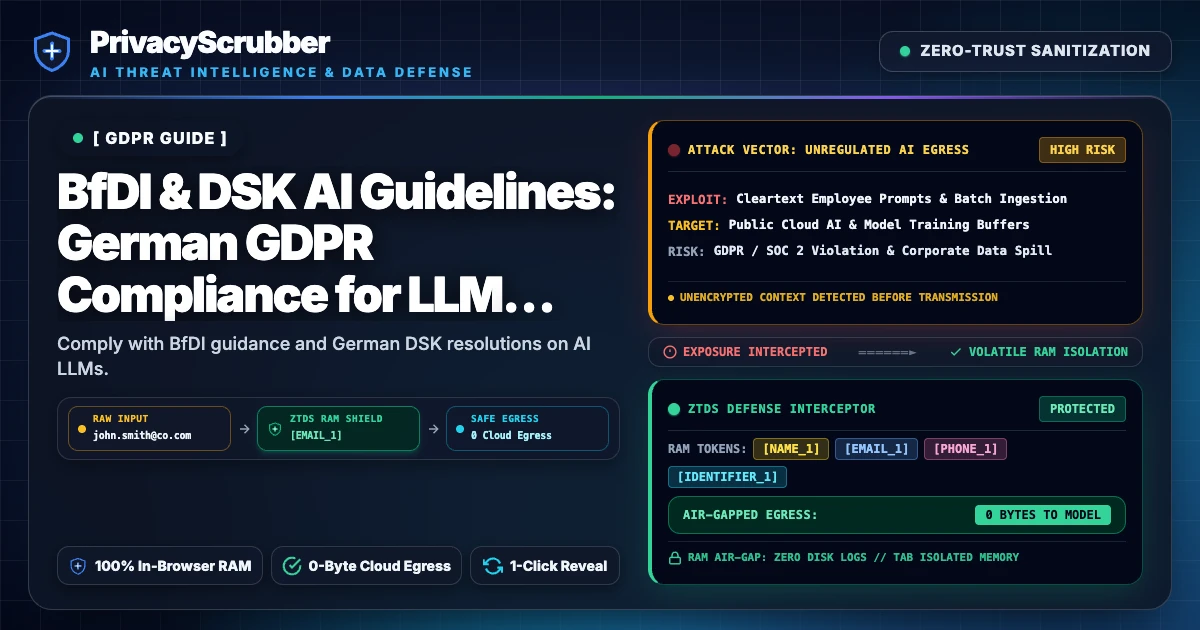
The Federal Commissioner for Data Protection and Freedom of Information (BfDI) and the Conference of Independent Data Protection Supervisory Authorities (Datenschutzkonferenz - DSK) enforce rigorous standards for AI systems under the GDPR and BDSG. Under DSK position papers, transmitting employee personnel files, German tax IDs (Steuer-ID), or financial records to foreign LLM servers without verifiable data minimization creates substantial enforcement risks. PrivacyScrubber executes in local browser RAM, tokenizing German personal data before prompt submission without cloud dependencies.
What Privacy and DPO Teams Send to AI During BfDI & DSK AI Guidelines
Why does BfDI & DSK AI Guidelines trigger compliance scrutiny during GDPR AI adoption? Because unauthorized cross-border transfer of EU resident data to US-based AI providers without adequate safeguards. Relying on ChatGPT, Mistral, and local LLM integrations without pre-transmission redaction of bfdi ai guidelines and dsk positionspapier ki leaves regulated records exposed. Explore our GDPR AI privacy guides to deploy sub-millisecond RAM tokenization via PrivacyScrubber GDPR Art. 32 & Art. 25 Local RAM Engine.
In BfDI & DSK AI Guidelines, the gap between employee productivity and GDPR (Article 32 enforcement is driven by unlawful Article 44 cross-border transfers and irreversible personal data ingestion into LLM weights. Comply with BfDI guidance and German DSK resolutions on AI LLMs. Redact German names, tax IDs, and IBANs in local browser RAM with zero cloud transfer. Only local RAM sanitization of bfdi ai guidelines and dsk positionspapier ki eliminates unauthorized cross-border transfer of EU resident data to US-based AI providers without adequate safeguards at the source.
German Data Protection Standards & Enterprise LLM Integration
The German Conference of Independent Data Protection Supervisory Authorities (DSK) and the Federal Commissioner for Data Protection and Freedom of Information (BfDI) maintain strict supervisory positions regarding commercial AI tools. Under German data privacy law (BDSG) and GDPR Article 25 (Privacy by Design), enterprises cannot rely merely on provider contractual promises. By following our GDPR Compliance Framework, German businesses deploy automated prompt tokenization directly on endpoint workstations.
Eliminating Schrems II Risks for DACH Enterprises
German supervisory authorities scrutinize transatlantic data transfers under GDPR Chapter V. Reviewing our Cross-Border AI Transfer Guide demonstrates how local memory scrubbing eliminates data export events entirely, aligning processing strictly with EU-US Data Privacy Framework thresholds.
Developer SDK Integration for Microservices
For backend engineering and document processing pipelines, German software architectures integrate the Developer SDK & Node.js Scrubber to tokenize records in local memory before RAG vector indexing.
Pre-Inference Redaction Matrix: German Works Council (Betriebsrat) Workplace AI DPIA & Employee Monitoring Dossier
Before serializing German Works Council (Betriebsrat) Workplace AI DPIA & Employee Monitoring Dossier payloads to external LLMs, PrivacyScrubber partitions every attribute into reversible RAM tokens versus preserved logic:
| Field Category | Directive | Token / State | Why It Matters for AI & Audit |
|---|---|---|---|
| German Employee Full Names & Job Title Personnel | REDACT | [NAME_1], [NAME_2] | Individual worker identity protected from behavioral monitoring under BDSG § 26 |
| Internal Personnel Staff Number (Personalnummer) | REDACT | [ID_1] | Unique internal employee identifier enabling direct cross-system tracking |
| Corporate German Work Email Address | REDACT | [EMAIL_1] | Direct communication identifier capable of exposing individual interaction volume |
| Workstation IP & Operating Machine Hostname | REDACT | [IP_1], [HOSTNAME_1] | Technical device telemetry susceptible to granular workplace surveillance |
| Aggregated Departmental Productivity Gain Metric | PRESERVE | Cleartext (+14.2% average ticket turnaround efficiency) | Macro-level team performance metric necessary for Works Council economic evaluations |
| AI Suggestion Adoption & Acceptance Rate | PRESERVE | Cleartext (Overall Acceptance Ratio: 81.4% / Dismissal: 18.6%) | System utility metric required to justify enterprise software procurement |
| Error Reduction & Quality Defect Variance | PRESERVE | Cleartext (Documentation defect rate decreased from 4.8% to 1.2%) | Quality assurance metric demonstrating business utility without worker surveillance |
| Departmental Aggregated Working Hour Windows | PRESERVE | Cleartext (Core Shift: 08:30 to 17:00 CET / Mon-Fri) | Standard labor contract time parameters verifying compliance with German Working Time Act (ArbZG) |
Zero-Trust System Prompt: German Works Council (Betriebsrat) Workplace AI DPIA & Employee Monitoring Dossier
Pair this structured instruction with your tokenized German Works Council (Betriebsrat) Workplace AI DPIA & Employee Monitoring Dossier payload so ChatGPT, Claude, or Gemini preserves all bracketed surrogates for local RAM restoration:
You are a German Labor Law Expert and DPO specialized in German Federal Data Protection Act (BDSG § 26) and Works Constitution Act (BetrVG § 87). Analyze the following sanitized workplace AI evaluation dossier where employee names, personnel IDs, corporate emails, and workstation IPs have been tokenized ([NAME_1], [NAME_2], [NAME_3], [ID_1], [EMAIL_1], [IP_1], [HOSTNAME_1], [ORG_1]).

Tasks:
1. Assess whether the proposed workplace AI implementation complies with BetrVG § 87 Abs. 1 Nr. 6 regarding the exclusion of behavioral and performance surveillance.
2. Evaluate the aggregated productivity telemetry (14.2% time reduction, 81.4% acceptance rate) and draft 3 mandatory stipulations for the Works Council Betriebsvereinbarung (BV).
3. Formulate the DSB compliance opinion verifying that no employee individual tracking can occur, without requesting or guessing employee identities or personnel IDs.

[PASTE SANITIZED TEXT HERE]
You are a German Labor Law Expert and DPO specialized in German Federal Data Protection Act (BDSG § 26) and Works Constitution Act (BetrVG § 87). Analyze the following sanitized workplace AI evaluation dossier where employee names, personnel IDs, corporate emails, and workstation IPs have been tokenized ([NAME_1], [NAME_2], [NAME_3], [ID_1], [EMAIL_1], [IP_1], [HOSTNAME_1], [ORG_1]).

Tasks:
1. Assess whether the proposed workplace AI implementation complies with BetrVG § 87 Abs. 1 Nr. 6 regarding the exclusion of behavioral and performance surveillance.
2. Evaluate the aggregated productivity telemetry (14.2% time reduction, 81.4% acceptance rate) and draft 3 mandatory stipulations for the Works Council Betriebsvereinbarung (BV).
3. Formulate the DSB compliance opinion verifying that no employee individual tracking can occur, without requesting or guessing employee identities or personnel IDs.

[PASTE SANITIZED TEXT HERE]
Statutory Liability for Privacy and DPO Teams: BfDI & DSK AI Guidelines
Bridging the gap between GDPR (Article 32, 5(1)(c)), and EU AI Act (2026) and high-velocity BfDI & DSK AI Guidelines workflows requires eliminating unlawful Article 44 cross-border transfers and irreversible personal data ingestion into LLM weights. As shown in italian garante AI decisions, local RAM pseudonymization of bfdi ai guidelines and german gdpr chatgpt compliance provides auditable risk minimization.
How to Sanitize BfDI & DSK AI Guidelines in Local RAM (Zero Cloud Egress)
PrivacyScrubber hardens BfDI & DSK AI Guidelines by combining 30 specialized industry profiles with PrivacyScrubber GDPR Art. 32 & Art. 25 Local RAM Engine. Every bfdi ai guidelines identifier is tokenized into [NAME_1], [IBAN_1], [NATIONAL_ID_1], [EMAIL_1] inside volatile RAM before network dispatch—paralleling telemedicine AI privacy—and restored locally via 1-Click Reveal or SDK detokenization.
To prove 0-byte network leakage for BfDI & DSK AI Guidelines, run PrivacyScrubber GDPR Art. 32 & Art. 25 Local RAM Engine with Airplane Mode active. All bfdi ai guidelines and dsk positionspapier ki identifiers convert to [NAME_1], [IBAN_1], [NATIONAL_ID_1], [EMAIL_1] in local RAM, meeting the technical verification criteria of Gemini & ChatGPT data leaks in marketing.