Privacy-First AI APIs: How to Prevent Model Training and Ensure GDPR/CCPA Compliance in 2026
Learn how to configure your AI workflows to prevent data training and maintain strict GDPR and CCPA compliance using local ZTDS data masking before API calls.

Published: · Updated: · 3 min read
AI Summary / Key Takeaways
"Learn how to configure your AI workflows to prevent data training and maintain strict GDPR and CCPA compliance using local ZTDS data masking before API calls."
Enterprise-Grade AI Privacy
Add custom redaction rules and priority support with PRO.
Zero-Trust Data Sanitization
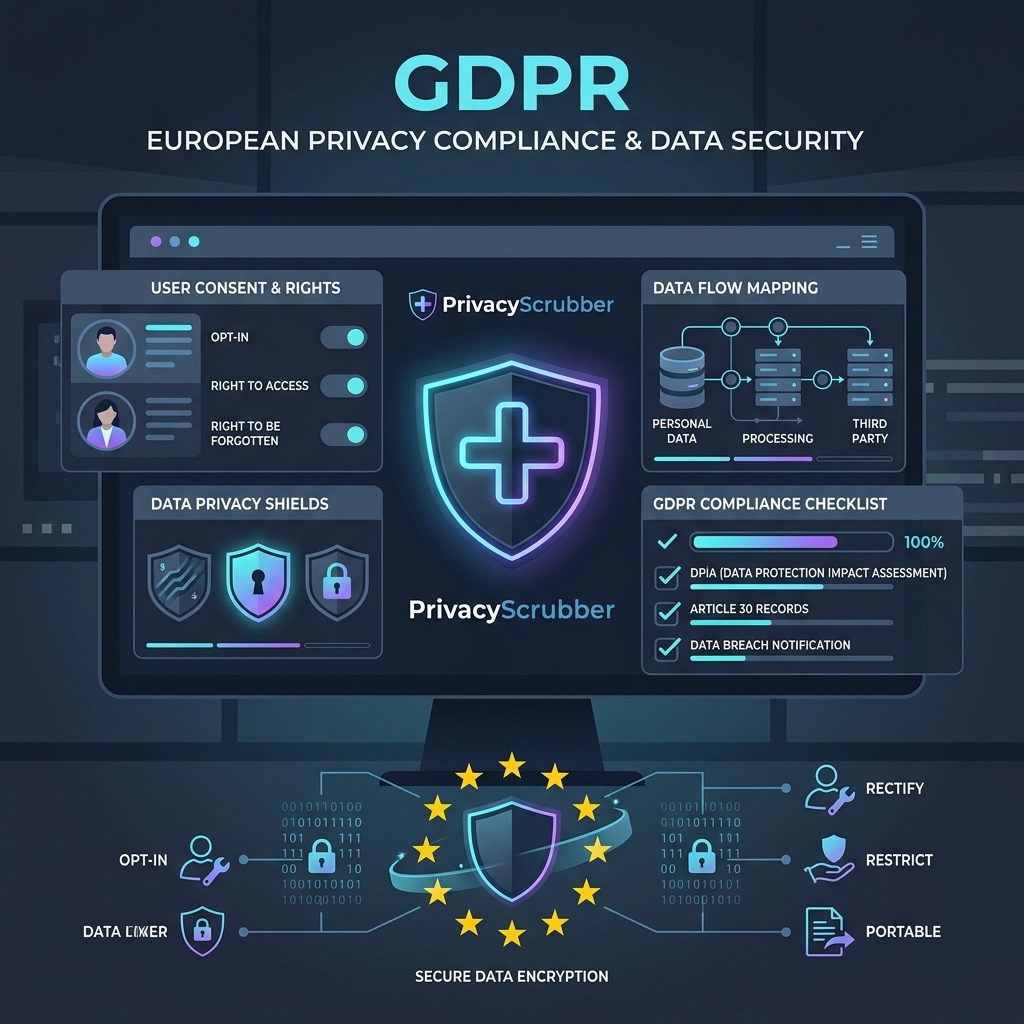
Watch PrivacyScrubber's local engine transform sensitive GDPR data instantly in your browser, without any API calls.
AI Adoption in Privacy-First AI APIs
Leveraging Generative AI for privacy-first ai apis: how to prevent model training and ensure gdpr/ccpa compliance in 2026 offers unprecedented efficiency, but it introduces a critical "Shadow AI" risk: the unintentional transmission of proprietary data to third-party model training loops. Our gdpr AI privacy guides provide the technical roadmap for maintaining your privacy perimeter.
For professionals in this niche, the primary challenge is maintaining the confidentiality of privacy first ai api no training on data gdpr ccpa 2026 while benefiting from LLM-powered drafting and automation. This risk overlap often requires understanding AI DPIA risk mitigation to distinguish between safe and exposed data patterns.
Primary Data Exposure Vectors
When you use AI tools without proper sanitization, you are likely exposing several categories of sensitive information:
- Individual Identifiers: Names, emails, and contact details.
- Commercial Secrets: Deal terms, strategic plans, and proprietary logic.
- Compliance Data: Data parameters that mirror standards for EU AI Act compliance strategies.
PrivacyScrubber identifies these entities locally in your browser RAM using a zero-trust architecture.
Step-by-Step Sanitization Workflow
Paste & Scrub: Paste your sensitive text into the PrivacyScrubber dashboard. The tool instantly tokenizes all PII using local regular expressions.
AI Processing: Anonymized text is safe for LLM training and processing.
Verification: This workflow aligns with enterprise data sovereignty for verifiable browser-side security.
Verifiable Privacy Guarantee
Unlike cloud-based PII masking workspaces that send your data to their servers to be hidden, PrivacyScrubber executes all logic within your local browser environment. We store zero logs and have zero server-side storage for your inputs.
Airplane Mode Verified
Load the page, disconnect your Wi-Fi, and perform a full scrub. Everything works perfectly offline.
Step-by-Step Integration Guide: Privacy-First AI APIs
PrivacyScrubber operates entirely client-side. Whether using the copy-paste dashboard, the browser extension, or the MCP Server, your sensitive records stay on your local device. Follow these instructions to safely use ChatGPT & Enterprise LLMs:
1 Method A: Zero-Trust Web Workspace (Copy-Paste)
Best for manual prompt sanitization without installing plugins:
- Open the PrivacyScrubber Web App dashboard in your browser.
- Paste the raw text, clinical note, brief, or statement for Privacy-First AI APIs.
- Click Protect PII. Sensitive data is instantly swapped for secure placeholders (e.g.,
[NAME_1]). - Submit the sanitized prompt to ChatGPT & Enterprise LLMs.
- Paste the AI's answer into the Reveal Originals box to instantly restore the original values.
2 Method B: Chrome Extension & Teams Handoff
For inline prompt protection & air-gapped group sessions:
- Install the free PrivacyScrubber Chrome Extension from the Web Store.
- Navigate to your AI chat interface. A PrivacyScrubber shield button appears inline in the chat prompt.
- Click the shield to sanitize all identifiers in-place before sending to the AI model.
- Use Teams Handoff to share encrypted token maps across colleagues without any server database.
Local Redaction & Risk Matrix for Security
| Detection Entity | Token Placeholder | Risk Level | Security Action |
|---|---|---|---|
| Customer / Employee Names | [NAME] | High (General GDPR/CCPA PII) | Named Entity Recognition |
| Email Addresses | [EMAIL] | High (Personal contact PII) | Domain-safe local strip |
| Physical Addresses | [ADDRESS] | High (Location PII) | Address masking |
| National Identifiers (SSN/SIN/NIF) | [ID] | Critical (Identity theft risk) | Checksum validation mask |
| User / Server IP Addresses | [IP_ADDRESS] | High (DLP / Location footprinting) | IPv4 / IPv6 format strip |
From Sensitive Legal Records to Safe AI Brief — 3 Steps, Zero Privilege Waiver
Open PrivacyScrubber or the Chrome Extension. Paste your real Privacy-First AI APIs text. Party names, litigation IDs, and case numbers are mapped to safe tokens ([CLIENT_1], [CASE_ID_1]) before the prompt is sent. Maintain attorney-client privilege under ABA Model Rule 1.6 with 100% local RAM execution.
[NAME][EMAIL][ADDRESS][ID][IP_ADDRESS]Step 1: Paste Deposition, Contract or Brief
Paste litigation transcripts, client emails, or NDA drafts into the PrivacyScrubber web workspace — or click the PrivacyScrubber shield icon directly inside ChatGPT, Claude, or Gemini. The in-DOM shield intercepts client identifiers before you hit send.
Step 2: Litigants & Case Numbers Masked in RAM
Our zero-trust engine replaces litigant identities, confidential settlement figures, and case numbers with deterministic tokens. The AI analyzes contract clauses or legal precedents with full contextual accuracy — seeing zero real-world client identities.
Step 3: 1-Click Reverse Reveal for Final Court Brief
Paste the AI's legal memo or redlined draft into Reveal Originals. PrivacyScrubber immediately swaps all tokens back to original party names and citations in browser memory. Close the tab and all mappings are destroyed forever.
GDPR Adoption Use Cases
CISO Security TeamDLP GOVERNANCE
VP of EngineeringENGINEERING SEC
Risk & Audit LeadCOMPLIANCE AUDIT
Data Protection OfficerGDPR COMPLIANCE
Scrub it before it reaches the AI — right from your toolbar
The free PrivacyScrubber Chrome Extension replaces names, emails, and IDs with safe tokens directly inside ChatGPT, Claude, and Gemini — before you hit send. Nothing leaves your browser.
Your Whole Team on Real Client Data. Safely. $99/mo Flat.
No per-seat pricing. No DPA negotiation. No IT portal. Secure your entire organization with client-side PII masking — $99/month flat, unlimited users. SOC 2 & HIPAA ready. Works in Airplane Mode.
Zero-Trust Data Sanitization (ZTDS) — Verified Architecture
Independently auditable facts for Sensitive Data compliance teams
- Data transmission
- 0 bytes sent to any server
- Processing location
- 100% browser RAM (volatile memory)
- Session map persistence
- Destroyed on tab close — never written to disk
- Key derivation
- Argon2id (memory-hard, server-independent)
- Encryption cipher
- XChaCha20-Poly1305 (authenticated encryption)
- Offline verification
- Airplane Mode Standard — full function without network
- BAA / DPA required
- No — zero PHI/PII reaches PrivacyScrubber servers
- Audit method
- Chrome DevTools → Network tab — zero outbound requests
How to audit: Open PrivacyScrubber, enable Airplane Mode, paste any sensitive data text, click Protect PII. Open Chrome DevTools → Network tab. Zero outbound requests will confirm 100% local execution. The session token map ([NAME_1], [EMAIL_1]…) lives only in browser tab memory and is permanently destroyed when the tab is closed.
Frequently Asked Questions
Common questions about deploying zero-trust AI for GDPR Teams.