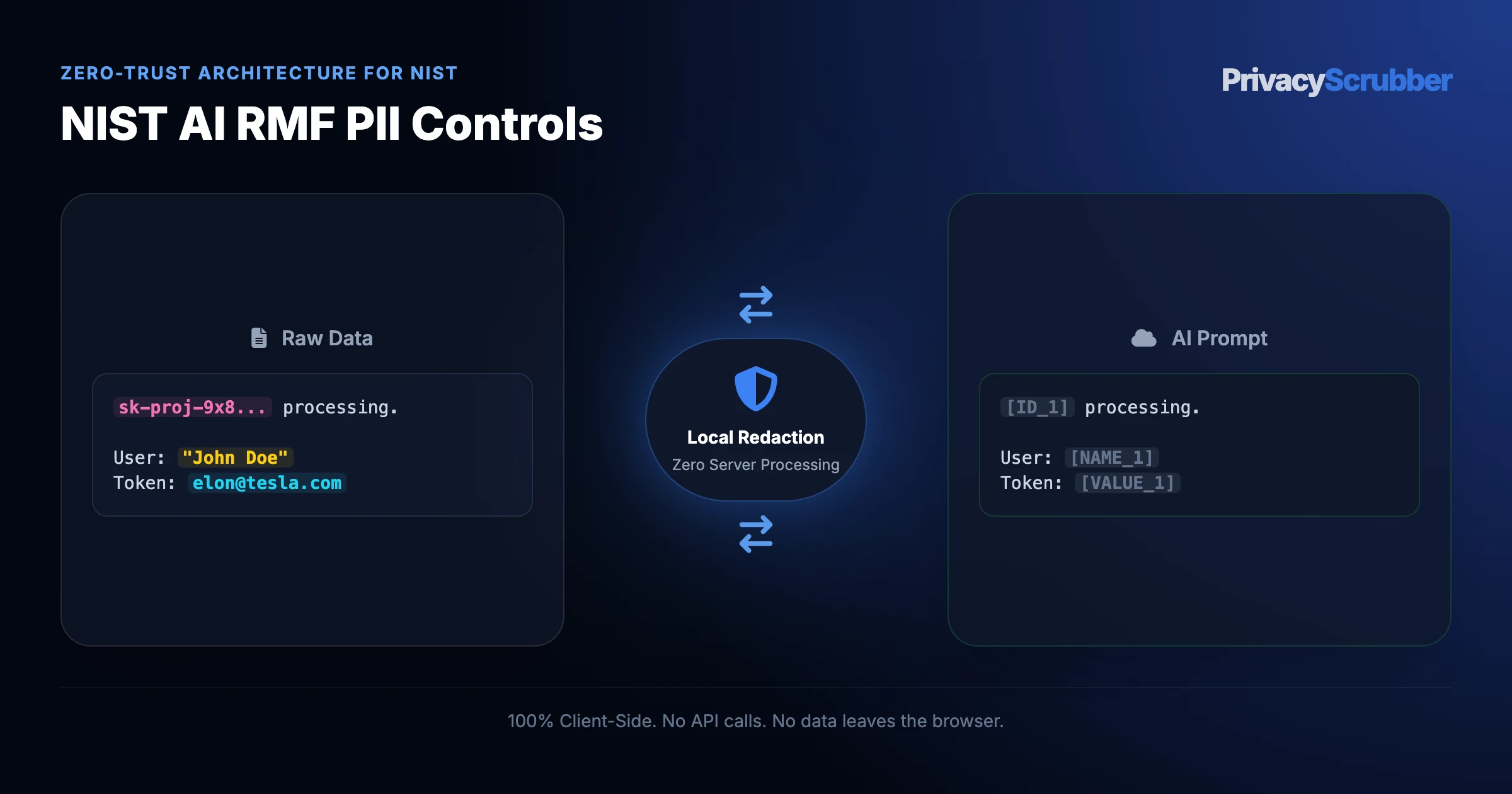
NIST AI RMF's GOVERN 1.1 requires policies for AI data inputs. Most enterprises have no technical mechanism to enforce these policies — employees paste unrestricted data into ChatGPT daily. PrivacyScrubber provides the enforcement layer that turns GOVERN policies into technical reality.
Data Leakage Risks in NIST AI RMF PII Controls for Security Compliance Teams
Keeping NIST AI RMF PII Controls off vendor telemetry starts with local browser ZTDS shield. federal CISO pair FedRAMP-authorized AI services with NIST AI privacy guides patterns to mask AI risk management framework privacy in <1ms.
Routing AI risk management framework privacy payloads across local government systems exposes federal CISO under PT-3) and NIST AI Risk Management Framework (AI RMF). Implement NIST AI Risk Management Framework controls for PII in enterprise AI systems. Redact PII locally in browser RAM with zero server egress. Converting identifiers to [ID_1] in RAM fixes root risk.
Bijective Token Flow for NIST AI RMF PII
Operating NIST AI RMF PII Controls inside local government systems exposes federal CISO to unmasked NIST AI RMF PII exposure whenever raw NIST AI RMF PII reaches external APIs. Through NIST SP 800-122 local engine, sensitive strings swap into [ID_1] locally beforehand.
Numbered tags like [ID_1] and [CLEARANCE_1] retain syntactic clarity so local government systems delivers accurate AI risk management framework privacy reasoning before 1-click restoration restores cleartext locally.
Deterministic Token Mapping for NIST AI RMF PII Controls
This field-level specification ensures NIST AI RMF PII Controls prompts retain 100% mathematical and semantic accuracy with zero cleartext PII egress:
| Data Attribute | Rule | In-Memory Output | Governance Justification |
|---|---|---|---|
| Keys & Account Codes (AI risk management framework privacy) | REDACT | [ID_1] | Stops AI risk management framework privacy credentials from entering cloud telemetry on NIST AI RMF PII Controls. |
| Internal IDs inside NIST AI RMF PII Controls | REDACT | [NAME_1] / [ID_1] | Prevents unmasked NIST AI RMF PII exposure via pre-send NIST SP 800-122 local engine substitution. |
| Private Records in NIST AI RMF PII Controls | REDACT | [CLEARANCE_1] | Replaces direct PII with [CLEARANCE_1] inside volatile client memory. |
| Numeric Totals & Ratios (AI risk management framework privacy) | PRESERVE | Cleartext ($ / %) | Enables accurate calculations across NIST AI RMF PII Controls without revealing identities. |
| Aggregation Counts & Deltas | PRESERVE | Cleartext Metrics | Supports statistical analysis of NIST AI RMF PII without linking individuals. |
| PT-3) and NIST AI Risk Management Framework (AI RMF) Clause Taxonomy | PRESERVE | Cleartext Rules | Allows models to map NIST AI RMF PII Controls findings directly against policy clauses. |
Token-Preserving AI Prompt for NIST AI RMF PII Controls
Pair this structured instruction with your tokenized NIST AI RMF PII Controls payload so ChatGPT, Claude, or Gemini preserves all bracketed surrogates for local RAM restoration:
Analyze NIST AI RMF PII Controls (AI risk management framework privacy) for federal CISO.
Surrogate markers [NAME_1] and [ID_1] replace raw fields.
1. Diagnose core issues.
2. Propose steps while leaving tags verbatim.

[INPUT SANITIZED DATA]
Analyze NIST AI RMF PII Controls (AI risk management framework privacy) for federal CISO.
Surrogate markers [NAME_1] and [ID_1] replace raw fields.
1. Diagnose core issues.
2. Propose steps while leaving tags verbatim.

[INPUT SANITIZED DATA]
Audit Readiness Across NIST AI RMF PII Controls Workstations
Eliminating third-party processor exposure on NIST AI RMF PII Controls matches NIST AI rmf safeguards and keeps AI risk management framework privacy compliant with PT-3) and NIST AI Risk Management Framework (AI RMF).
Local Tokenization Architecture: NIST AI RMF PII Controls
Client-side NIST SP 800-122 local engine preserves multi-turn clarity on NIST AI RMF PII Controls without leaking AI risk management framework privacy, applying naic compliance for generative AI usage bijective lookups locally.
Enable Airplane Mode and mask NIST AI RMF PII inside NIST AI RMF PII Controls; all [CLEARANCE_1] swaps finish in RAM per screenplay AI privacy.