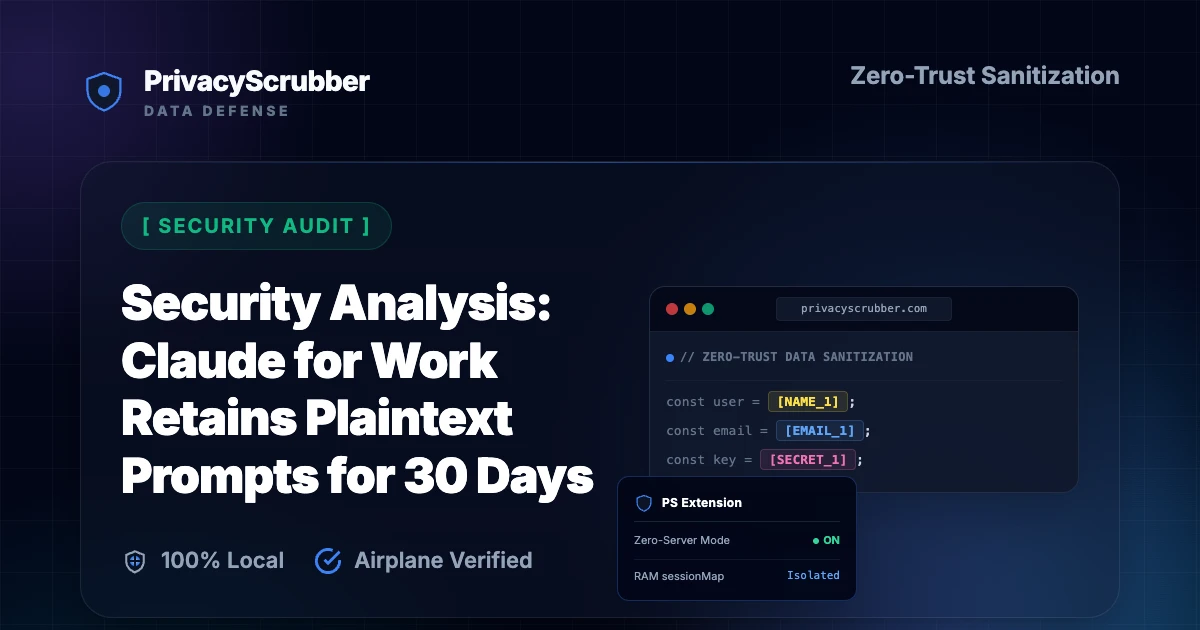
Security Analysis: Claude for Work Retains Plaintext Prompts for 30 Days
Security Analysis: A news analysis of Anthropic's Claude for Work data policies. Details the 30-day compliance logs that cache raw prompts in the cloud, triggering CISO concern.

The Claude for Work Enterprise Dilemma
Anthropic's release of the "Claude for Work" plan was marketed as the ultimate compliance layer for enterprise teams. However, security teams must configure an independent AI Security Perimeter to enforce data governance guidelines at the workstation level.
Independent security audits have highlighted a major loophole: The 30-Day Abuse Monitoring Log. Prompt inputs are cached in plaintext on AWS servers for up to 30 days. This mirrors the database telemetry leak detailed in the Corporate ChatGPT Bans Surge, showing that data caches remain a primary target for exfiltration.
Retention Window Exposes Privileged Data
For legal, HR, and financial departments, the storage of plaintext data—even for 30 days—presents an unacceptable risk. If a researcher pastes attorney-client privileged documents, those logs remain in a third-party cloud. This retention risk can immediately compromise audits under SOC 2 Confidentiality Guidelines, violating key trust controls.
If Anthropic's log storage is compromised, the data is exposed. This retention window is why enterprise security teams are still enforcing Claude bans despite training opt-outs.
Local Sanitization Neutralizes Retention Risks
Firms are solving this retention risk by implementing client-side obfuscation. Developers can debug scripts safely by deploying Local Server Log Sanitizers to strip connection strings before they leave the terminal.
By integrating PrivacyScrubber into the workflow, PII and proprietary metrics are tokenized locally in browser RAM with 0ms network latency. Claude's servers only receive and log anonymous placeholders (e.g., [EMAIL_1]). Once the reply is generated, PrivacyScrubber restores the original identities locally in the browser. Anthropic's 30-day logs contain nothing but useless tags, securing the enterprise against server-side compromise.
Direct Failure: ZTDS™ Invariant 1 (Zero External Egress) & Invariant 4 (Continuous Compliance & Zero Subprocessor Chain)
Transmitting sensitive enterprise records through third-party cloud proxies or LLM gateways creates an insecure subprocessor chain under GDPR Article 28 and HIPAA. The Zero-Trust Data Sanitization (ZTDS™) standard eliminates subprocessor liability by sanitizing payloads 100% locally in volatile RAM before network transmission.
Step-by-Step Integration Guide: Security Analysis
PrivacyScrubber operates entirely client-side. Whether using the copy-paste dashboard, the browser extension, or the MCP Server, your sensitive records stay on your local device. Follow these instructions to safely use Claude (Anthropic):
1 Method A: Zero-Trust Web Workspace (Copy-Paste)
Best for manual prompt sanitization without installing plugins:
- Open the PrivacyScrubber Web App dashboard in your browser.
- Paste the raw prompt or text containing sensitive details of Security Analysis.
- Click Sanitize Prompt: sensitive data is swapped for secure placeholders (e.g.,
[NAME_1]). - Submit the sanitized prompt to Claude (Anthropic).
- Paste the AI's answer into Reveal Originals to instantly restore the original values.
2 Method B: Chrome Extension (In-Context Redaction)
For automated, inline de-identification within chat interfaces:
- Install the free PrivacyScrubber Chrome Extension from the Web Store.
- Navigate to your AI chat interface. A PrivacyScrubber shield button will appear inline.
- Paste your raw prompt. Click the shield button to sanitize all identifiers instantly in-place.
- Send the prompt to the AI chatbot.
- The extension automatically intercepts and detokenizes the response, displaying raw values to you.
Local Redaction & Risk Matrix for Security
| Detection Entity | Token Placeholder | Risk Level | Security Action |
|---|---|---|---|
| User / Server IP Addresses | [IP_ADDRESS] | High (DLP / Location footprinting) | IPv4 / IPv6 format strip |
| AWS_KEY Details | [AWS_KEY] | Medium (PII Exposure) | Deterministic local swap |
| INTERNAL_HOSTNAME Details | [INTERNAL_HOSTNAME] | Medium (PII Exposure) | Deterministic local swap |
| MAC_ADDRESS Details | [MAC_ADDRESS] | Medium (PII Exposure) | Deterministic local swap |
| VULN_ID Details | [VULN_ID] | Medium (PII Exposure) | Deterministic local swap |
3-Step Zero-Trust AI Workflow Template
Role: Database Administrator / API Security Lead · Target: Claude (Anthropic)Act as a senior database administrator. Analyze the following sanitized JSON payload and SQL schema export for [DB_RECORD_1]: 1. Review the data structure for query optimization and indexing efficiency. 2. Generate refactored SQL queries with optimized JOIN operations. 3. Ensure output adheres strictly to standard schema syntax. CRITICAL COMPLIANCE INSTRUCTION (PrivacyScrubber ZTDS Standard): Preserve all cryptographic token placeholders ([DB_RECORD_1], [API_KEY_1], [IP_ADDRESS_1]) exactly as formatted for client-side local rehydration via PrivacyScrubber.
[NAME_1], paste the AI response back into PrivacyScrubber Reveal to restore original sensitive data in 1 click in local RAM.Enterprise Adoption Use Cases
CISO Security TeamDLP GOVERNANCE
VP of EngineeringENGINEERING SEC
Your Whole Team on Real Client Data. Safely. $99/mo Flat.
No per-seat pricing. No DPA negotiation. No IT portal. Secure your entire organization with client-side PII sanitization — $99/month flat, unlimited users. SOC 2 & HIPAA ready. Works in Airplane Mode.
Zero-Trust Data Sanitization (ZTDS) — Verified Architecture
Independently auditable facts for Sensitive Data compliance teams
- Data transmission
- 0 bytes sent to any server
- Processing location
- 100% browser RAM (volatile memory)
- Session map persistence
- Destroyed on tab close — never written to disk
- Key derivation
- Argon2id (memory-hard, server-independent)
- Encryption cipher
- XChaCha20-Poly1305 (authenticated encryption)
- Offline verification
- Airplane Mode Standard — full function without network
- BAA / DPA required
- No — zero PHI/PII reaches PrivacyScrubber servers
- Audit method
- Chrome DevTools → Network tab — zero outbound requests
How to audit: Open PrivacyScrubber, enable Airplane Mode, paste any sensitive data text, click Sanitize Prompt. Open Chrome DevTools → Network tab. Zero outbound requests will confirm 100% local execution. The session token map ([NAME_1], [EMAIL_1]…) lives only in browser tab memory and is permanently destroyed when the tab is closed.
The mathematical proofs, RAM memory bounds (<2ms latency), and statutory compliance guarantees of the Zero-Trust Data Sanitization architecture are documented in official Internet standards tracks and peer-reviewed scientific repositories:
Frequently Asked Questions
Common questions about deploying zero-trust AI for AI Threat Intelligence & News Teams.