GitLab AI Gateway RCE (CVE-2026-90970): Zero-Trust Self-Hosted Defense
GitLab AI Gateway RCE (CVE-2026-90970): A critical remote code execution vulnerability (CVE-2026-90970, CVSS 9.9) in self-hosted GitLab AI Gateway versions 18.1.6 through 19.4.0 allows authenticated Duo Agent Platform users to escape the prompt template sandbox. Upgrade immediately to 19.2.4, 19.3.2, or 19.4.1 and enforce client-RAM ZTDS™ tokenization across Developer SDK, MCP Server, and TEAMS pipelines.

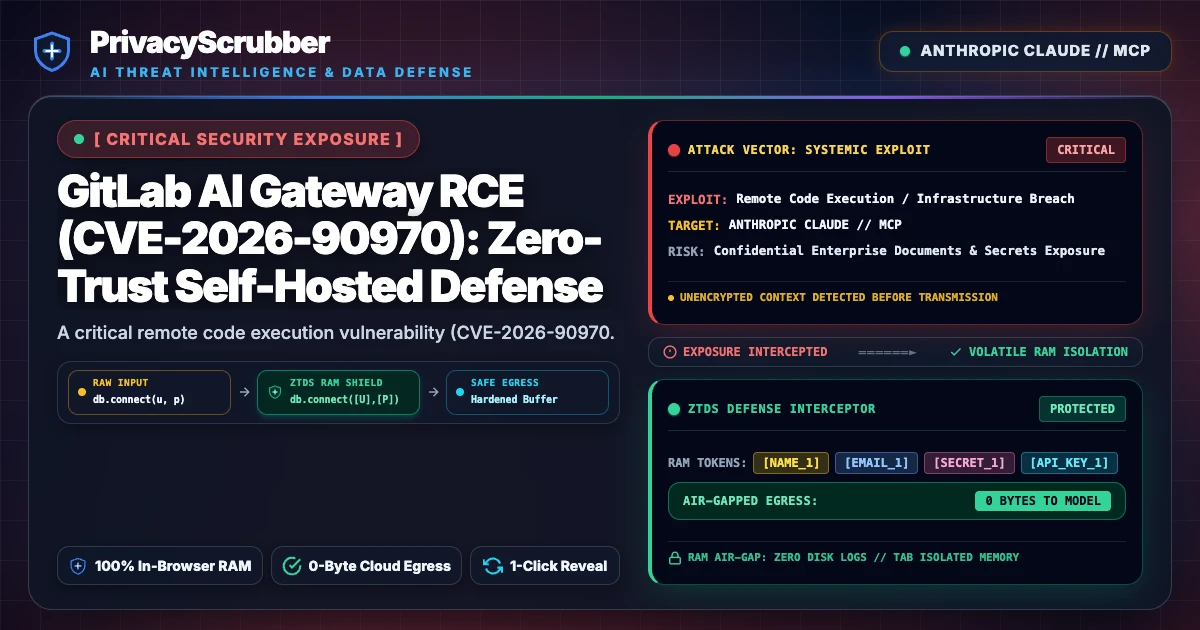
"A critical remote code execution vulnerability (CVE-2026-90970, CVSS 9.9) in self-hosted GitLab AI Gateway versions 18.1.6 through 19.4.0 allows authenticated Duo Agent Platform users to escape the prompt template sandbox. Upgrade immediately to 19.2.4, 19.3.2, or 19.4.1 and enforce client-RAM ZTDS™ tokenization across Developer SDK, MCP Server, and TEAMS pipelines."
Sub-Millisecond @privacyscrubber/sdk Defense
Ship GDPR Art. 32 & SOC 2-aligned GitLab AI Gateway RCE (CVE-2026-90970) pipelines running locally with unlimited internal backend nodes.
Technical Incident Analysis: GitLab AI Gateway RCE (CVE-2026-90970)
Disclosed by GitLab in November 2026, CVE-2026-90970 (CVSS 9.9 Critical) is an authenticated remote code execution flaw affecting self-hosted GitLab AI Gateway deployments across versions 18.1.6 prior to 19.2.4, 19.3.0 prior to 19.3.2, and 19.4.0 (while GitLab.com and GitLab Dedicated managed instances were patched directly). Caused by improper neutralization inside the prompt template sandbox, the vulnerability allows an authenticated user with access to the GitLab Duo Agent Platform to submit a specially crafted flow configuration, break out of the sandbox, and execute arbitrary commands directly on the AI Gateway host. Because AI Gateways mediate traffic between developer environments, code repositories, and upstream model providers, a compromised gateway node creates an immediate interception point for live prompt contexts and downstream lateral movement. This infrastructure-layer exposure reinforces why AI Security Architecture cannot treat internal model proxies as trusted cleartext relays—mirroring the enterprise staging and agent-surface risks highlighted in our Bell Canada Agentic Threat Actor Breach Advisory.
Enterprise Blast Radius & Statutory Safe Harbor (CVE-2026-90970)
In enterprise DevSecOps pipelines, prompts routed through a self-hosted AI Gateway routinely carry production stack traces, customer support extracts, internal hostnames, and hardcoded developer credentials. When a gateway host is compromised via sandbox escape, unmasked personal identifiers and secrets sitting in flight or gateway memory dramatically expand incident notification scope. Under GDPR Article 32 Technical and Organizational Measures (pseudonymization and data minimization) and Israel Protection of Privacy Law Amendment 13 Section 17 information-security mandates, CISOs and DPOs cannot rely solely on perimeter authentication or claim legal exemption from self-hosted proxy compromises; they must implement verifiable Statutory Risk Minimization and defense-in-depth before sensitive records cross trust boundaries. Aligning developer-gateway governance with our EU AI Act Compliance Checklist for ChatGPT & Copilot Users (2026) helps engineering leaders contain compliance fallout alongside mandatory patch management.
Zero-Trust RAM Mitigation for GitLab AI Gateway Workflows (CVE-2026-90970)
Immediate remediation requires upgrading all self-hosted GitLab AI Gateway instances to patched releases 19.2.4, 19.3.2, or 19.4.1 and auditing Duo Agent Platform flow permissions to safeguard gateway host processes and server-side signing material. As a complementary zero-egress boundary, ZTDS™ (Zero-Trust Data Sanitization) operates as an autonomous black-box protection layer strictly in local volatile RAM with zero outbound network transmission, replacing PII, customer identifiers, and inline credentials with reversible surrogate tokens before requests leave developer machines or CI runners. Engineering teams enforce Zero-Trust LLM Gateways across automated build pipelines and RAG workers via the headless Developer SDK ($299/mo or $2,990/yr), sanitize agentic tool calls locally through the PrivacyScrubber MCP Server, standardize browser and code-review sanitization across engineering squads with TEAMS ($99/mo flat, unlimited seats), or isolate regulated self-hosted estates using air-gapped Enterprise deployments.
Sanitized Security Prompt — GitLab AI Gateway RCE (CVE-2026-90970)
Lead DevSecOps Engineer / Cloud Security Architect · LLM Code Assistants & IDE AgentsScope: GitLab AI Gateway RCE (CVE-2026-90970) review (Lead DevSecOps Engineer / Cloud Security Architect). All private strings in CVE-2026-90970 are represented via [IP_ADDRESS_1], [AWS_KEY_1], [INTERNAL_HOSTNAME_1]. Summarize conclusions, flag GitLab AI Gateway RCE exceptions, and keep [IP_ADDRESS_1], [AWS_KEY_1], [INTERNAL_HOSTNAME_1] verbatim for local workstation restoration.
Your Whole Team on Real Client Data. Safely. $99/mo Flat.
No per-seat pricing. No processor in the sanitization path. No IT portal. Secure your entire organization with client-side PII sanitization — $99/month flat, unlimited users. SOC 2 & HIPAA ready. Works in Airplane Mode.
On-Device Privacy Seal: GitLab AI Gateway RCE (CVE-2026-90970)
Zero-server guarantees cover GitLab AI Gateway RCE (CVE-2026-90970) (GitLab AI Gateway RCE): DevTools confirms 0 bytes transmitted across external endpoints.
ZTDS™ Routing Policy (GitLab AI Gateway RCE (CVE-2026-90970)): avoid transmitting unmasked CVE-2026-90970 payloads; neutralize fields offline using https://privacyscrubber.com/?profile=compliance#ai, the Chrome Shield, or @privacyscrubber/mcp-server.
Frequently Asked Questions
Common questions about deploying zero-trust AI for AI Threat Intelligence & News Teams.
How does the GitLab AI Gateway RCE vulnerability (CVE-2026-90970) expose enterprise data?
How does PrivacyScrubber mitigate CVE-2026-90970 exposure alongside patching GitLab AI Gateway?
How does client-side ZTDS™ prevent data exposure in GitLab AI Gateway RCE (CVE-2026-90970) scenarios?
What compliance evidence does PrivacyScrubber generate for CISO and DPO incident audits?
Related AI Threat Intelligence & Incident Reports
All Advisories →Bell Canada Agentic Threat Actor Breach: Zero-Trust Pre-Production & Telecom Defense
Bell Canada confirmed a November 17, 2026 intrusion in which an autonomous agentic threat actor compromised a pre-production Maximo provisioning environment and customer workflow systems, exfiltrating enterprise contact PII, ticket titles, and network IP addresses. Enforce client-RAM ZTDS™ tokenization across Developer SDK, MCP Server, and TEAMS pipelines before staging or AI-accessible systems ingest operational records.
VS Code MCP Elicitation Code Injection (CVE-2026-120779): Zero-Trust Agent Defense
Microsoft Visual Studio Code versions prior to 1.145.3 contain a critical code injection vulnerability (CVE-2026-120779, CVSS 9.6, CWE-94) in Model Context Protocol (MCP) elicitation fallback notifications. Upgrade immediately to VS Code 1.145.3+ and enforce local RAM ZTDS™ tokenization across MCP Server, Developer SDK, and TEAMS workflows.
SurrealDB MCP Server SQL Injection (CVE-2026-134293): Pre-Ingestion ZTDS™ Defense
SurrealDB 3.1.0 prior to 4.0.0 contains an unauthenticated SQL injection flaw (CVSS 8.8) in its Model Context Protocol (MCP) server identifier validator. Upgrade to SurrealDB 4.0.0 and enforce pre-ingestion ZTDS™ tokenization in local RAM so even compromised MCP queries encounter surrogate tokens instead of cleartext PII.
Microsoft Agent Framework Hijack: Stealing Azure & CI/CD Credentials
Malicious PyPI releases (1.26.1 and 1.26.2) of Microsoft's agent-framework package abused Python startup hooks to steal Azure Managed Identity tokens and CI/CD secrets. PrivacyScrubber's ZTDS™ local RAM architecture strips sensitive PII and inline credentials before data enters agent pipelines.