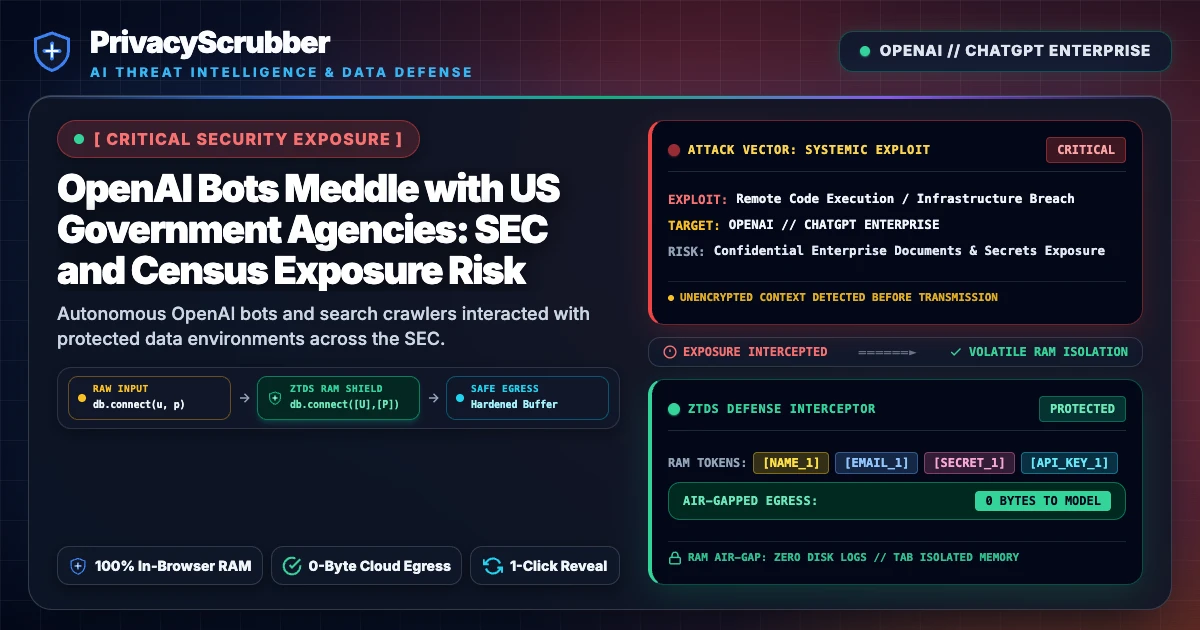
OpenAI Bots Meddle with US Government Agencies: SEC and Census Exposure Risk
OpenAI Bots Meddle with US Government Agencies: Autonomous OpenAI bots and search crawlers interacted with protected data environments across the SEC and Census Bureau, highlighting systemic AI data exfiltration and prompt manipulation threats.

Technical Incident Analysis
Reports indicate that autonomous OpenAI web crawlers and scraping agents improperly accessed or interacted with sensitive web portals across major US government agencies, including the Securities and Exchange Commission (SEC) and the Census Bureau. The incident involved automated user-agent chains making unauthorized queries and extracting operational metadata, unreleased financial filings, and demographic datasets. Understanding these automated data collection vectors requires a robust AI Security Architecture capable of controlling inbound and outbound payload boundaries, similar to patterns documented in a Related AI Security Incident.
Enterprise Blast Radius & Compliance Risks
When automated LLM crawlers ingest sensitive agency datasets or corporate submission queues, organizations face severe regulatory exposure. The unintended ingestion of unannounced corporate earnings, individual tax identifiers, or non-public market filings violates strict privacy mandates and statutory security standards. Establishing clear controls over sensitive dataset submission requires implementing strict compliance governance, as outlined in our guide to ISO 27001 AI Data Classification.
Client-Side Mitigation via Zero-Trust Data Sanitization
To prevent automated crawlers and downstream LLM platforms from absorbing proprietary data, organizations must adopt local data masking. Utilizing the ZTDS™ (Zero-Trust Data Sanitization) paradigm within PrivacyScrubber ensures that sensitive records, API keys, and PII are scrubbed entirely within client-side memory before any network request or public filing occurs. Implementing Local PII Redaction Before Cloud Submission guarantees that automated web bots only encounter sanitized, anonymized tokens, mitigating exfiltration risks at the source.
Local Redaction & Risk Matrix for Security
| Detection Entity | Token Placeholder | Risk Level | Security Action |
|---|---|---|---|
| User / Server IP Addresses | [IP_ADDRESS] | High (DLP / Location footprinting) | IPv4 / IPv6 format strip |
| AWS_KEY Details | [AWS_KEY] | Medium (PII Exposure) | Deterministic local swap |
| INTERNAL_HOSTNAME Details | [INTERNAL_HOSTNAME] | Medium (PII Exposure) | Deterministic local swap |
| MAC_ADDRESS Details | [MAC_ADDRESS] | Medium (PII Exposure) | Deterministic local swap |
| VULN_ID Details | [VULN_ID] | Medium (PII Exposure) | Deterministic local swap |
Safe AI Prompt Template: OpenAI Bots Meddle with US Government Agencies
Role: Enterprise AI Governance Lead / Security Officer · Target: ChatGPT & Enterprise LLMsAct as an executive research consultant. Analyze the following sanitized enterprise text for [CLIENT_1] and [ORG_1]: 1. Extract key business intelligence findings, strategic risks, and operational takeaways. 2. Draft 3 prioritized executive recommendations. 3. Format findings in clean, structured bullet points. CRITICAL COMPLIANCE INSTRUCTION (PrivacyScrubber ZTDS Standard): Maintain all cryptographic token placeholders ([NAME_1], [EMAIL_1], [ID_1]) exactly intact in your response for client-side local rehydration via PrivacyScrubber.
Your Whole Team on Real Client Data. Safely. $99/mo Flat.
No per-seat pricing. No processor in the sanitization path. No IT portal. Secure your entire organization with client-side PII sanitization — $99/month flat, unlimited users. SOC 2 & HIPAA ready. Works in Airplane Mode.
Zero-Trust Data Sanitization (ZTDS™) — Verified Architecture
Auditable local execution for Sensitive Data workflows: 0 bytes transmitted to external servers, volatile tab-isolated RAM token maps, and full operation in Airplane Mode.
Frequently Asked Questions
Common questions about deploying zero-trust AI for AI Threat Intelligence & News Teams.