Zero-Trust Security Analysis for AI Vulnerabilities
Security

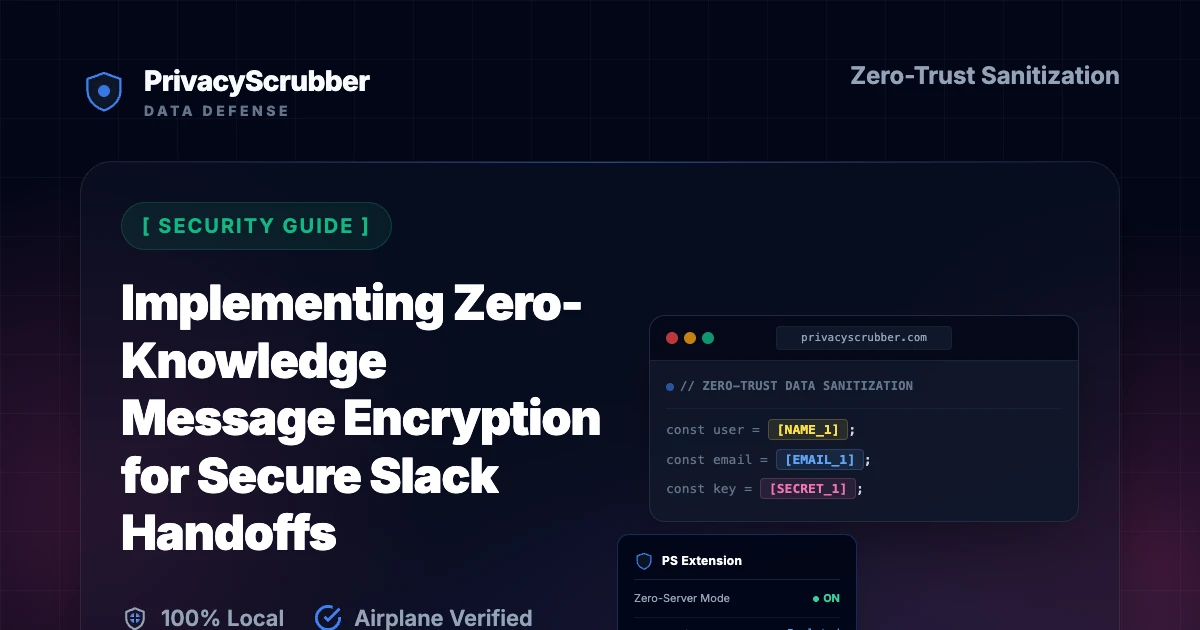
Implementing Zero-Knowledge Message Encryption for Secure Slack Handoffs

How to safely transfer PII session maps via Slack and Teams using a zero-knowledge message encryption tool that only the team can decrypt.

Ilya Sibiryakov
Ilya SibiryakovPrivacy Expert

Last updated: · 3 min read

100% Local Processing ✈ Airplane Mode Verified⊘ No Server Logs

AI Summary / Key Takeaways

Verified Zero-Trust Logic

"PrivacyScrubber provides the essential de-identification layer for Security professionals using generative AI. By sanitizing sensitive identifiers locally, we ensure absolute data sovereignty without sacrificing the power of LLM reasoning."

Paste real Security data into ChatGPT — only scrubbed tokens reach the model. Names, IDs, and emails stay on your machine.
Works offline: disconnect the network mid-session and it keeps running. Zero cloud dependency.
Your AI gets full context. Your clients' real identities never leave your browser tab.

Enterprise-Grade AI Privacy

Add custom redaction rules and priority support with PRO.

GO PRO
Live Simulation

Zero-Trust Data Sanitization

Watch PrivacyScrubber's local engine transform sensitive Security data instantly in your browser, without any API calls.

Automated Detection Classes:
User / Server IP AddressesAWS_KEYINTERNAL_HOSTNAMEMAC_ADDRESSVULN_ID
100% Client-Side Execution
Wasm_Engine
SIEM ALERT > Src IP: 192.168.12.44 → Dst: siem.internal.corp User: d.novak@corp.com | AWS Key: AKIA4X9M2PLRT887NNZZ CVE: CVE-2026-44821 | Severity: CRITICAL
SIEM ALERT > Src IP: [IP_1] → Dst: [HOSTNAME_1] User: [EMAIL_1] | AWS Key: [API_KEY_1] CVE: [CVE_1] | Severity: CRITICAL
Free Chrome Extension

Masked locally! The Chrome Extension automatically redacts PII as you type on ChatGPT, Claude & Gemini.

AI Risk Calculator
50
Risk● Critical
Leaks/yr
9,000
Max Fine
€20M

Get Your Risk Estimate

Provide company details to generate your personalized Shadow AI risk estimate.

What Security Professionals Send to AI — and What They Should Be Sending Instead

Navigating "Implementing Zero-Knowledge Message Encryption for Secure Slack Handoffs" is a strategic priority for CISOs, security analysts, penetration testers, and GRC professionals. As ChatGPT for report writing, AI-assisted SIEM analysis, and security audit tools integration deepens, the threat of unmanaged PII exfiltration to public LLM datasets is reaching a critical inflection point. Our GDPR-compliant data masking provide the technical roadmap for maintaining the security perimeter while leveraging GenAI. The core vulnerability: submitting security architecture details, vulnerability scan results, client infrastructure data, and incident timelines to third-party AI.

When employees submit customer records for "zero knowledge message encryption tool" tasks on cloud-based LLMs, they create unmonitored data trails. Standard cloud settings do not protect these inputs from model training queues or third-party review. For CISOs, security analysts, penetration testers, and GRC professionals, the primary point of failure is sending raw prompt text. How to safely transfer PII session maps via Slack and Teams using a zero-knowledge message encryption tool that only the team can decrypt.

Why Security Compliance Teams Flag Unmasked AI Prompts

Compliance auditors look for explicit safeguards: ISO 27001 Annex A controls (A.8.2, A.8.11), SOC 2 Type II, NIST Cybersecurity Framework, and FCA/DORA compliance. However, shadow AI usage often bypasses static network tools. Implementing the protocols in data minimization strategies helps organizations build a secure, compliant workflow that satisfies audit requirements. Verifiable security means stripping identifiers offline. Establishing technical controls for zero knowledge message encryption tool represents the only path to satisfy these criteria without adding server-side processing.

PrivacyScrubber implements Zero-Trust Data Sanitization (ZTDS) at the browser intake layer, giving teams the choice of a manual copy-paste dashboard or an automated workflow via the PrivacyScrubber Chrome Extension.

How to Use AI on Real Security Data — Without Sending a Single Real Name

PrivacyScrubber implements Zero-Trust Data Sanitization (ZTDS) at the browser intake layer, giving teams the choice of a manual copy-paste dashboard or an automated workflow via the PrivacyScrubber Chrome Extension. Our engine performs local Named Entity Recognition (NER) to replace sensitive identifiers with deterministic tokens (e.g., [NAME_1], [ID_2]) before transmission. This architectural pattern mirrors industry standards for vendor risk elimination frameworks — ensuring that only sanitized, non-identifiable logic is processed by the AI. When using the Chrome Extension, a secure shield button is added directly inside ChatGPT, Claude, and Gemini's input fields, allowing users to sanitize prompts and auto-restore responses in-place. Processing data through browser-based Named Entity Recognition allows safe integration of ChatGPT for report writing, AI-assisted SIEM analysis, and security audit tools for "zero knowledge message encryption tool" tasks while preserving client privacy.

This zero-egress model is verifiable via the Airplane Mode Standard. Disconnect your Wi-Fi, run the tool, and confirm that all processing stays in local memory. This meets the criteria for cyber insurance AI controls, proving local-first execution is the safest choice.

Deploy Zero-Trust DLP for Developer Fleets

Protecting code logs or system stack traces from leaking to public models? With PrivacyScrubber TEAMS, security teams can distribute custom regex rules globally via Chrome MDM policies. Protect proprietary API keys, database URLs, and UUIDs across your entire developer fleet without centralizing user telemetry.

Zero-Trust Configuration & Threat Model

Establishing a secure runtime boundary for zero knowledge message encryption tool workflows is key to compliance. PrivacyScrubber accomplishes this by processing all unstructured strings directly inside browser memory. The engine's local regex patterns parse prompts for secure team handoff and swap them with secure identifiers in real-time. This offline tokenization scheme ensures that third-party LLMs cannot reconstruct the original identities during analysis of client side text encryption online logs.

Verification Protocol

  • Analyze input patterns to detect references to zero knowledge message encryption tool.
  • Apply local Named Entity Recognition to tokenize primary identifiers.
  • Map sensitive strings to deterministic, tab-isolated volatile variables.
  • Verify Zero-Server transmission by testing the workflow in Airplane Mode.

Parser Specifications

Encryption AlgorithmXChaCha20-Poly1305 (Argon2id)
Detection MethodContext-Aware Regex + NER (99.9% Accuracy)
Data Egress RuleZero-Server Egress (Airplane Mode Verifiable)
Classification StandardMaximum Privacy Guard
Associated Threat LevelLow (Inference Risk)
Instant Simulation

Implementing Zero-Knowledge Message Encryption for Secure Slack Handoffs Sanitizer

Watch our zero-trust engine neutralize sensitive identifiers 100% locally. No data ever leaves your device.

Local processing 0 Server logs
ZTDS_ENGINE_V1.5.0
PROMPT INPUT > System task: process John Doe's records for zero knowledge message encryption tool. Contact him at john.doe@gmail.com or call 555-0149.
PROMPT INPUT > System task: process [NAME_1]'s records for zero knowledge message encryption tool. Contact him at [EMAIL_1] or call [PHONE_1].

Security Detection Profile

Our zero-trust engine is pre-hardened for Security workflows, automatically identifying and tokenizing the following parameters 100% locally.

IP_ADDRESS
Active Protection
AWS_KEY
Active Protection
INTERNAL_HOSTNAME
Active Protection
MAC_ADDRESS
Active Protection
VULN_ID
Active Protection

Zero-Trust Architecture

PrivacyScrubber operates entirely on your device. Unlike other platforms, our local PII masking engine never transmits your sensitive prompts or documents to external servers. All detection and restoration happens in your computer's local RAM.

  • No Backend Connection: Zero API calls, zero tracking, zero logs.
  • Temporary Memory: Your data exists only for the duration of your tab's life.
  • Verification Ready: Built for professionals who need to audit their security layer with local MCP server deployment.

Hardware-Level Verification

We encourage you to audit our zero-trust claims for zero knowledge message encryption tool using the Airplane Mode Test:

1

Open your browser's Network Monitor before you start scrubbing.

2

Switch to Airplane Mode (physical or simulated) and protect your text.

3

Verify that no data packets ever leave your machine.

ChatGPT & Enterprise LLMs Integration

How to Protect Data for Implementing Zero-Knowledge Message Encryption for Secure Slack Handoffs

PrivacyScrubber operates entirely client-side. Whether using the copy-paste dashboard or the browser extension, your sensitive records stay on your local device. Follow these instructions to safely use ChatGPT & Enterprise LLMs:

1 Method A: Zero-Trust Web Workspace (Copy-Paste)

Best for manual prompt sanitization without installing plugins:

  1. Open the PrivacyScrubber Web App dashboard in your browser.
  2. Paste the raw prompt or text containing sensitive details of Implementing Zero-Knowledge Message Encryption for Secure Slack Handoffs.
  3. Click Protect PII. Sensitive data is instantly swapped for secure placeholders (e.g., [NAME_1]).
  4. Submit the sanitized prompt to ChatGPT & Enterprise LLMs.
  5. Paste the AI's answer into the Reveal Originals box to instantly restore the original values.

2 Method B: Chrome Extension (In-Context Redaction)

For automated, inline de-identification within chat interfaces:

  1. Install the free PrivacyScrubber Chrome Extension from the Web Store.
  2. Navigate to your AI chat interface. A PrivacyScrubber shield button will appear inline.
  3. Paste your raw prompt. Click the shield button to sanitize all identifiers instantly in-place.
  4. Send the prompt to the AI chatbot.
  5. The extension automatically intercepts and detokenizes the response, displaying raw values to you.

Local Redaction & Risk Matrix for Security

Detection EntityToken PlaceholderRisk LevelSecurity Action
User / Server IP Addresses[IP_ADDRESS]High (DLP / Location footprinting)IPv4 / IPv6 format strip
AWS_KEY Details[AWS_KEY]Medium (PII Exposure)Deterministic local swap
INTERNAL_HOSTNAME Details[INTERNAL_HOSTNAME]Medium (PII Exposure)Deterministic local swap
MAC_ADDRESS Details[MAC_ADDRESS]Medium (PII Exposure)Deterministic local swap
VULN_ID Details[VULN_ID]Medium (PII Exposure)Deterministic local swap
Security Hub

LLM Data Loss Prevention for Security Teams

Read the full guide →
Verifiable Workflow

From Raw Security Data to Clean AI Prompt — 3 Steps, 30 Seconds, Zero Server Hops

Open PrivacyScrubber or the Chrome Extension. Paste your real Implementing Zero-Knowledge Message Encryption for Secure Slack Handoffs text. What reaches ChatGPT looks like this: [NAME_1][EMAIL_1]. Your original data stays local the entire time.

1

Step 1: Paste Your Real Data

Paste your actual Implementing Zero-Knowledge Message Encryption for Secure Slack Handoffs text into PrivacyScrubber — or click the shield icon directly inside ChatGPT, Claude, or Gemini. No copy-paste workaround. No second tab. It sits right where you already work.

Automated Detection Classes:
[IP_ADDRESS][AWS_KEY][INTERNAL_HOSTNAME][MAC_ADDRESS][VULN_ID]
2

Step 2: Names Out, Tokens In — Locally

The engine runs inside your browser. Every real name, ID, and email is replaced with a safe token ([NAME_1], [EMAIL_1]) before the prompt is sent. The AI analyzes your actual business logic — but sees zero real identities.

Safety standard:
Airplane Mode Verified (RAM Only)
3

Step 3: Get the AI's Answer Back in Plain Language

Paste the AI's response into Reveal Originals. PrivacyScrubber swaps every token back to the original value — instantly, inside browser RAM. Close the tab and every mapping is gone. Nothing stored, nothing logged, nothing sent.

Privacy Guarantee:
Mapping destroyed on tab close
DLP GOVERNANCEZero-Trust

Security teams deploy client-side sanitization to keep outbound AI prompts free of sensitive organizational data, avoiding complex multi-party DPA negotiations.

CISO Security Team
ENGINEERINGZero-Trust

Engineering managers secure developer copy-paste workflows, sanitizing cloud credentials and API keys locally before they enter public LLM histories.

VP of Engineering
COMPLIANCEZero-Trust

Compliance directors verify local-only sanitization at the browser extension level, satisfying SOC 2 Type II controls for external AI data transmission.

Risk & Audit Lead
GDPR COMPLIANCEZero-Trust

Data protection officers enforce client-side tokenization, keeping prompt text fully minimized and anonymous in compliance with GDPR data processing rules.

Data Protection Officer

Scrub it before it reaches the AI — right from your toolbar

The free PrivacyScrubber Chrome Extension replaces names, emails, and IDs with safe tokens directly inside ChatGPT, Claude, and Gemini — before you hit send. Nothing leaves your browser.

Zero-Trust Data Sanitization (ZTDS) — Verified Architecture

Independently auditable facts for Security compliance teams

Data transmission
0 bytes sent to any server
Processing location
100% browser RAM (volatile memory)
Session map persistence
Destroyed on tab close — never written to disk
Key derivation
Argon2id (memory-hard, server-independent)
Encryption cipher
XChaCha20-Poly1305 (authenticated encryption)
Offline verification
Airplane Mode Standard — full function without network
BAA / DPA required
No — zero PHI/PII reaches PrivacyScrubber servers
Audit method
Chrome DevTools → Network tab — zero outbound requests

How to audit: Open PrivacyScrubber, enable Airplane Mode, paste any security text, click Protect PII. Open Chrome DevTools → Network tab. Zero outbound requests will confirm 100% local execution. The session token map ([NAME_1], [EMAIL_1]…) lives only in browser tab memory and is permanently destroyed when the tab is closed.

Frequently Asked Questions

Does protecting implementing data before AI processing satisfy ISO 27001 Annex A controls (A.8.2?
Yes. Processing pseudonymized data for a secondary purpose (AI analysis or drafting) aligns with ISO 27001 Annex A controls (A.8.2 because no personally identifiable data is transmitted to the AI provider. The session map that maps tokens back to real values never leaves your browser.
What specific PII does PrivacyScrubber detect for security use cases?
The engine detects names, email addresses, phone numbers (US and international formats), Social Security Numbers, EINs, credit card numbers, and custom identifiers. PRO users can add custom regex rules to match security-specific patterns such as zero knowledge message encryption tool.
Can PrivacyScrubber be used offline for zero knowledge message?
Yes. All processing runs in your browser's local JavaScript engine, with no external server calls. Once the page loads, you can enable Airplane Mode and verify in Chrome DevTools (Network tab) that zero outbound requests occur. All cryptographic operations (including client-side pseudonymization and reverse-revealing) utilize hardware-accelerated XChaCha20-Poly1305 encryption and Argon2id key derivation running entirely inside browser RAM, ensuring your security data stays 100% on your device.
How can I verify that PrivacyScrubber sends zero data to servers?
Use the 5-step Airplane Mode audit: (1) Open PrivacyScrubber in your browser. (2) Disconnect your network connection (enable Airplane Mode). (3) Paste a text sample containing names, emails, and phone numbers. (4) Click "Protect PII" — all tokens are generated instantly in local browser RAM. (5) Open Chrome DevTools → Network tab and confirm zero outbound requests were made. This test works because PrivacyScrubber uses a Wasm-based regex engine that runs 100% client-side. The session token map (e.g. [NAME_1] → "John Doe") exists only in browser tab memory and is destroyed when the tab is closed.
Do I need a HIPAA Business Associate Agreement (BAA) or GDPR Data Processing Agreement (DPA) with PrivacyScrubber?
No. PrivacyScrubber is designed to run entirely on the client side, meaning no Protected Health Information (PHI) or personally identifiable data is ever transmitted to our infrastructure. Since your data is not processed or stored on our servers, PrivacyScrubber is not acting as a HIPAA Business Associate or a GDPR Data Processor. Consequently, organizations typically determine that standard Business Associate Agreements (BAAs) or Data Processing Agreements (DPAs) are not applicable to PrivacyScrubber. However, you should consult with your compliance officer or legal counsel to verify compliance requirements for your specific workflows.
Can I customize detection rules specifically for zero knowledge message encryption tool PII safety?
Yes. In the PRO edition of PrivacyScrubber, you can configure custom regular expression (regex) rules designed to target unique patterns associated with zero knowledge message encryption tool and other sector-specific nomenclature. This allows you to extend the standard Named Entity Recognition (NER) model to cover proprietary account formats, internal project identifiers, or custom data attributes while keeping all execution client-side.
What Security Professionals Send to AI — and What They Should Be Sending Instead
Why Security Compliance Teams Flag Unmasked AI Prompts
Compliance auditors look for explicit safeguards: ISO 27001 Annex A controls (A.8.2, A.8.11), SOC 2 Type II, NIST Cybersecurity Framework, and FCA/DORA compliance. However, shadow AI usage often bypasses static network tools. Implementing the protocols in data minimization strategies helps organizations build a secure, compliant workflow that satisfies audit requirements. Verifiable security means stripping identifiers offline. Establishing technical controls for zero knowledge message encryption tool represents the only path to satisfy these criteria without adding server-side processing.
How to Use AI on Real Security Data — Without Sending a Single Real Name
PrivacyScrubber implements Zero-Trust Data Sanitization (ZTDS) at the browser intake layer, giving teams the choice of a manual copy-paste dashboard or an automated workflow via the PrivacyScrubber Chrome Extension. Our engine performs local Named Entity Recognition (NER) to replace sensitive identifiers with deterministic tokens (e.g., [NAME_1], [ID_2]) before transmission. This architectural pattern mirrors industry standards for vendor risk elimination frameworks — ensuring that only sanitized, non-identifiable logic is processed by the AI. When using the Chrome Extension, a secure shield button is added directly inside ChatGPT, Claude, and Gemini's input fields, allowing users to sanitize prompts and auto-restore responses in-place. Processing data through browser-based Named Entity Recognition allows safe integration of ChatGPT for report writing, AI-assisted SIEM analysis, and security audit tools for "zero knowledge message encryption tool" tasks while preserving client privacy.