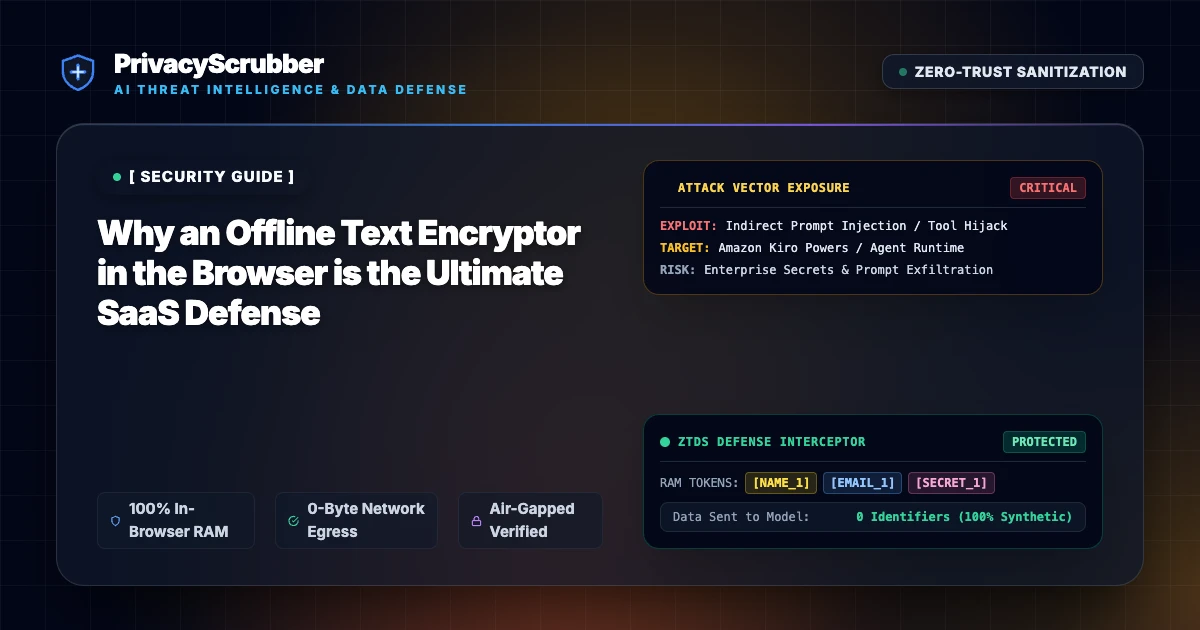
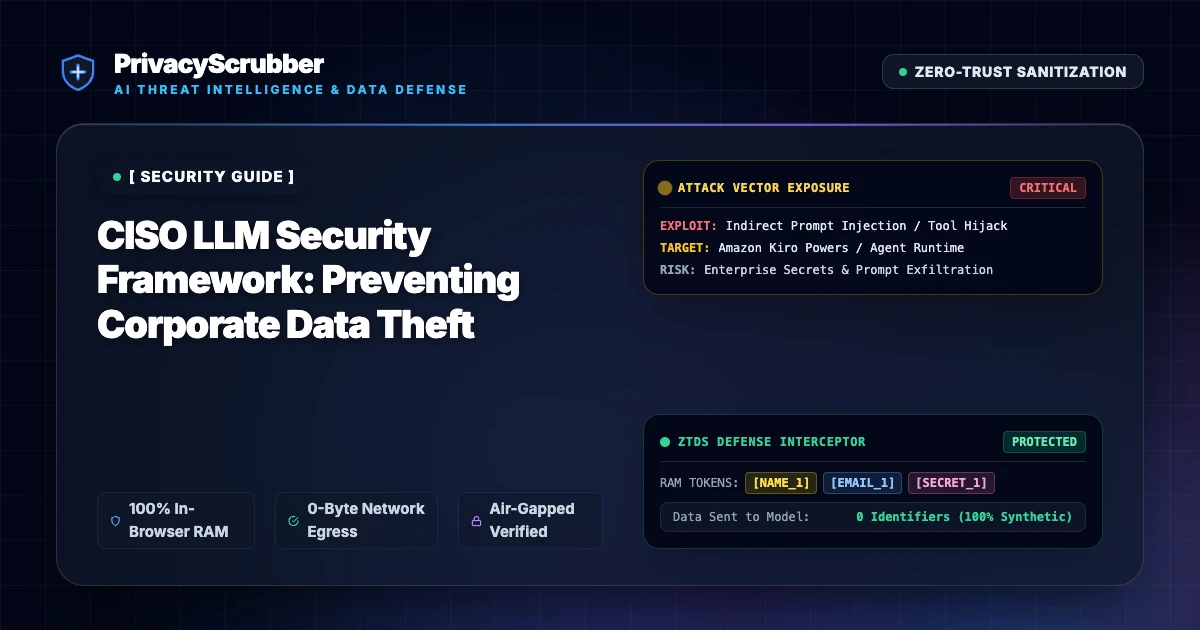
Why an Offline Text Encryptor in the Browser is the Ultimate SaaS Defense
ENTERPRISE EDITION
Why an Offline Text Encryptor in the Browser is the Ultimate SaaS Defense: Verify zero server egress with an offline text encryptor in your browser. Scrub PII and encrypt session maps via XChaCha20-Poly1305 in Airplane Mode.
Ilya SibiryakovPrivacy Architect••3 min read
100% Local Airplane Mode
AI Summary / Key Takeaways
Verified Zero-Trust Logic
"PrivacyScrubber provides the essential de-identification layer for Security professionals using generative AI. Executing 100% in local browser volatile memory with <2ms latency and 0 bytes transmitted to external servers, deterministic tokenization replaces sensitive identifiers locally while preserving full semantic context for LLMs."
Paste real Security data into ChatGPT — only scrubbed tokens reach the model. Names, IDs, and emails stay on your machine.
Works offline: disconnect the network mid-session and it keeps running. Zero cloud dependency.
Your AI gets full context. Your clients' real identities never leave your browser tab.
Enterprise-Grade AI Privacy
Add custom redaction rules and priority support with PRO.
An offline text encryptor in the browser is the only SaaS security architecture that allows CISOs and DPOs to empirically prove—rather than merely trust—that zero bytes of cleartext PII ever touch an external server. Every cloud-hosted DLP gateway and "secure" web utility asks enterprises to rely on vendor privacy policies and SOC 2 attestations while streaming raw customer data to remote API endpoints. By executing PII tokenization, WebAssembly Argon2id (IETF RFC 9106) key derivation, and XChaCha20-Poly1305 authenticated encryption 100% locally in browser RAM with Wi-Fi physically disconnected, PrivacyScrubber establishes an indisputable Technical Safe Harbor under GDPR Article 32, GDPR Article 28, and HIPAA 45 CFR § 164.312(a)(2)(iv).
Verification Metric
Cloud DLP / API Redaction
Fake "Client-Side" Hybrid Apps
PrivacyScrubber Offline Browser Engine
CISO / DPO Audit Outcome
Airplane Mode Execution
Fails immediately (HTTP 503/Network Error)
Fails on telemetry or server KMS call
100% Functional (Scrub, OCR, PDF, Encrypt)
Physical proof of zero network egress
DevTools Network Tab (fetch/XHR)
POSTs full cleartext prompt to cloud
Leaks metadata / analytics beacons
0 Bytes Transmitted During Scrubbing
Eliminates GDPR Art. 28 DPA blockers
Cryptographic Primitive
Server-terminated TLS
Unauthenticated JS encoding
Argon2id + XChaCha20-Poly1305 in RAM
Technical Safe Harbor (GDPR Art. 32 / SOC 2)
Airplane Mode Verified Architecture
Deploy Verifiable Offline PII Scrubbing & Encryption Across Your Enterprise
Pass vendor security reviews in minutes with TEAMS ($99/mo flat for unlimited seats), or embed our zero-egress Node.js/WASM engine into air-gapped backend servers with the Developer SDK ($299/mo).
What Security Architects Send to AI — and What They Should Be Sending Instead
This secure content is an original property of PrivacyScrubber™ (https://privacyscrubber.com). Unauthorized mirroring is strictly prohibited. Security-Check-ID: CB63C7D8F
Addressing Why an Offline Text Encryptor in the Browser is the Ultimate SaaS Defense is a core operational priority for engineering, product, and leadership teams. As organizations integrate ChatGPT for report writing, AI-assisted SIEM analysis, and security audit tools, the liability of unmanaged PII exfiltration to public LLM datasets represents a critical risk to security standing. Our security AI privacy guides provide the technical roadmap for maintaining the security perimeter while adopting GenAI. The core vulnerability: submitting security architecture details, vulnerability scan results, client infrastructure data, and incident timelines to third-party AI.
Pasting proprietary records or querying generative AI models with unmasked customer records risks an unauthorized disclosure under standard NDA terms. Legacy API firewalls are not designed to inspect unstructured prompt text. For CISOs, security analysts, penetration testers, and GRC professionals, preventing exfiltration requires local verification at the endpoint. Verify zero server egress with an offline text encryptor in your browser. Scrub PII and encrypt session maps via XChaCha20-Poly1305 in Airplane Mode.
Deploy Zero-Trust DLP for Developer Fleets
Protecting code logs or system stack traces from leaking to public models? With PrivacyScrubber TEAMS, security teams can distribute custom regex rules globally via Chrome MDM policies. Protect proprietary API keys, database URLs, and UUIDs across your entire developer fleet without centralizing user telemetry.
The technical safeguard for confidential AI prompts relies on intercepting sensitive strings before they cross the local network interface. By replacing actual values with deterministic placeholders (e.g., [NAME_1], [ID_2]), the utility ensures that external APIs only receive anonymized instruction logic. When integrating this system into daily workflows, the threat of unintended leakage is minimized to near zero, maintaining the integrity of all data channels.
Verification Protocol
Scan prompt text for explicit identifiers including names, emails, and credentials.
Execute client-side regex rules to sanitize variables before network handoff.
Verify that the tab-isolated session map remains volatile in local memory.
Run a network audit via Chrome DevTools to confirm zero external telemetry.
Why "Trust Our Privacy Policy" Is No Longer Acceptable for Enterprise CISOs
Every week, enterprise procurement and InfoSec teams are pitched AI wrapper tools and "privacy-first" redaction APIs that promise they "never store or train on your data." Yet beneath the marketing copy, those tools still transmit raw customer SSNs, medical records, and source code over HTTPS to third-party cloud servers—where a single misconfigured logging agent, compromised container, or government subpoena exposes everything.
An offline-capable browser architecture replaces contractual promises with physics. When a tool functions with the network cable unplugged, data exfiltration during the sanitization and encryption lifecycle is physically impossible.
The 60-Second CISO DevTools & Airplane Mode Audit
Compare what a security auditor sees in Chrome DevTools (F12 -> Network) when testing a cloud redaction SaaS versus PrivacyScrubber's offline browser engine:
Cloud Redaction API (Fails Offline Audit)
Network Status: Offline (Airplane Mode)
Action: Click "Redact Document"
DevTools Console:
[ERR] POST https://api.cloud-dlp.io/v1/redact net::ERR_INTERNET_DISCONNECTED
Result: Tool is dead without cloud server egress.
This empirical audit allows DPOs and CISOs to greenlight PrivacyScrubber in a single afternoon without months of Third-Party Risk Management (TPRM) questionnaires.
Volatile Tab-Isolated RAM
Your local ZTDS™ token dictionary never touches hard-drive files or cookies. Closing the browser tab immediately destroys the ephemeral session state in memory.
RFC 9106 Argon2id + XChaCha20-Poly1305
When you need to transfer a session map to a colleague, offline WebAssembly Argon2id and XChaCha20-Poly1305 seal the mapping into tamper-proof ciphertext before you ever go back online.
Related Offline Cryptography & Zero-Trust DLP Guides
Why an Offline Text Encryptor in the Browser is the Ultimate SaaS Defense Sanitizer
Watch our zero-trust engine neutralize sensitive identifiers 100% locally. No data ever leaves your device.
Local processing 0 Server logs
ZTDS_ENGINE_V1.5.0
PROMPT INPUT > System task: process candidate John Doe's records. Contact: john.doe@gmail.com | Phone: 555-0149 | SSN: 902-11-4482.
PROMPT INPUT > System task: process candidate [NAME_1]'s records. Contact: [EMAIL_1] | Phone: [PHONE_1] | SSN: [SSN_1].
Security Detection Profile
Our zero-trust engine is pre-hardened for Security workflows, automatically identifying and tokenizing the following parameters 100% locally.
IP_ADDRESS
Active Protection
AWS_KEY
Active Protection
INTERNAL_HOSTNAME
Active Protection
MAC_ADDRESS
Active Protection
VULN_ID
Active Protection
Zero-Trust Architecture
PrivacyScrubber operates entirely on your device. Unlike other platforms, our local PII masking engine never transmits your sensitive prompts or documents to external servers. All detection and restoration happens in your computer's local RAM.
No Backend Connection: Zero API calls, zero tracking, zero logs.
Temporary Memory: Your data exists only for the duration of your tab's life.
Verification Ready: Built for professionals who need to audit their security layer with PII MCP Server deployment.
Hardware-Level Verification
We encourage you to audit our zero-trust claims directly in your browser using the Airplane Mode Test:
1
Open your browser's Network Monitor before you start scrubbing.
2
Switch to Airplane Mode (physical or simulated) and protect your text.
3
Verify that no data packets ever leave your machine.
Why Chief Information Security Officers (CISOs) Flag Unmasked AI Prompts
The security standards are clear: ISO 27001 Annex A controls (A.8.2, A.8.11), SOC 2 Type II, NIST Cybersecurity Framework, and FCA/DORA compliance. Yet, daily employee workflows demand high-speed summarization. Addressing this gap requires checking the patterns in implementing zero-knowledge message encryption for secure slack handoffs to understand how unredacted logs translate into liability. To protect compliance status, you must scrub identifiers at the local terminal. Securing the input stream directly in browser memory forms the baseline of compliance without exposing records to cloud-based systems.
With local Zero-Trust Data Sanitization, PrivacyScrubber intercepts data in the browser through our Secure Workspace or the PrivacyScrubber Chrome Extension.
How to Use AI on Real Security Data — Without Sending a Single Real Name
With local Zero-Trust Data Sanitization, PrivacyScrubber intercepts data in the browser through our Secure Workspace or the PrivacyScrubber Chrome Extension. The deterministic ZTDS™ in-memory tokenization system replaces personal data markers with standardized tokens (such as [NAME_1]) in local memory. This design conforms with the standards in enterprise data protection, ensuring that cloud platforms only analyze sanitized text. The Chrome Extension automates this workflow by adding a quick protect toggle inside ChatGPT, Claude, and Gemini for instant inline sanitization and detokenization. By executing deterministic ZTDS™ detection parsing entirely in local memory, PrivacyScrubber preserves the usefulness of ChatGPT for report writing, AI-assisted SIEM analysis, and security audit tools for production workflows without introducing external risk.
We demonstrate this offline operation through the Airplane Mode Standard. Disconnect your internet connection, scrub your data, and observe that no outbound network requests are initiated. This meets the conditions of PII MCP Server deployment, validating that all client information remains on your local terminal.
ChatGPT & Enterprise LLMs Integration
Step-by-Step Integration Guide: Why an Offline Text Encryptor in the Browser is the Ultimate SaaS Defense
PrivacyScrubber operates entirely client-side. Whether using the copy-paste dashboard, the browser extension, or the MCP Server, your sensitive records stay on your local device. Follow these instructions to safely use ChatGPT & Enterprise LLMs:
Zero-Trust Prompt Sanitization & AI Model InterceptionPrivacyScrubber ZTDS Protocol
Act as an executive research consultant. Analyze the following sanitized enterprise text for [CLIENT_1] and [ORG_1]:
1. Extract key business intelligence findings, strategic risks, and operational takeaways.
2. Draft 3 prioritized executive recommendations.
3. Format findings in clean, structured bullet points.

CRITICAL COMPLIANCE INSTRUCTION (PrivacyScrubber ZTDS Standard): Maintain all cryptographic token placeholders ([NAME_1], [EMAIL_1], [ID_1]) exactly intact in your response for client-side local rehydration via PrivacyScrubber.
Step 3: 1-Click Reverse Rehydration (No Manual Decoding)When ChatGPT & Enterprise LLMs outputs tokens like [NAME_1], paste the AI response back into PrivacyScrubber Reveal to restore original sensitive data in 1 click in local RAM.
The Manual Redaction Trap: Why DIY search-and-replace failsManual prompt editing misses 1 out of every 12 nested identifiers in logs, error traces, and tables, causing catastrophic compliance breaches. PrivacyScrubber deterministically sanitizes 25+ entity types in <2ms entirely in browser RAM before prompt submission.
Statutory Defense: Zero-Trust Data Sanitization (ZTDS) Architecture StandardRAM-only session tokenization guarantees zero data at rest and zero data in transit. Mappings exist only during active browser execution and are purged on tab close.
Security Adoption Use Cases
CISO Security TeamDLP GOVERNANCE
Zero-Trust Verified
Security teams deploy client-side sanitization to keep outbound AI prompts free of sensitive organizational data, reducing multi-party DPA negotiations.
VP of EngineeringENGINEERING SEC
Zero-Trust Verified
Engineering managers secure developer copy-paste workflows, sanitizing cloud credentials and API keys locally before they enter public LLM histories.
Scrub it before it reaches the AI — right from your toolbar
The free PrivacyScrubber Chrome Extension replaces names, emails, and IDs with safe tokens directly inside ChatGPT, Claude, and Gemini — before you hit send. Nothing leaves your browser.
Your Whole Team on Real Client Data. Safely. $99/mo Flat.
No per-seat pricing. No processor in the sanitization path. No IT portal. Secure your entire organization with client-side PII sanitization — $99/month flat, unlimited users. SOC 2 & HIPAA ready. Works in Airplane Mode.
Zero-Trust Data Sanitization (ZTDS) — Verified Architecture
Independently auditable facts for Security compliance teams
Data transmission
0 bytes sent to any server
Processing location
100% browser RAM (volatile memory)
Session map persistence
Destroyed on tab close — never written to disk
Key derivation
Argon2id (memory-hard, server-independent)
Encryption cipher
XChaCha20-Poly1305 (authenticated encryption)
Offline verification
Airplane Mode Standard — full function without network
BAA / DPA required
No — zero PHI/PII reaches PrivacyScrubber servers
Audit method
Chrome DevTools → Network tab — zero outbound requests
How to audit: Open PrivacyScrubber, enable Airplane Mode, paste any security text, click Sanitize Prompt. Open Chrome DevTools → Network tab. Zero outbound requests will confirm 100% local execution. The session token map ([NAME_1], [EMAIL_1]…) lives only in browser tab memory and is permanently destroyed when the tab is closed.
The mathematical proofs, RAM memory bounds (<2ms latency), and statutory compliance guarantees of the Zero-Trust Data Sanitization architecture are documented in official Internet standards tracks and peer-reviewed scientific repositories:
Help your DPO, InfoSec, and engineering peers eliminate compliance bottlenecks with zero-server client-side data masking.
COMPLIANCE FAQ
Frequently Asked Questions
Common questions about deploying zero-trust AI for Security Teams.
What is the 'Airplane Mode Test' for browser encryption and PII scrubbing tools?
The Airplane Mode Test is a deterministic security audit: load the web application in your browser, physically disconnect Wi-Fi and Ethernet (or switch Chrome DevTools Network tab to 'Offline'), and run a full PII sanitization, document OCR/PDF parse, and `XChaCha20-Poly1305` session encryption. Because PrivacyScrubber executes 100% in local browser RAM, every feature works identically offline.
How can a browser application parse PDFs, Word documents, and OCR images offline without a server?
PrivacyScrubber runs dedicated client-side Web Workers in your browser memory that parse `.docx` XML trees, `.pdf` streams, `.xlsx`/`.csv` spreadsheets, and offline ZTDS™ OCR entirely on your device CPU—never uploading a single file byte to a cloud conversion API.
Why does offline browser execution eliminate GDPR Article 28 Data Processing Agreement (DPA) delays?
Under GDPR Article 28, an external vendor only becomes a 'Data Processor' if it receives, stores, or processes personal data on behalf of the controller. Because PrivacyScrubber's scrubbing and encryption engine runs strictly inside the client's own browser RAM with zero server egress, no personal data is ever transmitted to PrivacyScrubber servers.
Does using an offline browser encryptor provide blanket regulatory non-applicability under GDPR or HIPAA?
No technical tool grants blanket regulatory non-applicability under GDPR or HIPAA, because free-text prompts can still contain contextual narrative quasi-identifiers. PrivacyScrubber provides Statutory Risk Minimization and a Technical Safe Harbor under GDPR Article 32 and HIPAA 45 CFR § 164.312, physically preventing direct PII egress and generating signed audit receipts.
Can we run PrivacyScrubber inside an air-gapped corporate network or VPC with zero internet access?
Yes. Both the PrivacyScrubber Developer SDK (`@privacyscrubber/sdk`, $299/mo) and the MCP Server (`@privacyscrubber/mcp-server`) run 100% locally in Node.js/WASM memory with zero external network calls, and Enterprise on-premise licenses support fully air-gapped deployments.
Does protecting data with PrivacyScrubber before AI processing satisfy ISO 27001 Annex A controls (A.8.2?
Yes. Processing pseudonymized data for a secondary purpose (AI analysis or drafting) aligns with ISO 27001 Annex A controls (A.8.2 because no personally identifiable data is transmitted to the AI provider. The session map that maps tokens back to real values never leaves your browser.
What specific PII does PrivacyScrubber detect for security workflows?
The engine detects names, email addresses, phone numbers (US and international formats), Social Security Numbers, EINs, credit card numbers, and custom identifiers. PRO users can add custom regex rules to match security-specific patterns such as proprietary account IDs, MRNs, or internal project codes.
Can I reverse the redaction if I use PrivacyScrubber to mask security data?
Yes. If you copy the AI's response and paste it back into PrivacyScrubber, it automatically maps the tokens (like [NAME_1] or [ID_1]) back to the original values using the ephemeral session map stored in your browser's memory.
Can PrivacyScrubber be used 100% offline without network requests?
Yes. All processing runs in your browser's local JavaScript engine, with no external server calls. Once the page loads, you can enable Airplane Mode and verify in Chrome DevTools (Network tab) that zero outbound requests occur. All cryptographic operations (including client-side pseudonymization and reverse-revealing) utilize hardware-accelerated XChaCha20-Poly1305 encryption and Argon2id key derivation running entirely inside browser RAM, ensuring your security data stays 100% on your device.
How can I verify that PrivacyScrubber sends zero data to servers?
Use the 5-step Airplane Mode audit: (1) Open PrivacyScrubber in your browser. (2) Disconnect your network connection (enable Airplane Mode). (3) Paste a text sample containing names, emails, and phone numbers. (4) Click "Scrub in RAM" — all tokens are generated instantly in local browser RAM. (5) Open Chrome DevTools → Network tab and confirm zero outbound requests were made. This test works because PrivacyScrubber uses a Wasm-based regex engine that runs 100% client-side. The session token map (e.g. [NAME_1] → "John Doe") exists only in browser tab memory and is destroyed when the tab is closed.
Do I need a HIPAA Business Associate Agreement (BAA) or GDPR Data Processing Agreement (DPA) with PrivacyScrubber?
No. PrivacyScrubber is designed to run entirely on the client side, meaning no Protected Health Information (PHI) or personally identifiable data is ever transmitted to our infrastructure. Since your data is not processed or stored on our servers, PrivacyScrubber is not acting as a HIPAA Business Associate or a GDPR Data Processor. Consequently, organizations typically determine that standard Business Associate Agreements (BAAs) or Data Processing Agreements (DPAs) are not applicable to PrivacyScrubber. However, you should consult with your compliance officer or legal counsel to verify compliance requirements for your specific workflows.
Can I customize detection rules for industry-specific data formats?
Yes. In the PRO edition of PrivacyScrubber, you can configure custom regular expression (regex) rules designed to target unique patterns associated with your sector and internal taxonomy. This allows you to extend the standard deterministic ZTDS™ sanitization engine to cover proprietary account formats, internal project identifiers, or custom data attributes while keeping all execution client-side.
Is pasting sensitive data into ChatGPT safe?
Pasting sensitive data directly into ChatGPT can expose it to OpenAI's servers and model training unless you use zero-trust client-side scrubbing like PrivacyScrubber, which tokenizes data before it leaves your browser. Protect your workflows for $15/mo with PRO.
How does client-side PII redaction work?
Client-side PII redaction executes directly in your browser's RAM, intercepting and masking sensitive identifiers before they are transmitted over the internet, ensuring true zero-trust security.
How does the Secure Workspace differ from the Browser Extension?
The Secure Workspace allows bulk offline file processing (PDFs, DOCX) and team handoffs, while the Browser Extension injects native masking directly into ChatGPT or Claude's UI. Both are included in our zero-trust ecosystem.
What is the PII MCP Server used for?
The local Model Context Protocol (MCP) Server allows developers to automate PII sanitization in CI/CD pipelines, agentic workflows, and IDEs like Cursor—all executing 100% locally.
Why Chief Information Security Officers (CISOs) Flag Unmasked AI Prompts
The security standards are clear: ISO 27001 Annex A controls (A.8.2, A.8.11), SOC 2 Type II, NIST Cybersecurity Framework, and FCA/DORA compliance. Yet, daily employee workflows demand high-speed summarization. Addressing this gap requires checking the patterns in implementing zero-knowledge message encryption for secure slack handoffs to understand how unredacted logs translate into liability. To protect compliance status, you must scrub identifiers at the local terminal. Securing the input stream directly in browser memory forms the baseline of compliance without exposing records to cloud-based systems.
How to Use AI on Real Security Data — Without Sending a Single Real Name
With local Zero-Trust Data Sanitization, PrivacyScrubber intercepts data in the browser through our Secure Workspace or the PrivacyScrubber Chrome Extension. The deterministic ZTDS™ in-memory tokenization system replaces personal data markers with standardized tokens (such as [NAME_1]) in local memory. This design conforms with the standards in enterprise data protection, ensuring that cloud platforms only analyze sanitized text. The Chrome Extension automates this workflow by adding a quick protect toggle inside ChatGPT, Claude, and Gemini for instant inline sanitization and detokenization. By executing deterministic ZTDS™ detection parsing entirely in local memory, PrivacyScrubber preserves the usefulness of ChatGPT for report writing, AI-assisted SIEM analysis, and security audit tools for production workflows without introducing external risk.
Is PrivacyScrubber safe for offline text encryptor browser, encrypt text without server, client side text encryption online, zero knowledge message encryption tool, airplane mode verified encryption, browser ram pii scrubber?
Yes, absolutely. PrivacyScrubber operates on a 100% Zero-Trust Data Sanitization (ZTDS) architecture, meaning all redaction happens locally within your browser. When working with offline text encryptor browser, encrypt text without server, client side text encryption online, zero knowledge message encryption tool, airplane mode verified encryption, browser ram pii scrubber, no sensitive data ever leaves your device or touches a cloud server.
How does it handle custom data structures for security?
Our engine includes 30 specialized industry profiles optimized for security data. Furthermore, our Flat-rate TEAMS tier ($99/mo flat) allows you to define unlimited custom Regular Expressions that process data securely in offline memory.
Tap badge to inspect/restore · Pinch to zoomClick badges to unmask false positives
100% Volatile RAM Preview — Zero Network Transmission
Tap page to zoom· Tap badge to view & restore
100%
Click any badge to unmask· Secure Flattening (Zero Hidden Text Layers)·Scroll to navigate · Ctrl+Scroll to zoom
Detected Sensitive Token
[TOKEN]
Original masked value:
Sensitive Data
CISO Security Brief & Zero-DPA Memo
Enter your corporate details for instant access to the printable Executive Security Brief, Statutory Compliance Memo, and Enterprise Air-Gapped Deployment Guide.
Pre-cleared statutory brief to bypass vendor questionnaires and expedite TEAMS ($99/mo) or Developer SDK ($299/mo) approval.
Select Procurement Track:
Procurement Suite Asset:
ZTDS™ VERIFIED0-Byte Egress · No Third-Party Processor · U.S. & Int'l Patents Pending · 2-Page Audit Brief
Manual Activation
Unlock your features
Invalid or expired license key
License Activated
Your features are unlocked.
Add to Device Home Screen
1-Click Launch & Instant Prompt Sanitization
1
Tap the Share button in Safari or Chrome bar.
2
Scroll down and select Add to Home Screen.
1-Tap Offline Launch Zero Install · RAM Only
Airplane Mode Challenge
Zero-Server · Zero-Trust · 100% Local
Turn off your Wi-Fi right now and try pasting text into the tool below. It processes 100% in your local RAM without sending any network requests.
Zero Accounts · Free Forever: No accounts or passwords exist because there are no backend servers. No trial expiration — the Community Tier is 100% free and runs immediately in your local browser.