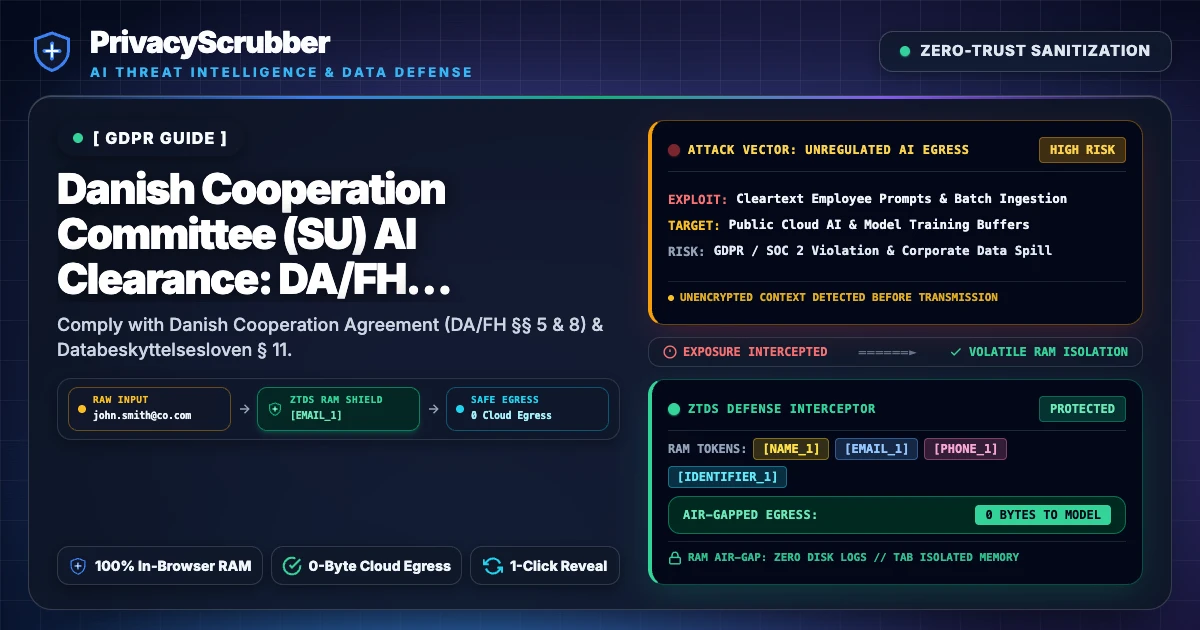
Danish Cooperation Committee (SU) AI Clearance: Comply with Danish Cooperation Agreement (DA/FH §§ 5 & 8) & Databeskyttelsesloven § 11. Redact CPR numbers & employee telemetry in RAM with zero cloud egress.
Ilya SibiryakovPrivacy Architect••4 min read
100% Local Airplane Mode
Danish Cooperation Committee (Samarbejdsudvalg - SU) AI Clearance Dossier (DA/FH § 5 & § 8 / CPR § 11) Danish Data Protection Officers (DPO), Cooperation Committee Members (Samarbejdsudvalg - SU / Tillidsrepræsentant), HR Directors & Danish Employment Lawyers Danish Cooperation Agreement (Samarbejdsaftalen DA/FH §§ 5 & 8), Danish Data Protection Act (Databeskyttelsesloven § 11 CPR), Danish Consolidation Act on Working Environment (Arbejdsmiljøloven), Danish DPA (Datatilsynet) Employee AI Guidance & GDPR Article 88
Direct Technical Standard (Zero-Trust Rule)
Under the Danish DA/FH Cooperation Agreement (Samarbejdsaftalen §§ 5 & 8) and Databeskyttelsesloven § 11, Danish employers must notify the Cooperation Committee (Samarbejdsudvalg - SU) at least 6 weeks before introducing control measures or AI tools, and must redact employee legal names, 10-digit CPR numbers (DDMMYY-SSSS), staff numbers (Medarbejdernummer), and workstation telemetry in client RAM prior to cloud AI ingestion. Preserving aggregated collective velocity (+16.9%), generative drafting acceptance (89.2%), and collective agreement parameters (Overenskomst 37h/week) in cleartext eliminates employee surveillance liabilities and ensures full SU consensus.
AI Summary / Key Takeaways
Verified Zero-Trust Logic
"PrivacyScrubber provides the essential de-identification layer for GDPR professionals using generative AI. Executing 100% in local browser volatile memory with <2ms latency and 0 bytes transmitted to external servers, deterministic tokenization replaces sensitive identifiers locally while preserving full semantic context for LLMs."
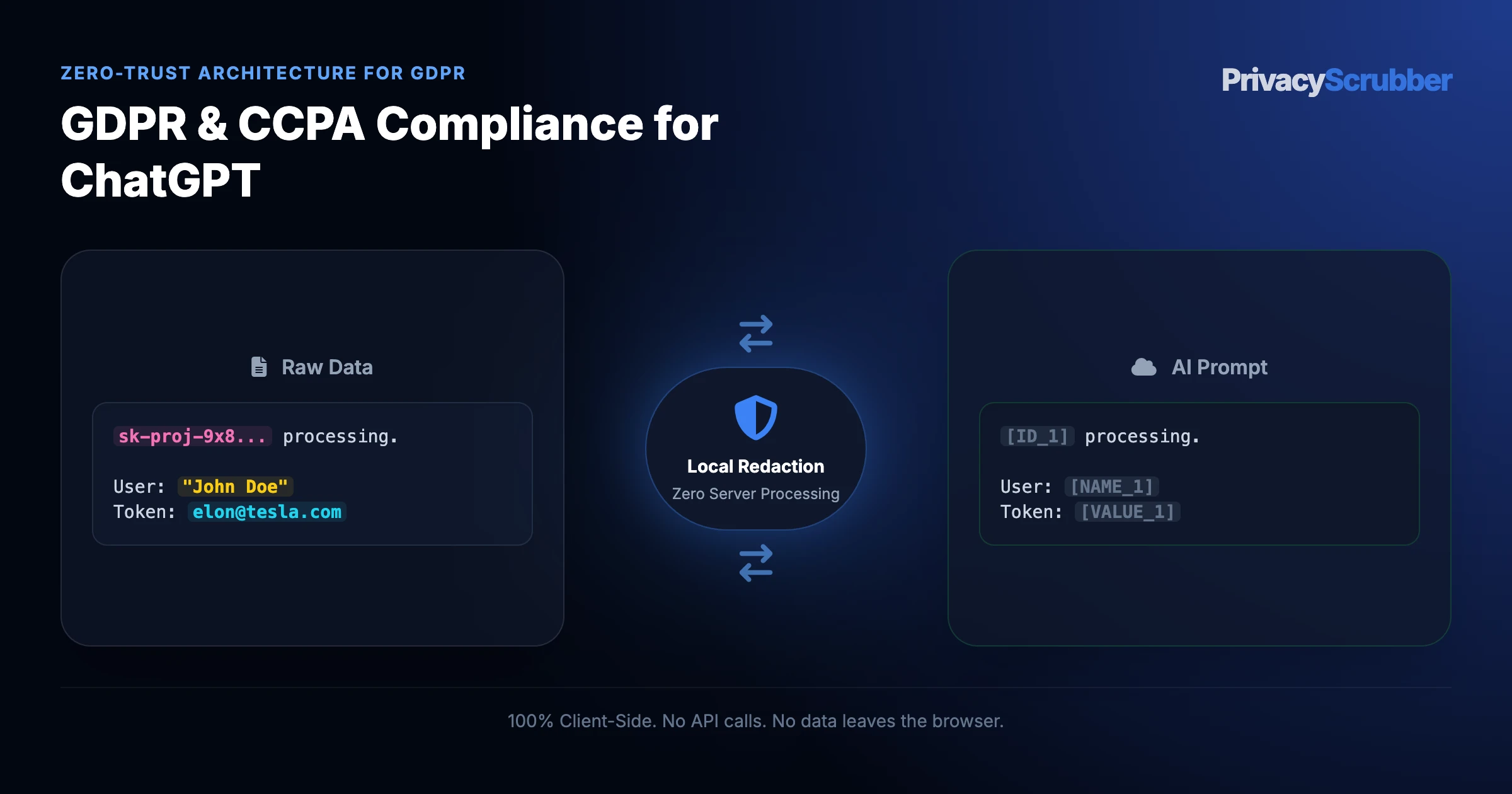
Paste real GDPR data into ChatGPT — only scrubbed tokens reach the model. Names, IDs, and emails stay on your machine.
Works offline: disconnect the network mid-session and it keeps running. Zero cloud dependency.
Your AI gets full context. Your clients' real identities never leave your browser tab.
Enterprise-Grade AI Privacy
Add custom redaction rules and priority support with PRO.
In Denmark, deploying generative AI copilots, automated decision support, and commercial cloud LLMs in the enterprise workplace is strictly governed by the collective Cooperation Agreement between the Confederation of Danish Enterprise (Dansk Arbejdsgiverforening - DA) and the Danish Trade Union Confederation (Fagbevægelsens Hovedorganisation - FH) (Samarbejdsaftalen). Under Section 5 and Section 8 of Samarbejdsaftalen, employers are contractually bound to inform and consult the joint Cooperation Committee (Samarbejdsudvalg - SU) or employee shop stewards (Tillidsrepræsentanter) at least 6 weeks before introducing any control measures (kontrolforanstaltninger) or significant technological alterations impacting working conditions. Concurrently, Section 11 of the Danish Data Protection Act (Databeskyttelsesloven) establishes strict statutory restrictions on the processing of Danish 10-digit Civil Registration Numbers (CPR-nummer - DDMMYY-SSSS). Datatilsynet (the Danish Data Protection Agency) strictly forbids transmitting unmasked CPR numbers to commercial cloud AI models without explicit statutory authority or cryptographic safeguards. Furthermore, using generative AI prompt logs, keystroke latency, or response speeds to evaluate worker performance constitutes an unlawful control measure under Samarbejdsaftalen § 8 unless agreed upon with the SU. Exposing Danish employee identities, CPR numbers, internal staff numbers (Medarbejdernummer), or workstation telemetry to cloud LLMs risks union dispute adjudication, labor arbitration fines under Arbejdsretten, and GDPR fines up to €20M from Datatilsynet. PrivacyScrubber's Zero-Trust Data Sanitization (ZTDS) operates exclusively in local browser RAM, tokenizing worker identifiers and endpoint telemetry before prompt dispatch. This provides mathematical certainty to the Samarbejdsudvalg that employee monitoring cannot occur, guaranteeing rapid SU consensus and seamless compliance with Danish labor law.
Zero-Trust Data Protection: Ensure Article 32 compliance by pseudonymizing data before it reaches public AI endpoints. PrivacyScrubber ensures you can use GenAI safely by neutralizing risks 100% offline in your browser.
What Privacy and DPO Teams Send to AI — and What They Should Be Sending Instead
This secure content is an original property of PrivacyScrubber™ (https://privacyscrubber.com). Unauthorized mirroring is strictly prohibited. Security-Check-ID: CB63C7D8F
Aligning AI tools with the standards of Danish Cooperation Committee (SU) AI Clearance requires strict data verification protocols. As enterprises deploy platforms like ChatGPT, Mistral, and local LLM integrations, preventing unmanaged information egress to public model training queues becomes a top priority. Our gdpr AI privacy guides maps out a clear path to maintain the gdpr safety envelope. The primary concern is preventing unauthorized cross-border transfer of EU resident data to US-based AI providers without adequate safeguards across all endpoints.
When staff upload regulated gdpr records or paste sensitive datasets into remote LLMs, each prompt poses a serious regulatory risk. Legacy API firewalls cannot meet the strict, granular auditing demanded by gdpr standards. For DPOs, European business owners, and compliance managers, the primary point of failure is sending raw prompt text to the cloud. Comply with Danish Cooperation Agreement (DA/FH §§ 5 & 8) & Databeskyttelsesloven § 11. Redact CPR numbers & employee telemetry in RAM with zero cloud egress.
Privacy Insight: In Denmark, deploying generative AI copilots, automated decision support, and commercial cloud LLMs in the enterprise workplace is strictly governed by the collective Cooperation Agreement between the Confederation of Danish Enterprise (Dansk Arbejdsgiverforening - DA) and the Danish Trade Union Confederation (Fagbevægelsens Hovedorganisation - FH) (Samarbejdsaftalen). Under Section 5 and Section 8 of Samarbejdsaftalen, employers are contractually bound to inform and consult the joint Cooperation Committee (Samarbejdsudvalg - SU) or employee shop stewards (Tillidsrepræsentanter) at least 6 weeks before introducing any control measures (kontrolforanstaltninger) or significant technological alterations impacting working conditions. Concurrently, Section 11 of the Danish Data Protection Act (Databeskyttelsesloven) establishes strict statutory restrictions on the processing of Danish 10-digit Civil Registration Numbers (CPR-nummer - DDMMYY-SSSS). Datatilsynet (the Danish Data Protection Agency) strictly forbids transmitting unmasked CPR numbers to commercial cloud AI models without explicit statutory authority or cryptographic safeguards. Furthermore, using generative AI prompt logs, keystroke latency, or response speeds to evaluate worker performance constitutes an unlawful control measure under Samarbejdsaftalen § 8 unless agreed upon with the SU. Exposing Danish employee identities, CPR numbers, internal staff numbers (Medarbejdernummer), or workstation telemetry to cloud LLMs risks union dispute adjudication, labor arbitration fines under Arbejdsretten, and GDPR fines up to €20M from Datatilsynet. PrivacyScrubber's Zero-Trust Data Sanitization (ZTDS) operates exclusively in local browser RAM, tokenizing worker identifiers and endpoint telemetry before prompt dispatch. This provides mathematical certainty to the Samarbejdsudvalg that employee monitoring cannot occur, guaranteeing rapid SU consensus and seamless compliance with Danish labor law.
Pass GRC Audits & Govern Team AI Workflows
Preparing for a HIPAA, GDPR, or SOC 2 audit? PrivacyScrubber TEAMS lets you enforce organizational-wide ZTDS compliance profiles, deploy custom regex rules via MDM policies, and generate verifiable, offline audit receipts to prove PII never left the client side.
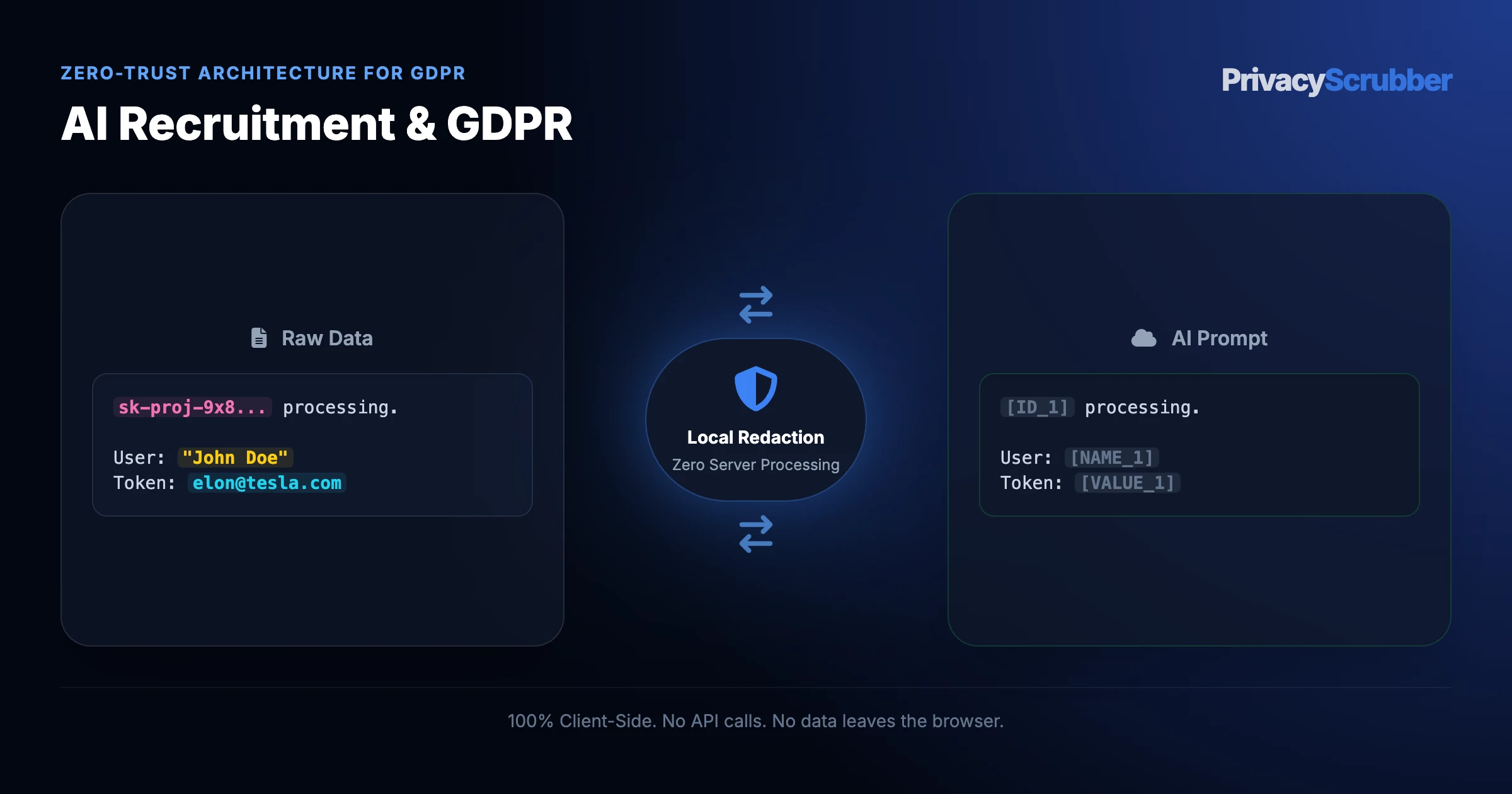
Establishing a secure runtime boundary for generative AI workflows is key to compliance. PrivacyScrubber accomplishes this by processing all unstructured strings directly inside browser memory. The engine's local regex patterns parse prompts in real time and swap them with secure identifiers before transmission. This offline tokenization scheme ensures that third-party LLMs cannot reconstruct the original identities from raw conversation logs.
Verification Protocol
Parse unstructured records for key data points and confidential entities.
Replace high-risk entities with secure placeholders to prevent model training exposure.
Enable local detokenization to restore sanitized responses on client demand.
Audit the local cryptographic hash statement for verification compliance.
Under the Danish DA/FH Cooperation Agreement (Samarbejdsaftalen), enterprises cannot deploy generative AI copilots without prior notification and consultation with the Cooperation Committee (Samarbejdsudvalg - SU) at least 6 weeks prior to implementation. Section 8 mandates that any technical control measures (kontrolforanstaltninger) must have a justified operational purpose and cannot be used for covert surveillance. Simultaneously, Section 11 of the Danish Data Protection Act (Databeskyttelsesloven) and Datatilsynet directives strictly prohibit the unauthorized transmission of 10-digit Danish Civil Registration Numbers (CPR-nummer) and individual employee prompt telemetry to external cloud AI systems.
The matrix below demonstrates how PrivacyScrubber neutralizes Danish enterprise workplace dossiers prior to LLM analysis under our GDPR & EU Privacy Compliance for AI framework:
Workplace Consultation Field
Raw Danish Enterprise Personnel Entry
PrivacyScrubber Local Token
DA/FH & CPR § 11 Clearance & AI Utility
Employee Full Legal Name
Medarbejder: Christian Møller (Underwriting)
Medarbejder: [NAME_1] (Underwriting)
Eliminates individual performance rating under Samarbejdsaftalen § 8
Civil Registration Number (CPR-nummer)
CPR: 140685-2819 (10-cifret personnummer)
CPR: [ID_1]
Protects statutory citizen ID under Databeskyttelsesloven § 11
Internal Staff ID (Medarbejdernummer)
Medarbejdernr: DK-774019 (Adgangskort)
Medarbejdernr: [ID_2]
Blocks cross-system profiling and badge activity correlation
Prevents interaction cadence and endpoint telemetry tracking
Aggregated Departmental Throughput Velocity
Gennemløbstid: +16.9% (71 min. til 59.0 min. avg)
Gennemløbstid: +16.9% (71 min. til 59.0 min. avg)
Preserved 100% Cleartext for SU Operational Planning
Suggestion Adoption & Defect Ratio
Acceptrate: 89.2% | Afvigelser: 3.8% til 0.5%
Acceptrate: 89.2% | Afvigelser: 3.8% til 0.5%
Preserved 100% Cleartext for Algorithmic Quality Review
Danish Enterprise AI Consultation Pipeline with @privacyscrubber/sdk
Danish corporate IT divisions and human resource management teams deploy in-memory tokenization to fulfill consultation protocols under Samarbejdsaftalen and Datatilsynet compliance before executing cloud LLM calls:
Node.js: Danish Cooperation Committee (SU) & CPR Sanitizernpm i @privacyscrubber/sdk
import { PrivacyScrubberEngine } from '@privacyscrubber/sdk';

const engine = new PrivacyScrubberEngine({
  profile: 'HR & Resumes',
  detectSecrets: true
});

const danishConsultationDossier = `SAMARBEJDSAFTALEN DA/FH & CPR § 11 SU KONSULTATIONSDOSSIER:
Virksomhed: Nordic Commercial & Maritime Assurance A/S (København Ø).
DPO: Henrik Lindqvist | Tillidsrepræsentant (HK/Privat): Mette Frederiksen.
Medarbejder Audit Sag: Christian Møller (CPR: 140685-2819, Medarbejdernr: DK-774019).
Evaluering: Generativ AI-copilot til bistand ved policevurdering og risikoklassificering.
Kollektivt Fund: 38 underwriting-specialister opnåede 16.9% effektivitetsgevinst uden individuel overvågning.`;

const { sanitizedText, tokenMap } = engine.sanitize(danishConsultationDossier);
console.log('Sanitized Payload for SU Consultation File:\n', sanitizedText);

// Rehydrate generated legal opinion in local client memory
const rawAiMemo = 'Arbejdsretligt Notat: I henhold til Samarbejdsaftalen §§ 5 & 8 og Databeskyttelsesloven § 11 sikrer den tekniske implementering hos [ORG_1], at individuel adfærds- eller præstationsovervågning af [NAME_1] er udelukket.';
const finalConsultationMemo = engine.restore(rawAiMemo, tokenMap);
European Labor Governance & Cross-Border Compliance
Danish Cooperation Committee (SU) AI Clearance Sanitizer
Watch our zero-trust engine neutralize sensitive identifiers 100% locally. No data ever leaves your device.
Local processing 0 Server logs
ZTDS_ENGINE_V1.5.0
PROMPT INPUT > Draft a reply for customer inquiry. Sender is Alice Johnson, email: alice.j@organization.org, mobile: 555-0177.
PROMPT INPUT > Draft a reply for customer inquiry. Sender is [NAME_1], email: [EMAIL_1], mobile: [PHONE_1].
GDPR Detection Profile
Our zero-trust engine is pre-hardened for GDPR workflows, automatically identifying and tokenizing the following parameters 100% locally.
NAME
Active Protection
EMAIL
Active Protection
ADDRESS
Active Protection
ID
Active Protection
IP_ADDRESS
Active Protection
Zero-Trust Architecture
PrivacyScrubber operates entirely on your device. Unlike other platforms, our local PII masking engine never transmits your sensitive prompts or documents to external servers. All detection and restoration happens in your computer's local RAM.
No Backend Connection: Zero API calls, zero tracking, zero logs.
Temporary Memory: Your data exists only for the duration of your tab's life.
Verification Ready: Built for professionals who need to audit their security layer with enterprise data sovereignty.
Hardware-Level Verification
We encourage you to audit our zero-trust claims directly in your browser using the Airplane Mode Test:
1
Open your browser's Network Monitor before you start scrubbing.
2
Switch to Airplane Mode (physical or simulated) and protect your text.
3
Verify that no data packets ever leave your machine.
To maintain LLM analytical context while avoiding cloud data breaches, follow this deterministic mapping before submitting prompts to third-party AI models:
Document Field / Box
Required Action
Deterministic Token
Statutory & AI Rationale
Danish Employee Full Legal Names & Titles
REDACT
[NAME_1], [NAME_2]
Individual worker identity protected from employee surveillance and profiling under Samarbejdsaftalen § 8 and Databeskyttelsesloven
Danish Civil Registration Number (CPR-nummer - 10 Digits)
REDACT
[ID_1]
Statutory 10-digit Danish citizen identifier (DDMMYY-SSSS) strictly protected under Section 11 of the Danish Data Protection Act
Copy and paste this structured prompt into ChatGPT, Claude, or Gemini alongside your tokenized text to prevent LLM rejection:
You are a Danish Employment Lawyer (Arbejdsretsadvokat) and Data Protection Officer specializing in the Danish Cooperation Agreement (Samarbejdsaftalen DA/FH §§ 5 & 8), Section 11 of the Danish Data Protection Act (Databeskyttelsesloven - CPR-nummer), the Danish Working Environment Act (Arbejdsmiljøloven), and Datatilsynet workplace AI monitoring directives. Review this sanitized workplace AI consultation dossier where worker identities, Danish CPR numbers, staff numbers (Medarbejdernummer), corporate emails, phone numbers, workstation hostnames, and IP addresses are replaced with tokens ([NAME_1], [NAME_2], [NAME_3], [ID_1], [ID_2], [ID_3], [EMAIL_1], [PHONE_1], [HOST_1], [IP_1]).

Tasks:
1. Assess whether the dossier satisfies mandatory information and co-determination under Samarbejdsaftalen §§ 5 & 8 without infringing Datatilsynet guidelines on employee monitoring and control measures (kontrolforanstaltninger).
2. Verify compliance with Section 11 of Databeskyttelsesloven regarding the strict confidentiality and prohibition against unwarranted processing of Danish CPR numbers in external LLMs.
3. Draft 3 statutory consultation clauses for the formal Cooperation Committee Agreement (Lokalaftale i Samarbejdsudvalget) confirming that client-side RAM tokenization physically prevents employee surveillance, prompt cadence tracking, or automated disciplinary ranking.

[PASTE SANITIZED TEXT HERE]
You are a Danish Employment Lawyer (Arbejdsretsadvokat) and Data Protection Officer specializing in the Danish Cooperation Agreement (Samarbejdsaftalen DA/FH §§ 5 & 8), Section 11 of the Danish Data Protection Act (Databeskyttelsesloven - CPR-nummer), the Danish Working Environment Act (Arbejdsmiljøloven), and Datatilsynet workplace AI monitoring directives. Review this sanitized workplace AI consultation dossier where worker identities, Danish CPR numbers, staff numbers (Medarbejdernummer), corporate emails, phone numbers, workstation hostnames, and IP addresses are replaced with tokens ([NAME_1], [NAME_2], [NAME_3], [ID_1], [ID_2], [ID_3], [EMAIL_1], [PHONE_1], [HOST_1], [IP_1]).

Tasks:
1. Assess whether the dossier satisfies mandatory information and co-determination under Samarbejdsaftalen §§ 5 & 8 without infringing Datatilsynet guidelines on employee monitoring and control measures (kontrolforanstaltninger).
2. Verify compliance with Section 11 of Databeskyttelsesloven regarding the strict confidentiality and prohibition against unwarranted processing of Danish CPR numbers in external LLMs.
3. Draft 3 statutory consultation clauses for the formal Cooperation Committee Agreement (Lokalaftale i Samarbejdsudvalget) confirming that client-side RAM tokenization physically prevents employee surveillance, prompt cadence tracking, or automated disciplinary ranking.

[PASTE SANITIZED TEXT HERE]
Why Data Protection Officers (DPOs) Flag Unmasked AI Prompts
Regulatory oversight for gdpr is explicit: GDPR (Article 32, 5(1)(c)), and EU AI Act (2026). However, technical implementation often lags behind AI adoption curves. Navigating the data exposure surface often overlaps with norwegian works council (su) ai clearance — identifying how unstructured data becomes a permanent liability in model weights. To achieve verifiable security, you must eliminate the PII before it reaches the cloud. Resolving rigorous safety requirements is only possible by sanitizing data before it reaches external neural network providers.
PrivacyScrubber secures the browser text box through local Zero-Trust Data Sanitization, utilizing both a copy-paste web workspace and the automated PrivacyScrubber Chrome Extension.
How to Use AI on Real European Consumer Data — Without Sending a Single Real Name
PrivacyScrubber secures the browser text box through local Zero-Trust Data Sanitization, utilizing both a copy-paste web workspace and the automated PrivacyScrubber Chrome Extension. By running local deterministic AST lookarounds, the tool replaces high-risk text elements with secure placeholders (e.g., [PHONE_1]) before cloud transmission. This aligns with standard procedures for EU AI Act compliance strategies, ensuring the AI receives only clean, non-PII context. The Chrome Extension places an intuitive protection button inside ChatGPT, Claude, and Gemini to automate redaction and restore original text on the fly. Running deterministic AST lookarounds locally ensures that teams can continue using ChatGPT, Mistral, and local LLM integrations for daily queries without any third-party data collection.
We back this zero-egress architecture with the Airplane Mode Standard. Users can disconnect from the internet and run the scrubbing routine locally to verify that no network requests are dispatched. This meets the criteria for enterprise data sovereignty, proving that local-first execution is the ultimate shield for enterprise data.
ChatGPT (OpenAI) Integration
Step-by-Step Integration Guide: Danish Cooperation Committee (SU) AI Clearance
PrivacyScrubber operates entirely client-side. Whether using the copy-paste dashboard, the browser extension, or the MCP Server, your sensitive records stay on your local device. Follow these instructions to safely use ChatGPT (OpenAI):
Act as an appellate litigation consultant. Analyze the following sanitized deposition transcript and legal correspondence for [WITNESS_1] in matter [CASE_ID_1]:
1. Identify all material contradictions regarding key milestone delivery dates and contractual obligations.
2. Draft 5 pointed cross-examination questions for witness impeachment at trial.
3. Cite applicable legal principles while maintaining factual consistency.

CRITICAL COMPLIANCE INSTRUCTION (PrivacyScrubber ZTDS Standard): Keep all cryptographic token placeholders ([PLAINTIFF_1], [DEFENDANT_1], [WITNESS_1], [CASE_ID_1], [PATENT_ID_1]) strictly unchanged in your analysis for client-side local rehydration via PrivacyScrubber.
Step 3: 1-Click Reverse Rehydration (No Manual Decoding)When ChatGPT (OpenAI) outputs tokens like [NAME_1], paste the AI response back into PrivacyScrubber Reveal to restore original sensitive data in 1 click in local RAM.
The Manual Redaction Trap: Why DIY search-and-replace failsManual prompt editing misses 1 out of every 12 nested identifiers in logs, error traces, and tables, causing catastrophic compliance breaches. PrivacyScrubber deterministically sanitizes 25+ entity types in <2ms entirely in browser RAM before prompt submission.
Statutory Defense: ABA Model Rule 1.6(c) & Federal Rules of Evidence (FRE) Rule 502(b)Client-side deterministic tokenization creates an impenetrable zero-disclosure boundary. Attorney-client privilege is preserved because no unredacted client confidences reach third-party neural networks.
GDPR Adoption Use Cases
CISO Security TeamDLP GOVERNANCE
Zero-Trust Verified
Security teams deploy client-side sanitization to keep outbound AI prompts free of sensitive organizational data, avoiding complex multi-party DPA negotiations.
VP of EngineeringENGINEERING SEC
Zero-Trust Verified
Engineering managers secure developer copy-paste workflows, sanitizing cloud credentials and API keys locally before they enter public LLM histories.
Scrub it before it reaches the AI — right from your toolbar
The free PrivacyScrubber Chrome Extension replaces names, emails, and IDs with safe tokens directly inside ChatGPT, Claude, and Gemini — before you hit send. Nothing leaves your browser.
Your Whole Team on Real Client Data. Safely. $99/mo Flat.
No per-seat pricing. No DPA negotiation. No IT portal. Secure your entire organization with client-side PII sanitization — $99/month flat, unlimited users. SOC 2 & HIPAA ready. Works in Airplane Mode.
Zero-Trust Data Sanitization (ZTDS) — Verified Architecture
Independently auditable facts for GDPR compliance teams
Data transmission
0 bytes sent to any server
Processing location
100% browser RAM (volatile memory)
Session map persistence
Destroyed on tab close — never written to disk
Key derivation
Argon2id (memory-hard, server-independent)
Encryption cipher
XChaCha20-Poly1305 (authenticated encryption)
Offline verification
Airplane Mode Standard — full function without network
BAA / DPA required
No — zero PHI/PII reaches PrivacyScrubber servers
Audit method
Chrome DevTools → Network tab — zero outbound requests
How to audit: Open PrivacyScrubber, enable Airplane Mode, paste any gdpr text, click Sanitize Prompt. Open Chrome DevTools → Network tab. Zero outbound requests will confirm 100% local execution. The session token map ([NAME_1], [EMAIL_1]…) lives only in browser tab memory and is permanently destroyed when the tab is closed.
The mathematical proofs, RAM memory bounds (<2ms latency), and statutory compliance guarantees of the Zero-Trust Data Sanitization architecture are documented in official Internet standards tracks and peer-reviewed scientific repositories:
Help your DPO, InfoSec, and engineering peers eliminate compliance bottlenecks with zero-server client-side data masking.
COMPLIANCE FAQ
Frequently Asked Questions
Common questions about deploying zero-trust AI for GDPR Teams.
Why is Cooperation Committee (Samarbejdsudvalg - SU) consultation mandatory for AI in Denmark?
Under the DA/FH Cooperation Agreement (Samarbejdsaftalen §§ 5 & 8), employers must notify the Cooperation Committee (SU) at least 6 weeks before introducing major technological changes or control measures that impact employee working conditions or evaluation.
What are the restrictions on Danish CPR numbers under Databeskyttelsesloven § 11?
Section 11 of the Danish Data Protection Act strictly restricts processing of 10-digit CPR numbers. Ingesting identifiable CPR numbers into commercial cloud AI models violates Danish law and triggers severe regulatory enforcement from Datatilsynet.
How does Samarbejdsaftalen § 8 govern AI employee monitoring and control measures?
Under Section 8, any control measure must pursue a legitimate purpose and cannot infringe employee dignity. Using AI prompt logs or telemetry for individual worker performance tracking without prior SU consent violates collective labor agreements.
How does PrivacyScrubber enable compliant enterprise AI rollout in Denmark?
PrivacyScrubber tokenizes Danish employee names, CPR numbers, staff numbers (Medarbejdernummer), corporate emails, and workstation hostnames into deterministic placeholders ([NAME_1], [ID_1], [ID_2]) in local memory before dispatch, mathematically ensuring zero employee surveillance.
Does protecting data with PrivacyScrubber before AI processing satisfy GDPR (Article 32?
Yes. Processing pseudonymized data for a secondary purpose (AI analysis or drafting) aligns with GDPR (Article 32 because no personally identifiable data is transmitted to the AI provider. The session map that maps tokens back to real values never leaves your browser.
What specific PII does PrivacyScrubber detect for gdpr workflows?
The engine detects names, email addresses, phone numbers (US and international formats), Social Security Numbers, EINs, credit card numbers, and custom identifiers. PRO users can add custom regex rules to match gdpr-specific patterns such as proprietary account IDs, MRNs, or internal project codes.
Can I reverse the redaction if I use PrivacyScrubber to mask gdpr data?
Yes. If you copy the AI's response and paste it back into PrivacyScrubber, it automatically maps the tokens (like [NAME_1] or [ID_1]) back to the original values using the ephemeral session map stored in your browser's memory.
Can PrivacyScrubber be used 100% offline without network requests?
Yes. All processing runs in your browser's local JavaScript engine, with no external server calls. Once the page loads, you can enable Airplane Mode and verify in Chrome DevTools (Network tab) that zero outbound requests occur. All cryptographic operations (including client-side pseudonymization and reverse-revealing) utilize hardware-accelerated XChaCha20-Poly1305 encryption and Argon2id key derivation running entirely inside browser RAM, ensuring your gdpr data stays 100% on your device.
How can I verify that PrivacyScrubber sends zero data to servers?
Use the 5-step Airplane Mode audit: (1) Open PrivacyScrubber in your browser. (2) Disconnect your network connection (enable Airplane Mode). (3) Paste a text sample containing names, emails, and phone numbers. (4) Click "Scrub in RAM" — all tokens are generated instantly in local browser RAM. (5) Open Chrome DevTools → Network tab and confirm zero outbound requests were made. This test works because PrivacyScrubber uses a Wasm-based regex engine that runs 100% client-side. The session token map (e.g. [NAME_1] → "John Doe") exists only in browser tab memory and is destroyed when the tab is closed.
Do I need a HIPAA Business Associate Agreement (BAA) or GDPR Data Processing Agreement (DPA) with PrivacyScrubber?
No. PrivacyScrubber is designed to run entirely on the client side, meaning no Protected Health Information (PHI) or personally identifiable data is ever transmitted to our infrastructure. Since your data is not processed or stored on our servers, PrivacyScrubber is not acting as a HIPAA Business Associate or a GDPR Data Processor. Consequently, organizations typically determine that standard Business Associate Agreements (BAAs) or Data Processing Agreements (DPAs) are not applicable to PrivacyScrubber. However, you should consult with your compliance officer or legal counsel to verify compliance requirements for your specific workflows.
Can I customize detection rules for industry-specific data formats?
Yes. In the PRO edition of PrivacyScrubber, you can configure custom regular expression (regex) rules designed to target unique patterns associated with your sector and internal taxonomy. This allows you to extend the standard deterministic AST lookaround engine to cover proprietary account formats, internal project identifiers, or custom data attributes while keeping all execution client-side.
How do I make AI prompts GDPR compliant?
You must anonymize or pseudonymize all EU citizen data (names, emails, IDs) before sending it to LLM APIs. PrivacyScrubber handles this automatically at the browser level. Avoid Article 99 fines instantly with our PRO tier at $15/mo.
Does OpenAI train on my data?
By default on consumer tiers, yes. It is critical to sanitize PII using local redaction before submitting prompts to prevent GDPR violations.
Is pasting sensitive data into ChatGPT safe?
Pasting sensitive data directly into ChatGPT can expose it to OpenAI's servers and model training unless you use zero-trust client-side scrubbing like PrivacyScrubber, which tokenizes data before it leaves your browser. Protect your workflows for $15/mo with PRO.
How does client-side PII redaction work?
Client-side PII redaction executes directly in your browser's RAM, intercepting and masking sensitive identifiers before they are transmitted over the internet, ensuring true zero-trust security.
How does the Secure Workspace differ from the Browser Extension?
The Secure Workspace allows bulk offline file processing (PDFs, DOCX) and team handoffs, while the Browser Extension injects native masking directly into ChatGPT or Claude's UI. Both are included in our zero-trust ecosystem.
What is the PII MCP Server used for?
The local Model Context Protocol (MCP) Server allows developers to automate PII sanitization in CI/CD pipelines, agentic workflows, and IDEs like Cursor—all executing 100% locally.
Why Data Protection Officers (DPOs) Flag Unmasked AI Prompts
Regulatory oversight for gdpr is explicit: GDPR (Article 32, 5(1)(c)), and EU AI Act (2026). However, technical implementation often lags behind AI adoption curves. Navigating the data exposure surface often overlaps with norwegian works council (su) ai clearance — identifying how unstructured data becomes a permanent liability in model weights. To achieve verifiable security, you must eliminate the PII before it reaches the cloud. Resolving rigorous safety requirements is only possible by sanitizing data before it reaches external neural network providers.
How to Use AI on Real European Consumer Data — Without Sending a Single Real Name
PrivacyScrubber secures the browser text box through local Zero-Trust Data Sanitization, utilizing both a copy-paste web workspace and the automated PrivacyScrubber Chrome Extension. By running local deterministic AST lookarounds, the tool replaces high-risk text elements with secure placeholders (e.g., [PHONE_1]) before cloud transmission. This aligns with standard procedures for EU AI Act compliance strategies, ensuring the AI receives only clean, non-PII context. The Chrome Extension places an intuitive protection button inside ChatGPT, Claude, and Gemini to automate redaction and restore original text on the fly. Running deterministic AST lookarounds locally ensures that teams can continue using ChatGPT, Mistral, and local LLM integrations for daily queries without any third-party data collection.
Is PrivacyScrubber safe for samarbejdsaftalen da fh kunstig intelligens, samarbejdsudvalg su ai godkendelse, kontrolforanstaltninger arbejdspladsen ai, cpr nummer anonymisering chatgpt, datatilsynet overvågning medarbejdere ai?
Yes, absolutely. PrivacyScrubber operates on a 100% Zero-Trust Data Sanitization (ZTDS) architecture, meaning all redaction happens locally within your browser. When working with samarbejdsaftalen da fh kunstig intelligens, samarbejdsudvalg su ai godkendelse, kontrolforanstaltninger arbejdspladsen ai, cpr nummer anonymisering chatgpt, datatilsynet overvågning medarbejdere ai, no sensitive data ever leaves your device or touches a cloud server.
How does it handle custom data structures for gdpr?
Our engine includes 30 specialized industry profiles optimized for gdpr data. Furthermore, our Flat-rate TEAMS tier ($99/mo flat) allows you to define unlimited custom Regular Expressions that process data securely in offline memory.
Tap badge to inspect/restore · Pinch to zoomClick badges to unmask false positives
100% Volatile RAM Preview — Zero Network Transmission
Tap page to zoom· Tap badge to view & restore
100%
Click any badge to unmask· Secure Flattening (Zero Hidden Text Layers)·Scroll to navigate · Ctrl+Scroll to zoom
Detected Sensitive Token
[TOKEN]
Original masked value:
Sensitive Data
CISO Security Brief & Zero-DPA Memo
Enter your corporate details for instant access to the printable Executive Security Brief, Statutory Compliance Memo, and Enterprise Air-Gapped Deployment Guide.
Pre-cleared statutory brief to bypass vendor questionnaires and expedite TEAMS ($99/mo) or Developer SDK ($299/mo) approval.
Select Procurement Track:
ZTDS™ VERIFIED0-Byte Egress · No DPA · Patent Pending (IL 331905 · WIPO: B17B) · 2-Page Audit Brief
Manual Activation
Unlock your features
Invalid or expired license key
License Activated
Your features are unlocked.
Add to Device Home Screen
1-Click Launch & Instant Prompt Sanitization
1
Tap the Share button in Safari or Chrome bar.
2
Scroll down and select Add to Home Screen.
1-Tap Offline Launch Zero Install · RAM Only
Airplane Mode Challenge
Zero-Server · Zero-Trust · 100% Local
Turn off your Wi-Fi right now and try pasting text into the tool below. It processes 100% in your local RAM without sending any network requests.
Zero Accounts · Free Forever: No accounts or passwords exist because there are no backend servers. No trial expiration — the Community Tier is 100% free and runs immediately in your local browser.