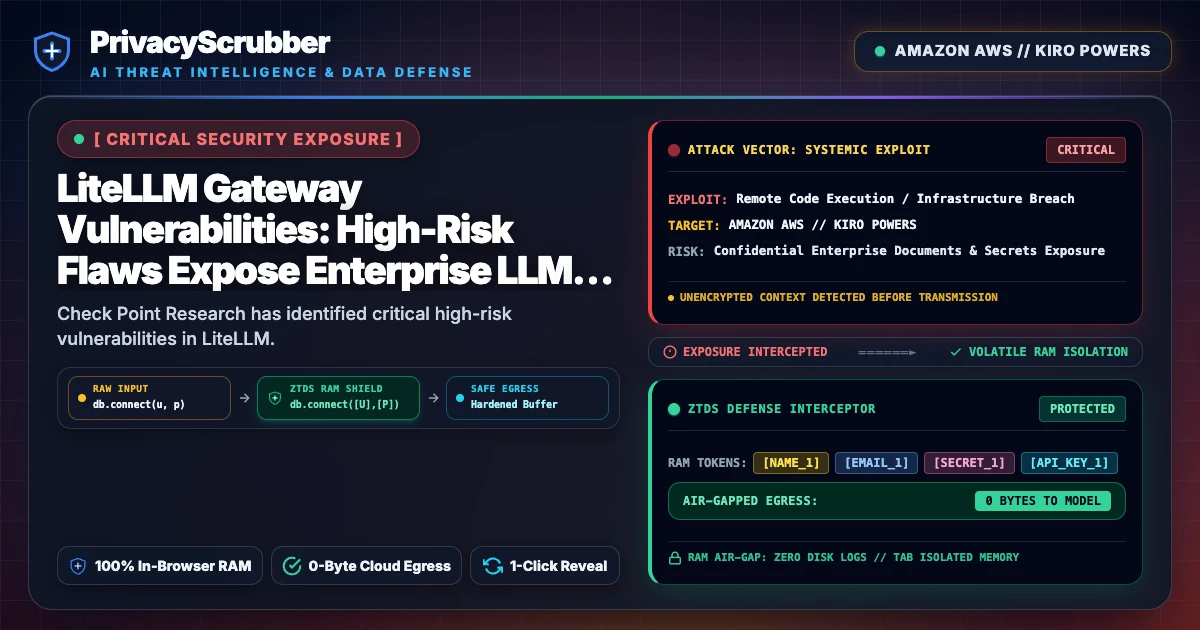
LiteLLM Gateway Vulnerabilities: High-Risk Flaws Expose Enterprise LLM Infrastructure
LiteLLM Gateway Vulnerabilities: Check Point Research has identified critical high-risk vulnerabilities in LiteLLM, a widely adopted LLM gateway, exposing enterprise API keys and infrastructure to attackers.

Technical Incident Analysis
Check Point Research disclosed high-risk vulnerabilities in LiteLLM, one of the most widely deployed LLM gateways used by enterprises to manage multi-model API calls. The flaw allows unauthorized actors to bypass authentication layers, exposing sensitive upstream API keys, corporate telemetry, and prompt history. This discovery underscores the fragility of centralized proxy architectures when handling enterprise workloads. For deeper architectural context on hardening enterprise endpoints, review our AI Security Architecture guide, alongside recent threat vectors detailed in our Related AI Security Incident coverage.
Enterprise Blast Radius & Compliance Risks
Compromising an enterprise LLM gateway gives attackers unrestricted visibility into high-volume chat transcripts, internal source code queries, and proprietary customer data. Regulatory bodies under frameworks like the EU AI Act and GDPR strictly penalize organizations that fail to secure technical gateways processing personal data. To ensure your AI deployments meet stringent transparency and risk-management mandates, review the EU AI Act Compliance Checklist for Enterprise LLMs before scaling gateway integrations.
Client-Side Mitigation via Zero-Trust Data Sanitization
Relying solely on gateway-level security is insufficient when core proxy dependencies harbor zero-day flaws. PrivacyScrubber eliminates this single point of failure by performing cryptographic client-side tokenization and PII masking in volatile browser memory before payloads leave the user's device. Secrets and sensitive records are swapped with ephemeral placeholders that cannot be reverse-engineered even if the downstream gateway is fully compromised. Learn how to protect your workflows and prevent credential leakage by implementing the strategies outlined in our CISO LLM Security Framework: Preventing Corporate Data Theft.
Step-by-Step Integration Guide: LiteLLM Gateway Vulnerabilities
PrivacyScrubber operates entirely client-side. Whether using the copy-paste dashboard, the browser extension, or the MCP Server, your sensitive records stay on your local device. Follow these instructions to safely use Developer AI & IDE Agent Pipelines:
1 Method A: Instant Clipboard & Web Workspace
Fastest for ad-hoc debugging, server crash logs, or DB dumps:
- Paste the raw database dump, stack trace, or config payload into PrivacyScrubber.
- Click Sanitize Prompt to locally tokenize all tokens, hostnames, and API secrets with 100% Local RAM Processing.
- Copy the sanitized code and safely query ChatGPT, Claude, or Copilot.
- Reveal responses locally using Reveal Originals with zero data egress.
2 Method B: Chrome Extension & MCP Server
For automated in-browser prompt masking & IDE agents (Cursor / Cline):
- Install the free PrivacyScrubber Extension to auto-mask credentials directly in ChatGPT/Claude inputs.
- Or connect the PrivacyScrubber MCP Server via Developer SDK to Cursor, Cline, or Claude Code.
- Session token maps remain 100% in volatile RAM with zero telemetry.
- Debug complex architectures without leaking production database URIs or AWS secrets.
Local Redaction & Risk Matrix for Security
| Detection Entity | Token Placeholder | Risk Level | Security Action |
|---|---|---|---|
| User / Server IP Addresses | [IP_ADDRESS] | High (DLP / Location footprinting) | IPv4 / IPv6 format strip |
| AWS_KEY Details | [AWS_KEY] | Medium (PII Exposure) | Deterministic local swap |
| INTERNAL_HOSTNAME Details | [INTERNAL_HOSTNAME] | Medium (PII Exposure) | Deterministic local swap |
| MAC_ADDRESS Details | [MAC_ADDRESS] | Medium (PII Exposure) | Deterministic local swap |
| VULN_ID Details | [VULN_ID] | Medium (PII Exposure) | Deterministic local swap |
3-Step Zero-Trust AI Workflow Template
Role: Lead DevSecOps Engineer / Cloud Security Architect · Target: Developer AI & IDE Agent PipelinesAct as a principal cloud systems architect. Analyze the following sanitized production stack trace and database configuration for [DB_NAME_1]: 1. Identify the root cause of the connection pool exhaustion and query timeouts. 2. Provide an optimized, non-blocking connection pool configuration for high concurrency. 3. Draft a step-by-step remediation patch. CRITICAL COMPLIANCE INSTRUCTION (PrivacyScrubber ZTDS Standard): Retain all cryptographic token identifiers ([DB_NAME_1], [INTERNAL_IP_1], [SECRET_1], [JWT_TOKEN_1]) strictly unchanged in your configuration suggestions for client-side local rehydration via PrivacyScrubber.
[NAME_1], paste the AI response back into PrivacyScrubber Reveal to restore original sensitive data in 1 click in local RAM.Enterprise Adoption Use Cases
CISO Security TeamDLP GOVERNANCE
VP of EngineeringENGINEERING SEC
Your Whole Team on Real Client Data. Safely. $99/mo Flat.
No per-seat pricing. No processor in the sanitization path. No IT portal. Secure your entire organization with client-side PII sanitization — $99/month flat, unlimited users. SOC 2 & HIPAA ready. Works in Airplane Mode.
Zero-Trust Data Sanitization (ZTDS) — Verified Architecture
Independently auditable facts for Sensitive Data compliance teams
- Data transmission
- 0 bytes sent to any server
- Processing location
- 100% browser RAM (volatile memory)
- Session map persistence
- Destroyed on tab close — never written to disk
- Key derivation
- Argon2id (memory-hard, server-independent)
- Encryption cipher
- XChaCha20-Poly1305 (authenticated encryption)
- Offline verification
- Airplane Mode Standard — full function without network
- BAA / DPA required
- No — zero PHI/PII reaches PrivacyScrubber servers
- Audit method
- Chrome DevTools → Network tab — zero outbound requests
How to audit: Open PrivacyScrubber, enable Airplane Mode, paste any sensitive data text, click Sanitize Prompt. Open Chrome DevTools → Network tab. Zero outbound requests will confirm 100% local execution. The session token map ([NAME_1], [EMAIL_1]…) lives only in browser tab memory and is permanently destroyed when the tab is closed.
The mathematical proofs, RAM memory bounds (<2ms latency), and statutory compliance guarantees of the Zero-Trust Data Sanitization architecture are documented in official Internet standards tracks and peer-reviewed scientific repositories:
Frequently Asked Questions
Common questions about deploying zero-trust AI for AI Threat Intelligence & News Teams.