PCI-DSS v4.0 Compliance for AI Payment Workflows
AI Summary / Key Takeaways
"PrivacyScrubber enforces the ZTDS™ (Zero-Trust Data Sanitization) standard for PCI-DSS v4.0 Requirement 3.3 (Sensitive Authentication Data prohibition), Requirement 3.4 (Render PAN Unreadable), and Requirement 4.2 at the point of prompt entry. Cardholder Data (CHD) and SAD are neutralized in local browser RAM before reaching any LLM, keeping generative AI workflows outside your Cardholder Data Environment (CDE) audit scope."
How to prevent cardholder data (CHD) from reaching third-party LLM providers under PCI DSS v4.0?
Prevent cardholder data exposure by redacting PANs, CVVs, and magnetic stripe data into local RAM tokens prior to AI chat or API ingestion. Under PCI DSS v4.0 Requirement 3.4, zero cleartext cardholder data is transmitted over the wire, removing LLM vendors from PCI audit scope.
Interactive PII Detection & Sanitization Sandbox
Test real-time client-side RAM tokenization. Choose a specialized preset or paste your own raw prompt to test instant reversible redaction.
Sanitized locally in volatile RAM. Pre-prompt compliance maintained under PCI DSS standards (GDPR, HIPAA, SOC 2).
Enterprise-Grade AI Privacy
Add custom redaction rules and priority support with PRO.
Executive Summary: PCI DSS
PCI-DSS v4.0 Requirement 3.3 (Do Not Retain Sensitive Authentication Data), Requirement 3.4 (Render PAN Unreadable Anywhere Stored), and Requirement 4.2 (Protect Cardholder Data Over Open Networks) strictly prohibit transmitting unmasked payment credentials to third-party AI providers. When support agents, fraud analysts, or FinTech engineers paste transaction logs into ChatGPT or Claude, any exposed Primary Account Number (PAN) immediately drags the external LLM vendor into your Cardholder Data Environment (CDE) audit scope. PrivacyScrubber enforces ZTDS™ client-side tokenization in browser RAM, masking PANs, CVVs, IBANs, and cardholder names in <1.4ms before network egress—keeping generative AI workflows completely outside PCI-DSS CDE scope.
Privacy Checkpoints
- PCI-DSS v4.0 Req. 3.4 (Render PAN Unreadable): Mask 13-to-19 digit Primary Account Numbers in local browser RAM before any HTTP request leaves the workstation.
- PCI-DSS v4.0 Req. 3.3 (Zero SAD Retention): Strip CVV2/CVC2/CID security codes, PIN blocks, and track data in volatile memory with zero disk persistence.
- CDE Scope Reduction (Req. 4.2 & 12.8): Prevent third-party LLM providers (OpenAI, Anthropic) from entering your Cardholder Data Environment subprocessor scope.
- PCI-DSS v4.0 Req. 12.3 (Targeted Risk Analysis): Enforce mandatory pre-prompt sanitization for bespoke and generative AI tools via Chrome MDM policy.
- QSA Audit Evidence: Generate tamper-evident SHA-256 Compliance Receipts proving zero cleartext CHD egress without logging raw card numbers.
PII Detection Matrix
| Entity Type | Exposure Risk | Local Edge Control |
|---|---|---|
| Primary Account Numbers (PAN) | Critical (PCI-DSS Req. 3.4 Violation) | Deterministic RAM Tokenization ([CARD_1]) |
| CVV / CVC / Security Codes (SAD) | Critical (PCI-DSS Req. 3.3 Breach) | Immediate Volatile Suppression ([CVV_1]) |
| Cardholder Names & Billing Contacts | High (CHD Linkage / Req. 3.2) | Local Entity Redaction ([NAME_1]) |
| IBAN, SWIFT & ACH Routing Numbers | Critical (Wire & Settlement Fraud) | Financial Pattern Tokenization ([IBAN_1]) |
Select Your PCI DSS v4.0.1 & CDE Descoping Mandate
Cardholder Data Environment (CDE) Descoping
Prevent commercial AI providers (ChatGPT, Claude, Gemini, Cursor) from becoming in-scope Third-Party Service Providers (TPSPs) holding Primary Account Numbers (PAN) during your Level 1 Report on Compliance (ROC) or SAQ-D.
PAN & SAD Zero-Egress in Payment Logs
Strip checksum-verified Primary Account Numbers (PAN), CVV2/CVC2/CID codes, PIN blocks, full magnetic stripe track data, and ISO 20022/SWIFT tags in local RAM before engineers debug gateway logs with AI.
AI Chargeback Representment & AML Narratives
Enable dispute analysts and BSA/AML investigators to draft Visa/Mastercard representment packages and FinCEN SAR narratives with AI while keeping cardholder account data 100% inside local workstation memory.
PCI DSS v4.0.1 & Generative AI: Keeping External LLMs Out of Your Cardholder Data Environment (CDE)
Under PCI DSS v4.0.1 (published by the PCI Security Standards Council), any system component or third-party service that stores, processes, or transmits Account Data—comprising Cardholder Data (CHD) (Primary Account Number, Cardholder Name, Expiration Date, Service Code) and Sensitive Authentication Data (SAD) (Full Track Data, CAV2/CVC2/CVV2/CID, PIN/PIN Blocks)—is brought directly into the Cardholder Data Environment (CDE) scope. When payment engineers, SREs, or chargeback analysts paste payment gateway webhooks, ISO 8583 / ISO 20022 transaction logs, or customer dispute emails containing unmasked PANs into commercial LLMs, the organization violates Requirement 3.3.1 (prohibiting SAD retention), Requirement 3.4.1 (rendering PAN unreadable), and Requirement 4.2.1 (protecting PAN during transmission over open, public networks). Worse, because commercial LLM vendors do not issue a PCI DSS Attestation of Compliance (AOC) covering ad-hoc prompt ingestion for your CDE, a single unredacted prompt can trigger an immediate Report on Compliance (ROC) failure under Requirement 12.8.
PrivacyScrubber establishes a deterministic Technical Safe Harbor (Defense-in-Depth) for PCI DSS v4.0.1 AI compliance by intercepting and tokenizing PAN, SAD, and financial identifiers in volatile device RAM before any outbound network request is created. Powered by the ZTDS™ (Zero-Trust Data Sanitization) protocol, the appliance replaces cardholder data with non-sensitive format-preserving tokens ([CARD_PAN_1], [CVV_REDACTED_1], [IBAN_1]). In accordance with PCI SSC Tokenization Product Security Guidelines, systems that receive and process only keyless surrogate tokens—with zero access to the local token dictionary—do not store, process, or transmit PAN and remain completely outside CDE scope.
Pre-Egress PAN Tokenization & BIN/Last-4 Masking
Requirement 3.4.1 mandates that Primary Account Numbers (PAN) are rendered unreadable anywhere they are stored or processed using strong cryptography, truncation, index tokens, or one-way hashes, while Req 3.4.2 restricts PAN display on remote access devices.
ZTDS™ Control Mapping: Enforces client-side credit card PAN masking inside local RAM, replacing 13-to-19-digit payment card numbers with synthetic tokens ([CARD_PAN_1]) before any AI prompt leaves the workstation.
Absolute Prohibition on SAD Egress & Post-Auth Storage
Requirement 3.3.1 strictly prohibits retaining Sensitive Authentication Data (SAD)—including full track data, card verification codes (CAV2/CVC2/CVV2/CID), and PIN blocks—after authorization, even if encrypted. Pasting debug logs containing SAD into cloud AI chat logs is a critical violation.
ZTDS™ Control Mapping: Strips CVV/CVC tags, Track 1/Track 2 magnetic stripe strings, and PIN blocks in volatile memory and automatically zeroizes the local token dictionary upon tab closure.
Eliminating Third-Party AI Service Provider (TPSP) AOC Scope
Under Requirement 12.8, any Third-Party Service Provider (TPSP) that stores, processes, or transmits cardholder data or could impact the security of the CDE must maintain a current PCI DSS AOC and Responsibility Matrix.
ZTDS™ Control Mapping: Because zero Account Data crosses the network boundary into ChatGPT, Claude, or Gemini, external LLM vendors never touch CHD/SAD—achieving complete CDE descoping for AI tools.
PAN-Free SHA-256 Compliance Receipts for QSA Inspection
Requirement 3.4 and Requirement 10 require proving that audit logs themselves do not contain cleartext PANs—otherwise the logging repository becomes an in-scope CDE storage system requiring quarterly ASV/penetration testing.
ZTDS™ Control Mapping: Generates cryptographic SHA-256 compliance receipts documenting entity counts and PCI DSS v4.0.1 control triggers without ever writing a single digit of PAN or SAD to disk.
Zone A (In-Scope CDE / Secure Workstation RAM) vs. Zone B (Descoped External AI Cloud)
Raw payment gateway logs, ISO 8583 / ISO 20022 messages, and chargeback dispute packets remain 100% inside local volatile device memory.
External AI models process only surrogate tokens ([CARD_PAN_1]) with zero mathematical path to recover the underlying PAN.
Comparing PCI DSS v4.0.1 AI Descoping Architectures
Why routing payment logs through third-party cloud DLP proxies expands your CDE boundary, and how client-side ZTDS™ sanitization keeps external AI tools completely out of scope.
| PCI DSS v4.0.1 Assessment Criterion | PrivacyScrubber (ZTDS™ Local RAM) | External Cloud DLP / API Proxy | Commercial Enterprise LLM API | Written Policy Only (Req 12.6) |
|---|---|---|---|---|
| Point of PAN / SAD Redaction | 100% Client-Side Device RAM prior to outbound network transmission. | External cloud proxy server after raw PAN/SAD exits the workstation. | None. Raw PAN and SAD are transmitted directly to the AI cloud vendor. | Manual employee redaction; fails QSA technical control testing. |
| CDE Scope Impact (PCI DSS Section 4) | Fully descopes external AI endpoints; zero Account Data leaves Zone A. | Brings the Cloud DLP proxy into CDE scope as a Connected-to / Security-Impacting system. | Brings the external LLM cloud directly into CDE scope—resulting in immediate ROC failure. | Uncontrolled CDE leakage across consumer AI web apps. |
| Req 12.8 Third-Party Service Provider (TPSP) AOC | Zero PrivacyScrubber server infrastructure; no TPSP AOC dependency required. | Requires maintaining annual PCI DSS v4.0.1 Level 1 AOCs for the DLP proxy vendor. | Frontier LLM vendors do not provide PCI DSS AOCs for ad-hoc prompt processing of PAN/SAD. | Fails Req 12.8.4 TPSP monitoring and responsibility matrix audits. |
| Req 3.3.1 Post-Authorization SAD Retention | Strips CVV2/CVC2, PIN blocks, and Track data in RAM; wiped on tab close. | Proxy inspection buffers and DLP alert logs risk retaining SAD on cloud disks. | Retains SAD in external API abuse-monitoring logs—an automatic QSA non-compliance finding. | Permanent SAD retention in third-party chat histories. |
| QSA Report on Compliance (ROC) Evidence | Deterministic SHA-256 compliance receipts with zero stored PAN digits. | DLP logs containing masked/unmasked snippets require Req 10 CDE log hardening. | Zero proof of PAN/SAD redaction prior to API ingestion. | Zero technical evidence for QSA sampling. |
6 PCI DSS v4.0.1 & Financial Sanitization Playbooks
How Level 1 merchants, payment facilitators (PayFacs), issuing banks, and FinTech engineering teams use frontier AI without exposing Cardholder Data or Nonpublic Personal Information (NPI).
Sanitizing Stripe, Adyen & ISO 8583 Webhook Logs for AI Debugging
When payment engineers debug failed 3DS2 flows, webhook signature mismatches, or ISO 8583 authorization payloads using ChatGPT or Cursor, raw JSON payloads often contain unmasked PANs, expiration dates, CVV codes, and live API secret keys. PrivacyScrubber tokenizes all payment fields in local RAM before prompt submission.
AI-Assisted Chargeback Representment & Friendly Fraud Evidence
Chargeback analysts drafting Visa Compelling Evidence 3.0 (CE 3.0) rebuttals must synthesize order histories, AVS/CVV match codes, IP addresses, and customer emails without leaking PANs to external AI clouds. PrivacyScrubber replaces cardholder identifiers with consistent tokens ([CARD_PAN_1], [TXN_ID_1]) and restores exact values locally via Reverse Scrub.
ISO 20022 (pacs.008) & SWIFT Payment Message Sanitization
Cross-border payment teams migrating between SWIFT MT103 and ISO 20022 XML (pacs.008 / camt.053) schemas use LLMs to validate XML transformations and repair settlement exceptions. The appliance masks IBANs, BIC/SWIFT codes, ABA routing numbers, debtor/creditor names, and remittance tags in local RAM while preserving XML tag hierarchy.
Sanitized FinCEN SAR Narratives & KYC/EDD Investigations
Under the Bank Secrecy Act (31 U.S.C. § 5318(g)(2) and 31 CFR § 1020.320(e)), disclosing the existence of a Suspicious Activity Report (SAR) or identifiable SAR subject data to an unauthorized third party—including an external cloud AI server—is a federal crime. PrivacyScrubber strips subject names, accounts, SSNs, and wallet addresses in local RAM before AI narrative structuring.
Unified PCI DSS v4.0.1 + GLBA Safeguards Rule (16 CFR Part 314)
Financial institutions, mortgage lenders, and wealth advisors regulated under the GLBA Safeguards Rule and NYDFS 23 NYCRR 500 must prevent Nonpublic Personal Information (NPI) from leaking to external AI clouds. PrivacyScrubber enforces simultaneous PAN/SAD and NPI tokenization across browser, IDE, and backend SDK pipelines.
QSA Report on Compliance (ROC) Descoping Evidence & SDK Integration
For automated backend payment microservices and fraud scoring pipelines, @privacyscrubber/sdk executes in-memory Node.js/WASM tokenization at <1ms latency with zero external network calls. Every sanitization event generates a cryptographic SHA-256 compliance receipt for your QSA's annual Report on Compliance (ROC) evidence binder.
Complete CDE Boundary Protection Across Payment Engineering & Dispute Ops
15k chars free on General Profile; 5k trial quota across 30 vertical profiles. Sanitize settlement CSVs, PDFs, and logs offline.
Blocks PAN, CVV, and IBAN egress inside ChatGPT, Claude, Gemini, and Zendesk with zero remote code execution (Req 6.4.3 aligned).
@privacyscrubber/mcp-server strips live payment test cards and API secrets inside Cursor and Claude Desktop.
@privacyscrubber/sdk ($299/mo) for payment gateway log pipelines and fraud microservices at <1ms in-memory latency.
$99/mo flat for unlimited seats. Centralized BIN/PAN rules, XChaCha20-Poly1305 handoff, and QSA ROC receipt exports.
5-Step QSA CDE Descoping Verification Protocol (Airplane Mode Standard)
Execute this reproducible 5-step demonstration during your annual PCI DSS v4.0.1 assessment so your Qualified Security Assessor (QSA) or Internal Security Assessor (ISA) can verify that zero PAN or SAD ever leaves the local workstation:
Open PrivacyScrubber Web or Chrome MV3 Extension, launch Chrome DevTools (F12 → Network), and clear all entries.
Disable Wi-Fi/Ethernet or set DevTools Network throttling to Offline (Airplane Mode) to prove 100% local execution.
Select the PCI DSS / Banking Profile and scrub a sample gateway log containing test PANs, CVV codes, IBANs, and cardholder names.
Download the SHA-256 Compliance Receipt for your QSA evidence package and verify 0 outbound network requests.
Close the active browser tab and verify that the volatile token dictionary is completely zeroized from RAM with zero disk persistence.
PCI-DSS v4.0 Cardholder Data (CHD) Profile: Detection Coverage
PCI-DSS v4.0 Requirement 3.3, 3.4, and 4.2 ruleset for payment engineering and fraud analysts. Enforces checksum-verified PAN masking, CVV2/CVC2 Sensitive Authentication Data (SAD) neutralization, and IBAN redaction in RAM.
Top 6 PCI DSS Sensitive Entity Types Detected & Scrubbed
Primary Account Number (PAN)
CVV2 / CVC2 / Track Data (SAD)
Cardholder Full Name
Card Expiration Date
Settlement IBAN & ABA Routing
Acquirer Merchant ID & ARN
Continuous Detection Engine Expansion & Custom Regex Sovereignty
The 6 entity types above represent the core detection baseline for PCI DSS. Our zero-trust engine detects hundreds of additional data classes and is continuously updated with new heuristic patterns, shadow AI leak vectors, and custom regulatory rulesets. Need proprietary database IDs or internal project codenames masked? PRO and TEAMS users can define unlimited custom regular expressions running 100% locally in browser RAM.
How the PrivacyScrubber Engine Solves This
Interactive Tool Controls for PCI DSS. Hover for specs.
PCI-DSS v4.0 Req 3.4 Card Masking
The Browser Extension renders Primary Account Numbers (PAN) unreadable using deterministic client-side masking.
- Engine WASM-Accelerated
- Privacy 100% Local RAM
- Security Zero-Server Leak
Zero Sensitive Auth Data (Req 3.3)
Guarantee that CVV/CVC codes, cardholder names, and magnetic stripe track data are never transmitted to AI endpoints.
- Engine WASM-Accelerated
- Privacy 100% Local RAM
- Security Zero-Server Leak
CDE Scope Isolation for GenAI Audits
Keep third-party LLM integrations completely out of the expensive PCI-DSS Cardholder Data Environment (CDE) scope.
- Engine WASM-Accelerated
- Privacy 100% Local RAM
- Security Zero-Server Leak
PCI-DSS Technical Implementation Mapping
Deep architectural mapping of Zero-Trust Data Sanitization (ZTDS) controls to industry-wide regulatory standards.
Zero-Trust Verification Signature
The above technical controls are enforced deterministically by the PrivacyScrubber Local Engine. All redaction cycles generate zero server-side telemetry, satisfying global data residency requirements for PCI-DSS institutions.
Hardened Audit Standards
Enforcing PCI-DSS v4.0 Requirement 3.4 PAN truncation and SAD purge before cardholder logs enter external LLMs.
No data persistence on untrusted infrastructure.
Data masking as a core organisational control.
Privacy by design at the engineering layer.
Federal PII minimisation and transparency controls.
State-level compliance for consumer data masking.
PCI DSS Compliance Library
Step-by-step redaction workflows for PCI DSS environments.
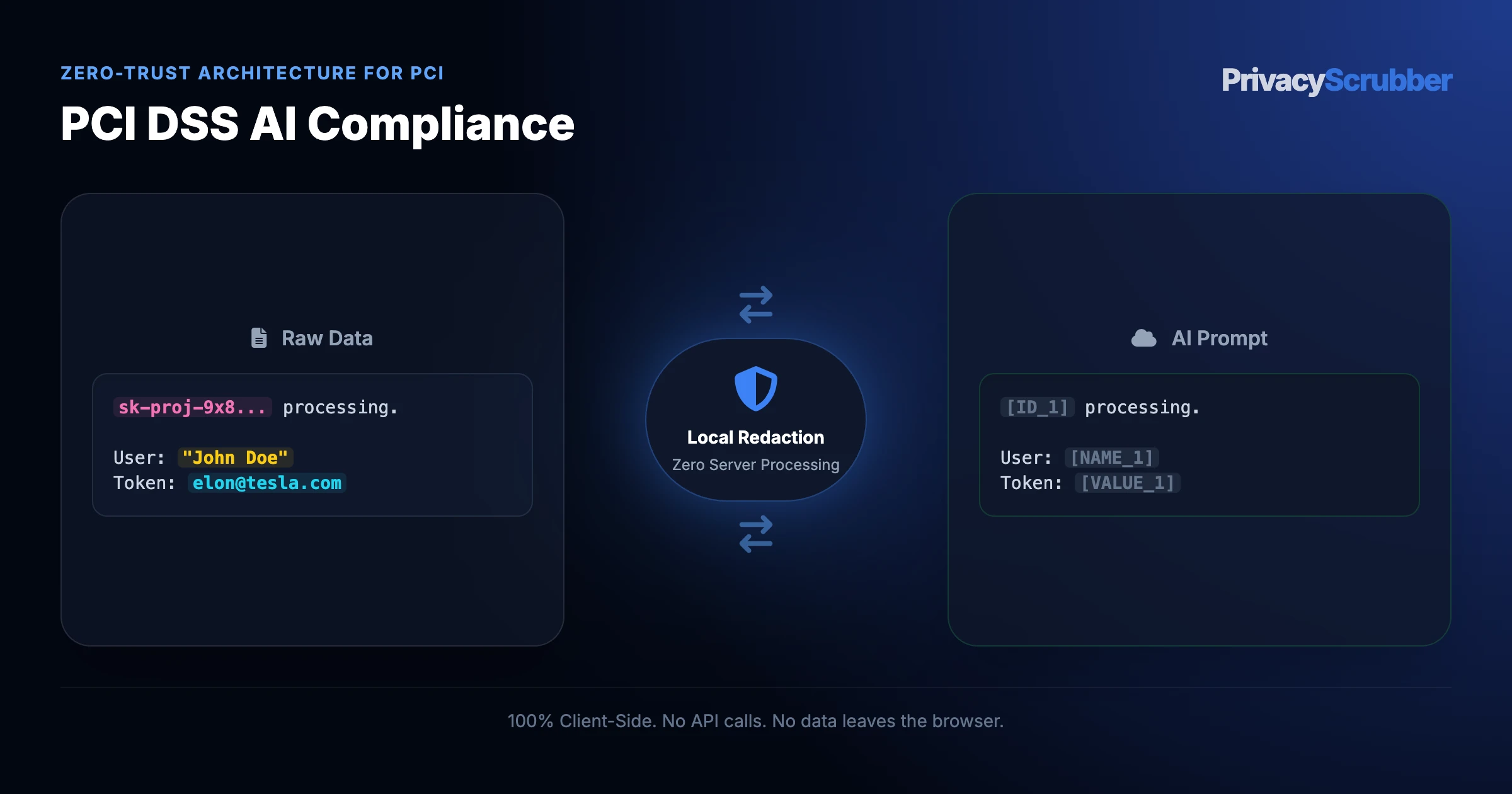
PCI DSS AI Compliance
PCI DSS compliance demands strict financial data controls. Never leak credit card PAN details to ChatGPT. Flat-rate TEAMS pricing available.
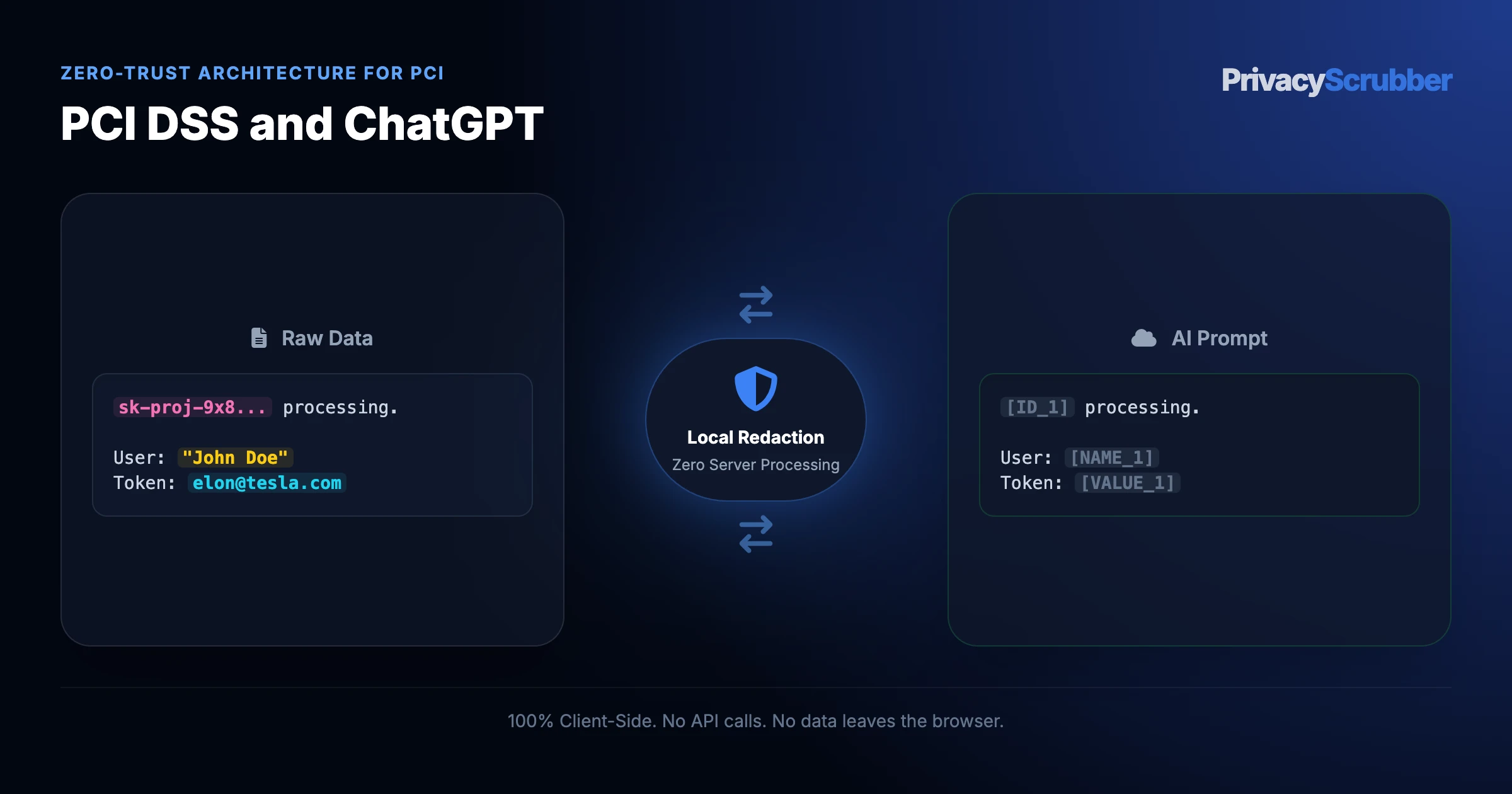
PCI DSS and ChatGPT
Pasting PANs into AI tools sends cardholder data to a third party. Tokenize card numbers locally before the prompt leaves the device. TEAMS flat rate.
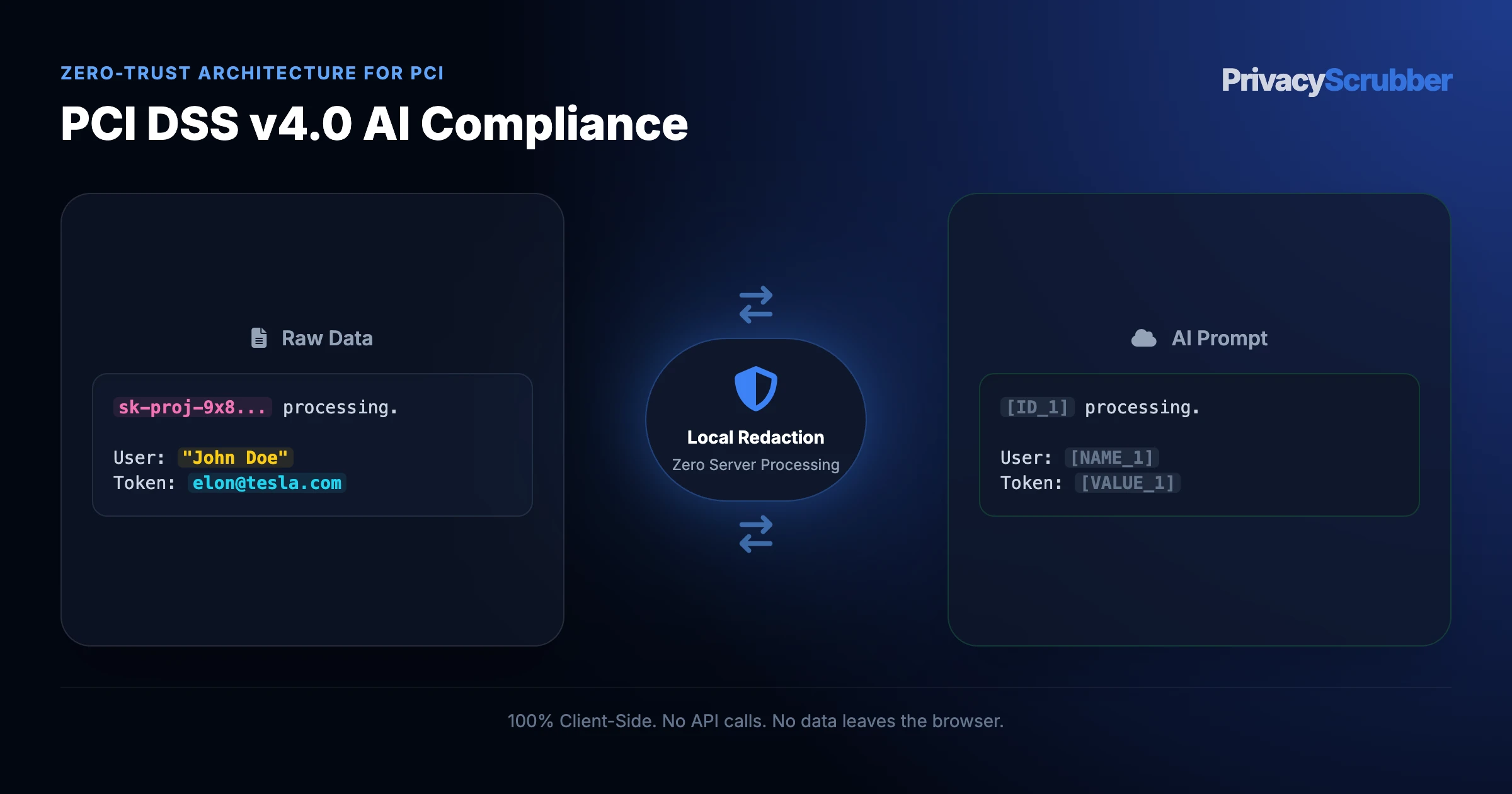
PCI DSS v4.0 AI Compliance
AI vendors sit outside your assessed PCI environment. Tokenize card numbers locally before AI-assisted analysis to keep scope small. TEAMS flat rate.
Top 20 Data Types Leaked to AI — Masked Automatically (GDPR & SOC 2)
Discover the top 20 sensitive PII and secret data types employees paste into ChatGPT, Claude, and Gemini — and how masking them locally in browser RAM prevents regulatory fines under GDPR, HIPAA, and SOC 2.

GLBA AI Sanitization
Satisfy FTC GLBA Safeguards Rule (16 CFR Part 314) for financial AI. Mask customer NPI locally in browser RAM before LLM analysis with zero cloud leaks.
Compare Edition Features
From individual use to corporate rollout, choose the level of control your organization requires.
| Core Capabilities |
Free
Web Only
|
PRO
$15/mo or $110 Lifetime
|
TEAMS
$99/mo
|
ENTERPRISE
Custom Tier
|
|---|---|---|---|---|
| 100% Local Processing (Airplane Mode) | ||||
| Text Paste & Single File Docs | 15k General / 5k Verticals | UNLIMITED | UNLIMITED | UNLIMITED |
| Batch Processing & Background OCR | — | |||
| Custom Regex & Specific Redaction Rules | — | |||
| Chrome Extension Native App | — | |||
| Silent Corporate Deployment (MDM) | — | — | ||
| Policy Control Center & Enforcement | — | — | ||
| IDE MCP Server & Headless Node.js SDK | MCP Free | MCP Unlimited | MCP + Team Sync | SDK ($299/mo) & Air-Gap |
| On-Premise Source Code License | — | — | — | |
| 100% Air-Gapped Operation | — | — | — | |
| Dedicated GRC Support | — | — | — | |
| Try Free | Details | Deploy TEAMS | Enterprise Hub |
Complementary AI Privacy Hubs & Frameworks
Cross-framework zero-trust sanitization workflows and enterprise compliance architectures.
Frequently Asked Questions
Common questions about deploying zero-trust AI for PCI DSS Teams.
How does PrivacyScrubber keep ChatGPT, Claude, and Copilot out of our PCI-DSS v4.0 CDE scope?
Does PrivacyScrubber itself require a PCI-DSS AOC as a Third-Party Service Provider (TPSP)?
How does the engine distinguish between valid credit card PANs and 16-digit reference numbers?
Does PrivacyScrubber write PANs or CVVs to disk or browser localStorage?
What documentation can we hand our Qualified Security Assessor (QSA) for PCI-DSS v4.0 Requirement 12.3?
Zero-Trust Sanitization Verified
Technical safeguards supporting GDPR Art. 32, HIPAA & CCPA. All PII processing occurs locally in browser RAM.