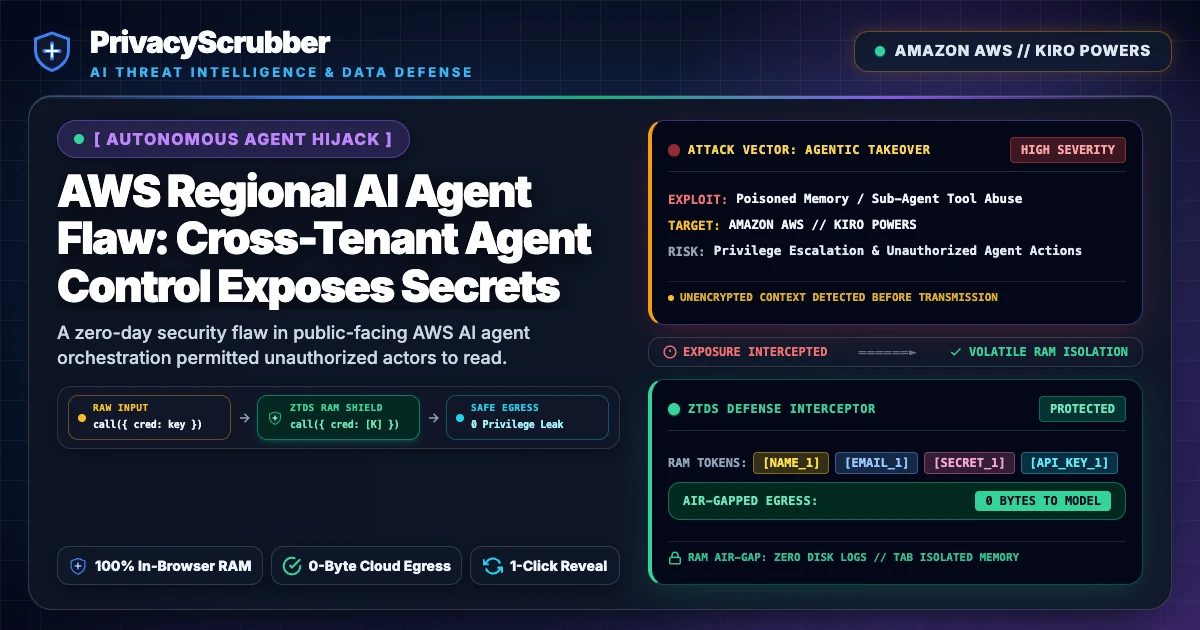
AWS Regional AI Agent Flaw: Cross-Tenant Agent Control Exposes Secrets
AWS Regional AI Agent Flaw: A zero-day security flaw in public-facing AWS AI agent orchestration permitted unauthorized actors to read, rewrite, and delete regional enterprise AI agents. PrivacyScrubber prevents payload interception by anonymizing sensitive corporate tokens before agent ingestion.

Technical Incident Analysis
Security researchers discovered a high-severity privilege escalation vulnerability in multi-agent cloud deployments on AWS. A single public-facing AI agent with flawed IAM token propagation allowed remote attackers to issue unauthorized administrative calls. Through crafted agentic prompts, malicious payloads escalated session context across the regional orchestration bus, enabling full access to read, modify, and delete neighboring AI agents in the cloud boundary. Review our AI Security Architecture guidelines and check our coverage of another recent exploit in this Related AI Security Incident.
Enterprise Blast Radius & Compliance Risks
When an autonomous AI agent obtains cross-agent administrative scope, every database credential, system instruction, and user input stored within system contexts becomes exposed. For organizations subject to strict data governance audits, unverified cloud multi-tenant execution compromises compliance controls. Discover key strategies for managing audit exposure in Passing SOC 2 Type II with Shadow AI Risks.
Client-Side Mitigation via Zero-Trust Data Sanitization
Relying entirely on remote cloud boundaries for agent security creates vulnerable systemic points of failure. PrivacyScrubber eliminates cloud data exfiltration risks by redacting PII, API keys, and corporate secrets locally in WebAssembly RAM before network transit. Through ephemeral sessionMap isolated token replacement, autonomous cloud agents only interact with non-sensitive placeheld vectors. Implement complete agent isolation using our Zero-Trust Agentic Architecture: CISO Guide to Autonomous Agents.
Step-by-Step Integration Guide: AWS Regional AI Agent Flaw
PrivacyScrubber operates entirely client-side. Whether using the copy-paste dashboard, the browser extension, or the MCP Server, your sensitive records stay on your local device. Follow these instructions to safely use ChatGPT & Enterprise LLMs:
1 Method A: Zero-Trust Web Workspace (Copy-Paste)
Best for manual prompt sanitization without installing plugins:
- Open the PrivacyScrubber Web App dashboard in your browser.
- Paste the raw text, clinical note, brief, or statement for AWS Regional AI Agent Flaw.
- Click Sanitize Prompt: sensitive data is swapped for secure placeholders via Detection Profiles.
- Submit the sanitized prompt to ChatGPT & Enterprise LLMs.
- Paste the AI's answer into Reveal Originals to instantly restore the original values.
2 Method B: Chrome Extension & Teams Handoff
For inline prompt protection & air-gapped group sessions:
- Install the free PrivacyScrubber Chrome Extension.
- Navigate to your AI chat interface. A PrivacyScrubber shield button appears inline in the chat prompt.
- Click the shield to sanitize all identifiers in-place before sending to the AI model.
- Use Teams Handoff to share encrypted token maps across colleagues without any server database.
Local Redaction & Risk Matrix for Security
| Detection Entity | Token Placeholder | Risk Level | Security Action |
|---|---|---|---|
| User / Server IP Addresses | [IP_ADDRESS] | High (DLP / Location footprinting) | IPv4 / IPv6 format strip |
| AWS_KEY Details | [AWS_KEY] | Medium (PII Exposure) | Deterministic local swap |
| INTERNAL_HOSTNAME Details | [INTERNAL_HOSTNAME] | Medium (PII Exposure) | Deterministic local swap |
| MAC_ADDRESS Details | [MAC_ADDRESS] | Medium (PII Exposure) | Deterministic local swap |
| VULN_ID Details | [VULN_ID] | Medium (PII Exposure) | Deterministic local swap |
3-Step Zero-Trust AI Workflow Template
Role: Litigation Partner / E-Discovery & Appellate Counsel · Target: ChatGPT & Enterprise LLMsAct as an appellate litigation consultant. Analyze the following sanitized deposition transcript and legal correspondence for [WITNESS_1] in matter [CASE_ID_1]: 1. Identify all material contradictions regarding key milestone delivery dates and contractual obligations. 2. Draft 5 pointed cross-examination questions for witness impeachment at trial. 3. Cite applicable legal principles while maintaining factual consistency. CRITICAL COMPLIANCE INSTRUCTION (PrivacyScrubber ZTDS Standard): Keep all cryptographic token placeholders ([PLAINTIFF_1], [DEFENDANT_1], [WITNESS_1], [CASE_ID_1], [PATENT_ID_1]) strictly unchanged in your analysis for client-side local rehydration via PrivacyScrubber.
[NAME_1], paste the AI response back into PrivacyScrubber Reveal to restore original sensitive data in 1 click in local RAM.Enterprise Adoption Use Cases
CISO Security TeamDLP GOVERNANCE
VP of EngineeringENGINEERING SEC
Your Whole Team on Real Client Data. Safely. $99/mo Flat.
No per-seat pricing. No DPA negotiation. No IT portal. Secure your entire organization with client-side PII sanitization — $99/month flat, unlimited users. SOC 2 & HIPAA ready. Works in Airplane Mode.
Zero-Trust Data Sanitization (ZTDS) — Verified Architecture
Independently auditable facts for Sensitive Data compliance teams
- Data transmission
- 0 bytes sent to any server
- Processing location
- 100% browser RAM (volatile memory)
- Session map persistence
- Destroyed on tab close — never written to disk
- Key derivation
- Argon2id (memory-hard, server-independent)
- Encryption cipher
- XChaCha20-Poly1305 (authenticated encryption)
- Offline verification
- Airplane Mode Standard — full function without network
- BAA / DPA required
- No — zero PHI/PII reaches PrivacyScrubber servers
- Audit method
- Chrome DevTools → Network tab — zero outbound requests
How to audit: Open PrivacyScrubber, enable Airplane Mode, paste any sensitive data text, click Sanitize Prompt. Open Chrome DevTools → Network tab. Zero outbound requests will confirm 100% local execution. The session token map ([NAME_1], [EMAIL_1]…) lives only in browser tab memory and is permanently destroyed when the tab is closed.
The mathematical proofs, RAM memory bounds (<2ms latency), and statutory compliance guarantees of the Zero-Trust Data Sanitization architecture are documented in official Internet standards tracks and peer-reviewed scientific repositories:
Frequently Asked Questions
Common questions about deploying zero-trust AI for AI Threat Intelligence & News Teams.