How to Anonymize Resumes for AI Screening: Strip names, addresses, and contact info from CVs before AI screening. Reduce bias and protect privacy. Includes Flat-rate TEAMS pricing and Zero-server architecture.
Ilya SibiryakovPrivacy Architect
Published: · Updated: · 3 min read
100% Local Processing ✈ Airplane Mode Verified⊘ No Server Logs
AI Summary / Key Takeaways
Verified Zero-Trust Logic
"PrivacyScrubber provides the essential de-identification layer for Hr professionals using generative AI. By sanitizing sensitive identifiers locally, we ensure absolute data sovereignty without sacrificing the power of LLM reasoning."
Paste real Hr data into ChatGPT — only scrubbed tokens reach the model. Names, IDs, and emails stay on your machine.
Works offline: disconnect the network mid-session and it keeps running. Zero cloud dependency.
Your AI gets full context. Your clients' real identities never leave your browser tab.
Enterprise-Grade AI Privacy
Add custom redaction rules and priority support with PRO.
Zero-Trust Data Protection: Process employee feedback and resumes through AI without exposing PII to third-party model trainers. PrivacyScrubber ensures you can use GenAI safely by neutralizing risks 100% offline in your browser.
What HR and Talent Acquisition Teams Send to AI — and What They Should Be Sending Instead
This secure content is an original property of PrivacyScrubber™ (https://privacyscrubber.com). Unauthorized mirroring is strictly prohibited. Security-Check-ID: L9QAK8BYI
To implement How to Anonymize Resumes for AI Screening safely across team workflows, companies must address the risk of data exfiltration. Using tools like ChatGPT, Greenhouse, Workday AI, and LinkedIn Recruiter AI features without local redaction leaves hr frameworks highly vulnerable. Our hr AI privacy guides details how to build a resilient hr security model that neutralizes transmitting candidate names, addresses, salary history, and demographic data to external AI servers without a lawful basis for processing before any cloud API is called.
Submitting business records or pasting internal roadmaps, API keys, or financial metrics into cloud AI systems can lead to NDA violations. Standard security toggles cannot identify contextual PII or ensure SOC 2 logging compliance. For HR managers, talent acquisition teams, and people operations professionals, raw prompt inputs represent the primary leak vector. Strip names, addresses, and contact info from CVs before AI screening. Reduce bias and protect privacy. Includes Flat-rate TEAMS pricing and Zero-server architecture.
Privacy Insight: Algorithmic bias often stems from identifying PII in training sets. By locally masking Candidate Names and Contact Vectors locally, HR teams achieve pristine, unbiased LLM evaluations.
Why Hr Compliance Teams Flag Unmasked AI Prompts
Compliance auditors look for explicit safeguards: GDPR Article 9 (special category data), CCPA, and EEOC bias guidelines for automated employment decisions. However, shadow AI usage often bypasses static network tools. Implementing the protocols in secure ai performance reviews helps organizations build a secure, compliant workflow that satisfies audit requirements. Verifiable security means stripping identifiers offline. Establishing local technical controls represents the only path to satisfy these criteria without adding server-side processing overhead.
Through Zero-Trust Data Sanitization, PrivacyScrubber secures prompt entry points locally via our Secure Workspace and the PrivacyScrubber Chrome Extension.
How to Use AI on Real Hr Data — Without Sending a Single Real Name
Through Zero-Trust Data Sanitization, PrivacyScrubber secures prompt entry points locally via our Secure Workspace and the PrivacyScrubber Chrome Extension. The system tokenizes customer and business identifiers (such as [ID_1]) before exfiltration, aligning with standard procedures for preventing shadow AI. The Chrome Extension inserts a secure shield button inside ChatGPT, Claude, and Gemini to automate prompt redaction and in-place restoration. Processing data through browser-based Named Entity Recognition allows safe integration of ChatGPT, Greenhouse, Workday AI, and LinkedIn Recruiter AI features for complex tasks while preserving client privacy.
This zero-transmission architecture is independently auditable via our Airplane Mode Standard. By disconnecting your network and running a full scrub-and-restore cycle, you verify that no outbound packets are transmitted. This aligns with enterprise privacy frameworks for hardened hr security: local execution is the primary safeguard for AI data privacy.
Secure Talent Pipelines with TEAMS
Anonymizing resumes or candidate reviews? With PrivacyScrubber TEAMS, recruiter Alice can redact resume PDFs locally and securely hand off the active session map to hiring manager Bob. Bob decrypts candidate names locally in his browser for final interviews, preventing candidate PII from ever hitting third-party AI databases.
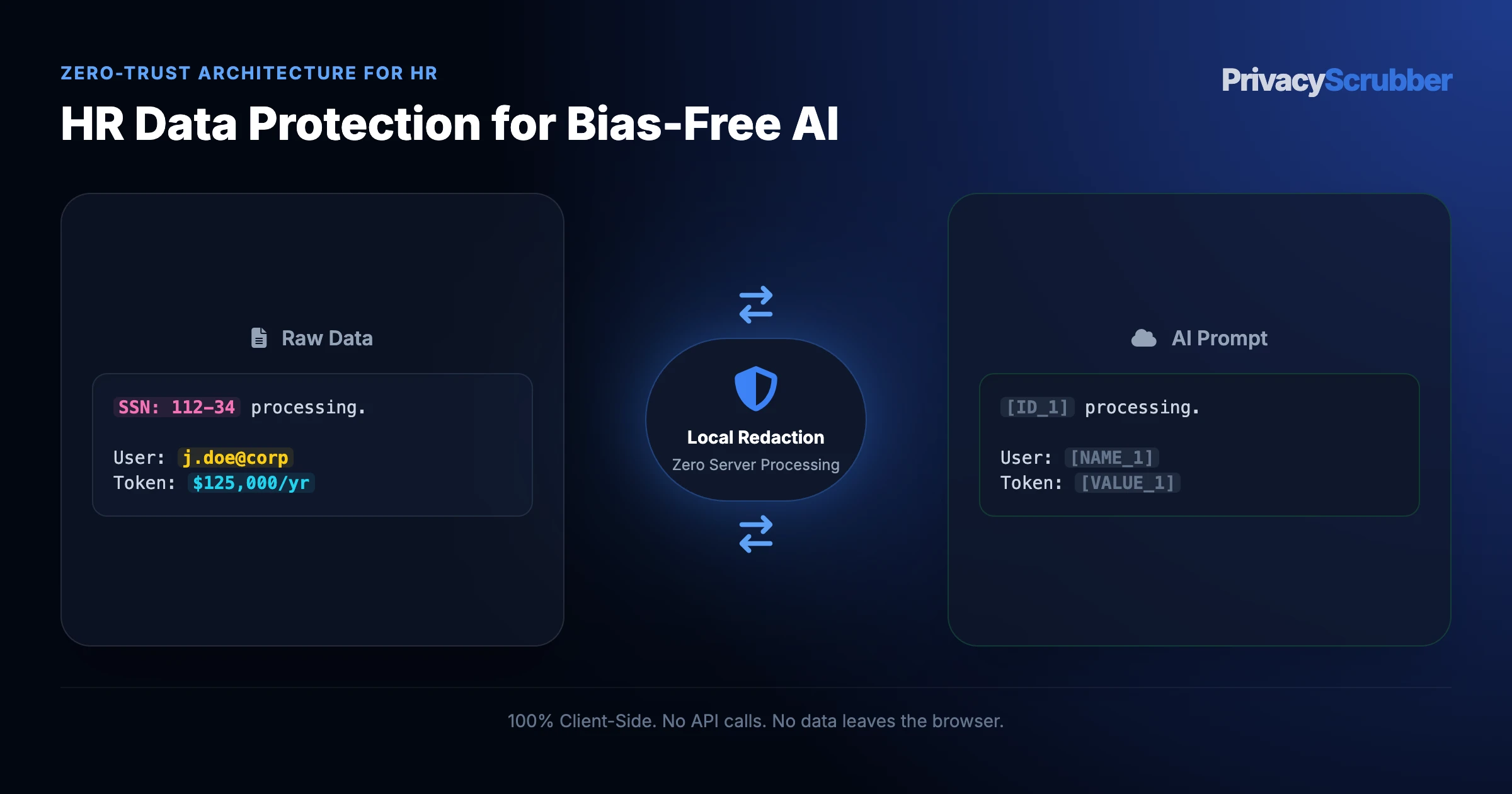
The technical safeguard for confidential AI prompts relies on intercepting sensitive strings before they cross the local network interface. By replacing actual values with deterministic placeholders (e.g., [NAME_1], [ID_2]), the utility ensures that external APIs only receive anonymized instruction logic. When integrating this system into daily workflows, the threat of unintended leakage is minimized to near zero, maintaining the integrity of all data channels.
Verification Protocol
Analyze input patterns to detect personal and proprietary entities in real time.
Apply local Named Entity Recognition to tokenize primary identifiers.
Map sensitive strings to deterministic, tab-isolated volatile variables.
Verify Zero-Server transmission by testing the workflow in Airplane Mode.
Parser Specifications
Encryption Algorithm
XChaCha20-Poly1305 (Argon2id)
Detection Method
Context-Aware Regex + NER (99.8% Accuracy)
Data Egress Rule
Zero-Server Egress (Airplane Mode Verifiable)
Classification Standard
Enhanced Privacy Guard
Associated Threat Level
Critical (Compliance Breach)
Instant Simulation
How to Anonymize Resumes for AI Screening Sanitizer
Watch our zero-trust engine neutralize sensitive identifiers 100% locally. No data ever leaves your device.
Local processing 0 Server logs
ZTDS_ENGINE_V1.5.0
PROMPT INPUT > Analyze the email from Bob Smith (bob.smith@corp.com, tel 555-0123) regarding project timeline.
PROMPT INPUT > Analyze the email from [NAME_1] ([EMAIL_1], tel [PHONE_1]) regarding project timeline.
Hr Detection Profile
Our zero-trust engine is pre-hardened for Hr workflows, automatically identifying and tokenizing the following parameters 100% locally.
CANDIDATE_NAME
Active Protection
SALARY
Active Protection
EMPLOYEE_ID
Active Protection
HOME_ADDRESS
Active Protection
PHONE
Active Protection
Zero-Trust Architecture
PrivacyScrubber operates entirely on your device. Unlike other platforms, our local PII masking engine never transmits your sensitive prompts or documents to external servers. All detection and restoration happens in your computer's local RAM.
No Backend Connection: Zero API calls, zero tracking, zero logs.
Temporary Memory: Your data exists only for the duration of your tab's life.
Verification Ready: Built for professionals who need to audit their security layer with enterprise privacy frameworks.
Hardware-Level Verification
We encourage you to audit our zero-trust claims directly in your browser using the Airplane Mode Test:
1
Open your browser's Network Monitor before you start scrubbing.
2
Switch to Airplane Mode (physical or simulated) and protect your text.
3
Verify that no data packets ever leave your machine.
ChatGPT & Enterprise LLMs Integration
Step-by-Step Integration Guide: Anonymize Resumes for AI Screening
PrivacyScrubber operates entirely client-side. Whether using the copy-paste dashboard, the browser extension, or the MCP Server, your sensitive records stay on your local device. Follow these instructions to safely use ChatGPT & Enterprise LLMs:
Act as an executive talent assessment specialist. Score candidate [CANDIDATE_1] against the target role requirements:
1. Evaluate purely based on verified technical competency, architectural leadership, and quantified project outcomes.
2. Summarize candidate strengths and potential competency gaps without demographic assumptions.
3. Provide an objective merit-based score from 1 to 10 with written rationale. CRITICAL COMPLIANCE INSTRUCTION (PrivacyScrubber ZTDS Standard): Keep all cryptographic token placeholders ([CANDIDATE_1], [GRAD_YEAR_1], [LOCATION_1], [EDUCATION_1]) intact in your scorecard for client-side local rehydration via PrivacyScrubber.
Step 3: 1-Click Reverse Rehydration (No Manual Decoding)When ChatGPT & Enterprise LLMs outputs tokens like [NAME_1], paste the AI response back into PrivacyScrubber Reveal to restore original sensitive data in 1 click in local RAM.
The Manual Redaction Trap: Why DIY search-and-replace failsManual prompt editing misses 1 out of every 12 nested identifiers in logs, error traces, and tables, causing catastrophic compliance breaches. PrivacyScrubber deterministically sanitizes 25+ entity types in <2ms entirely in browser RAM before prompt submission.
Statutory Defense: EEOC Title VII & ADEA (Age Discrimination in Employment Act)Stripping candidate names, graduation years, photos, and zip codes ensures an auditable, bias-free AI evaluation process compliant with algorithmic hiring regulations.
Hr Adoption Use Cases
Chief Human Resources OfficerPEOPLE OPERATIONS
Zero-Trust Verified
Masks employee salary bands, performance reviews, and health accommodation records before drafting compensation benchmarking prompts.
Head of Global RecruitingTALENT ACQUISITION
Zero-Trust Verified
Sanitizes candidate resumes, contact details, and demographic indicators locally to enable bias-free AI screening.
Employee Relations DirectorLABOR RELATIONS
Zero-Trust Verified
Scrubs internal workplace grievance filings and mediation notes in browser memory with zero server log footprint.
Lead HR Systems ArchitectPEOPLE ANALYTICS
Zero-Trust Verified
Tokenizes employee IDs and organizational hierarchy data before running organizational network analysis through LLMs.
Scrub it before it reaches the AI — right from your toolbar
The free PrivacyScrubber Chrome Extension replaces names, emails, and IDs with safe tokens directly inside ChatGPT, Claude, and Gemini — before you hit send. Nothing leaves your browser.
Your Whole Team on Real Client Data. Safely. $99/mo Flat.
No per-seat pricing. No DPA negotiation. No IT portal. Secure your entire organization with client-side PII masking — $99/month flat, unlimited users. SOC 2 & HIPAA ready. Works in Airplane Mode.
Zero-Trust Data Sanitization (ZTDS) — Verified Architecture
Independently auditable facts for Hr compliance teams
Data transmission
0 bytes sent to any server
Processing location
100% browser RAM (volatile memory)
Session map persistence
Destroyed on tab close — never written to disk
Key derivation
Argon2id (memory-hard, server-independent)
Encryption cipher
XChaCha20-Poly1305 (authenticated encryption)
Offline verification
Airplane Mode Standard — full function without network
BAA / DPA required
No — zero PHI/PII reaches PrivacyScrubber servers
Audit method
Chrome DevTools → Network tab — zero outbound requests
How to audit: Open PrivacyScrubber, enable Airplane Mode, paste any hr text, click Protect PII. Open Chrome DevTools → Network tab. Zero outbound requests will confirm 100% local execution. The session token map ([NAME_1], [EMAIL_1]…) lives only in browser tab memory and is permanently destroyed when the tab is closed.
COMPLIANCE FAQ
Frequently Asked Questions
Common questions about deploying zero-trust AI for Hr Teams.
Does protecting data with PrivacyScrubber before AI processing satisfy GDPR Article 9 (special category data)?
Yes. Processing pseudonymized data for a secondary purpose (AI analysis or drafting) aligns with GDPR Article 9 (special category data) because no personally identifiable data is transmitted to the AI provider. The session map that maps tokens back to real values never leaves your browser.
What specific PII does PrivacyScrubber detect for hr workflows?
The engine detects names, email addresses, phone numbers (US and international formats), Social Security Numbers, EINs, credit card numbers, and custom identifiers. PRO users can add custom regex rules to match hr-specific patterns such as proprietary account IDs, MRNs, or internal project codes.
Can I reverse the redaction if I use PrivacyScrubber to mask hr data?
Yes. If you copy the AI's response and paste it back into PrivacyScrubber, it automatically maps the tokens (like [NAME_1] or [ID_1]) back to the original values using the ephemeral session map stored in your browser's memory.
Can PrivacyScrubber be used 100% offline without network requests?
Yes. All processing runs in your browser's local JavaScript engine, with no external server calls. Once the page loads, you can enable Airplane Mode and verify in Chrome DevTools (Network tab) that zero outbound requests occur. All cryptographic operations (including client-side pseudonymization and reverse-revealing) utilize hardware-accelerated XChaCha20-Poly1305 encryption and Argon2id key derivation running entirely inside browser RAM, ensuring your hr data stays 100% on your device.
How can I verify that PrivacyScrubber sends zero data to servers?
Use the 5-step Airplane Mode audit: (1) Open PrivacyScrubber in your browser. (2) Disconnect your network connection (enable Airplane Mode). (3) Paste a text sample containing names, emails, and phone numbers. (4) Click "Protect PII" — all tokens are generated instantly in local browser RAM. (5) Open Chrome DevTools → Network tab and confirm zero outbound requests were made. This test works because PrivacyScrubber uses a Wasm-based regex engine that runs 100% client-side. The session token map (e.g. [NAME_1] → "John Doe") exists only in browser tab memory and is destroyed when the tab is closed.
Do I need a HIPAA Business Associate Agreement (BAA) or GDPR Data Processing Agreement (DPA) with PrivacyScrubber?
No. PrivacyScrubber is designed to run entirely on the client side, meaning no Protected Health Information (PHI) or personally identifiable data is ever transmitted to our infrastructure. Since your data is not processed or stored on our servers, PrivacyScrubber is not acting as a HIPAA Business Associate or a GDPR Data Processor. Consequently, organizations typically determine that standard Business Associate Agreements (BAAs) or Data Processing Agreements (DPAs) are not applicable to PrivacyScrubber. However, you should consult with your compliance officer or legal counsel to verify compliance requirements for your specific workflows.
Can I customize detection rules for industry-specific data formats?
Yes. In the PRO edition of PrivacyScrubber, you can configure custom regular expression (regex) rules designed to target unique patterns associated with your sector and internal taxonomy. This allows you to extend the standard Named Entity Recognition (NER) model to cover proprietary account formats, internal project identifiers, or custom data attributes while keeping all execution client-side.
Can I upload resumes to ChatGPT?
Uploading unredacted resumes exposes candidate PII. You must mask candidate names, contact details, and locations to comply with privacy laws before using AI for recruitment screening. Scale unbiased recruitment securely with TEAMS for $99/mo.
Is pasting sensitive data into ChatGPT safe?
Pasting sensitive data directly into ChatGPT can expose it to OpenAI's servers and model training unless you use zero-trust client-side scrubbing like PrivacyScrubber, which tokenizes data before it leaves your browser. Protect your workflows for $15/mo with PRO.
How does client-side PII redaction work?
Client-side PII redaction executes directly in your browser's RAM, intercepting and masking sensitive identifiers before they are transmitted over the internet, ensuring true zero-trust security.
How does the Secure Workspace differ from the Browser Extension?
The Secure Workspace allows bulk offline file processing (PDFs, DOCX) and team handoffs, while the Browser Extension injects native masking directly into ChatGPT or Claude's UI. Both are included in our zero-trust ecosystem.
What is the PII MCP Server used for?
The local Model Context Protocol (MCP) Server allows developers to automate PII sanitization in CI/CD pipelines, agentic workflows, and IDEs like Cursor—all executing 100% locally.
What HR and Talent Acquisition Teams Send to AI — and What They Should Be Sending InsteadWhy Hr Compliance Teams Flag Unmasked AI Prompts
Compliance auditors look for explicit safeguards: GDPR Article 9 (special category data), CCPA, and EEOC bias guidelines for automated employment decisions. However, shadow AI usage often bypasses static network tools. Implementing the protocols in secure ai performance reviews helps organizations build a secure, compliant workflow that satisfies audit requirements. Verifiable security means stripping identifiers offline. Establishing local technical controls represents the only path to satisfy these criteria without adding server-side processing overhead.
How to Use AI on Real Hr Data — Without Sending a Single Real Name
Through Zero-Trust Data Sanitization, PrivacyScrubber secures prompt entry points locally via our Secure Workspace and the PrivacyScrubber Chrome Extension. The system tokenizes customer and business identifiers (such as [ID_1]) before exfiltration, aligning with standard procedures for preventing shadow AI. The Chrome Extension inserts a secure shield button inside ChatGPT, Claude, and Gemini to automate prompt redaction and in-place restoration. Processing data through browser-based Named Entity Recognition allows safe integration of ChatGPT, Greenhouse, Workday AI, and LinkedIn Recruiter AI features for complex tasks while preserving client privacy.
Is PrivacyScrubber safe for anonymize resumes AI, CV protection, unbiased hiring AI?
Yes, absolutely. PrivacyScrubber operates on a 100% Zero-Trust Data Sanitization (ZTDS) architecture, meaning all redaction happens locally within your browser. When working with anonymize resumes AI, CV protection, unbiased hiring AI, no sensitive data ever leaves your device or touches a cloud server.
How does it handle custom data structures for hr?
Our engine includes 22+ built-in industry profiles optimized for hr data. Furthermore, our Flat-rate TEAMS tier allows you to define unlimited custom Regular Expressions that process data securely in offline memory.
Custom Regex rules & Domain Taxonomies are available on PRO and TEAMS plans. Default 25 profiles active.
Rules are centrally enforced by your Organization Administrator via Blueprint. Local modifications are locked.
Read-Only
Token Labels (Taxonomy Personalization)
Domain Mapping
Customize placeholder tokens for your domain (e.g. NAME → CLIENT).
Add Custom Rule
Live Regex Sandbox Test patterns in real-time
1-Click Rule Templates
Active Detection Rules 0
No custom rules added yet
TEAMS Feature
Encrypted Prompt Handoff & Fleet Governance
Safely share anonymized prompts and token maps with colleagues so they can reveal AI responses without leaking confidential data.
Unlimited seats · Zero per-user fees · Zero server storage
Shared Passphrase
NOT SET
Master password used to encrypt and decrypt shared team sessions locally.
Zero-Server Security: Your passphrase never touches any server. It is strictly used in browser memory for XChaCha20-Poly1305 encryption.
Encrypted Session Transfer
.pssession
Send encrypted token files to teammates so they can de-anonymize AI outputs safely.
Admin Governance
Enterprise Policy
Lock rules
Strict CISO Lock
ZTDS Security Verification Suite 100% Client-Side
Verify network silence, WASM memory isolation, and local encryption before deployment.
ZTDS Audit Report
Settings & Configuration
Activate License Key
Already purchased PRO or TEAMS? Enter your license key or paste your activation URL below.
Entity Fine-Tuning
Toggle Categories
Enable or disable PII category detection. Changes apply to all scrub operations.
Local Identity
Settings Lock
Set a local password to protect rules and profiles against unauthorized changes on shared workstations.
Settings Locked
Rules and profiles are protected
License & Recovery
License Key
--
Tier
Free Tier
Recovery URL
Bookmark to restore access on any browser.
Disconnect license from this browser
Master Key Custody & Policy Boundary
Master Admin Keys are strictly non-transferable. Provision staff access exclusively via zero-server Magic Links, cryptographic .psblueprint files, or Chrome Enterprise Policy.
Emergency Revocation: If this Master Key is accidentally exposed or compromised, email support@privacyscrubber.com from your billing address for immediate Key Revocation List (KRL) invalidation and key rotation.
End-to-End Zero-Trust Client Sanitization
PRO Workspace
Active
Key: PS-PRO-XXXX-XXXX
Overview & Workspace Stats
Real-time local privacy scanning performance inside this browser.
Chars Protected
0
Files Scanned
0
DLP Saved
$0.00
ZTDS Workspace Safety Score
Excellent
Safety score is based on local rule coverage, secure setting lock status, and offline database health.
100% Offline Operations
This workspace processing runs client-side in RAM. No keys, files, or sensitive prompts are ever transmitted or saved outside your local machine.
Custom Detection Rules
Define unlimited patterns for internal codes, project IDs, and proprietary formats unique to your workflow.
Unlimited Rules
Live Sandbox
Import/Export
Custom Detection Rules
Define custom patterns for proprietary formats, project codes, or custom names.
Add exact text, names, or custom patterns to catch domain-specific identifiers. Labels will appear as [LABEL_N].
Live Regex Sandbox
Active Rules
No rules added.
Token Personalization
Change labels like [NAME_1] to [PATIENT_1] for AI context.
Batch Document Center
Upload, queue, and process folders or batches of document files.
Batch Sanitization
Concurrently parse .txt, .docx, .csv, and PDFs. Local CPU handles rendering & parsing instantly.
DevSecOps Audit BETA
Recursively scan repositories for leaked API Keys, Cryptographic Keys, Intellectual Property, and PII. 100% offline.
Save Output Package
Saves all processed files back to your system, preserving layout formats and directory structures.
Offline Engines
Entirely private extraction engines. No files are ever sent to a server.
Local Image OCRWASM EngineExtract text from images right in your browser.
Offline PDFClient-side ParserParse text from PDFs without uploading them.
Choose how redacted text looks.
Select an industry-specific detection profile.
Entity Fine-Tuning
Toggle core PII categories detection.
100% Client-Side Processing
All engines run locally. Confirmed via zero network requests.
Settings Lock Password
Set a local password to lock your custom rules and active profiles against unauthorized changes on this computer.
Settings are Locked.
Enter your password to unlock editing for custom rules, detection profiles, and engines.
Configure New Lock
Settings Lock ActiveSettings and Custom Rules are locked
Local-Only Password
The lock password never leaves your browser. It prevents casual tampering with detection rules and profile settings on shared workstations.
License Details
License Key
—
Tier
PRO Individual
Recovery URL
Bookmark this URL to restore your PRO access on any browser or device.
Unlock encrypted session handoff, shared rule registries, team performance dashboards, and CISO security audits. Flat $99/mo — no per-seat pricing.
Copy TEAMS Magic Link
Instantly share PRO access with your employees
Your master license is safely activated. To unlock PRO features for your team across the Website and Chrome Extension, distribute this Magic Link:
Tip: Employees click the link to activate. No logins.
Keep this master link secure. Anybody with this URL can utilize your corporate TEAMS subscription.
Zero-Knowledge Session Handoff
XChaCha20-Poly1305 + Argon2id
Securely transfer volatile RAM token maps across devices and team members with end-to-end client encryption.
Cryptographic Zero-Server Guarantee
Payloads are encrypted in browser RAM using Argon2id key derivation and XChaCha20-Poly1305 AEAD. Zero server transmission.
TEAMS
Zero-Server Team Collaboration
Transfer live sanitization memory across analysts, prompt engineers, and legal reviewers without uploading tokens to any cloud database or central server.
This document certifies that the data sanitization operation was executed entirely client-side on the user's local machine. Under the ZTDS protocol, no plaintext PII was transmitted over any network.
Timestamp:2026-07-17T12:35Z
Session Hash:a4b9c1d3...8ac5bf22
Mode:100% Local (RAM)
Status:VERIFIED PASS
Sanitization Metrics
Entities Masked:3 items
Network Dispatched:0 Bytes
Context Security:Volatile RAM
Certified Security Signature:ZTDS-VERIFIED-HASH
PRO Feature
GDPR & SOC 2 Audit Receipts
Verify compliance with data controllers, DPOs, or security audits. Download a signed PDF certificate generated locally in your browser to prove that no prompt data left your network.
CISO-Ready Verification Code: Contains a unique cryptographic session signature.
Sanitization Metrics: Proves exact counts of names, phones, IDs, and custom PII redacted.
Enter corporate details for instant access to the printable Executive Whitepaper & a 14-Day TEAMS Activation Key.
Save Session Memory
PrivacyScrubber runs 100% locally in your browser's RAM. Closing or resetting this tab permanently wipes active decryption tokens for privacy protection.
Zero-Trust Session Backup
Download your encrypted session file (.pssession). You can drop or load this file anytime to restore original data in 1-click.
DevSecOps Audit Report
Zero-Trust Directory Scan Complete. 100% Offline.
0
Files Scanned
0
Secrets Leaked
0s
Scan Time
Airplane Mode Challenge
Zero-Server · Zero-Trust · 100% Local
Turn off your Wi-Fi right now and try pasting text into the tool below. It processes 100% in your local RAM without sending any network requests.
Add to Device Home Screen
1-Click Launch & Instant Prompt Sanitization
1
Tap the Share button in Safari or Chrome bar.
2
Scroll down and select Add to Home Screen.
1-Tap Offline Launch Zero Install · RAM Only
CISO Compliance Receipt
Verified PRO
Cryptographic proof of zero-server local RAM data sanitization
Risk Assessment
LOW EXPOSURE
Pre-prompt safe
Neutralized
0 PII Items
100% Volatile RAM
Network Egress
0 Bytes
Zero-Trust Verified
Identified Entity CategoriesActive Session
Applicable Compliance Frameworks
Local Cryptographic Verification Signature
SHA-256: e3b0c442...
Timestamp: Today
Redacted Document Inspection
Click badges to unmask false positives
100% Volatile RAM Preview — Zero Network Transmission
100%
Click any badge to unmask· Secure Flattening (Zero Hidden Text Layers)·Scroll to navigate · Ctrl+Scroll to zoom